
Much Ado About Nothing at Shakespeare’s Globe – review
Chelsea Walker’s production of the Bard’s much-loved comedy runs until 24 October
 |
London
|
|
London
|
22 June 2026
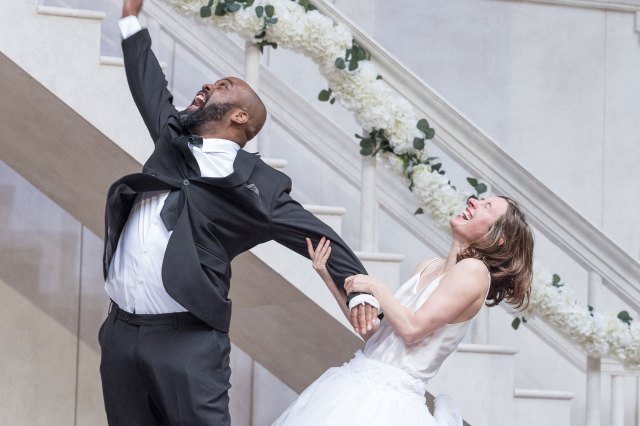
It’s the romantic soft centre rather than the bitter chocolate coating that has increasingly made Much Ado About Nothing the Shakespeare comedy of the moment.
After Jamie Lloyd’s pink-hued, disco-dancing sensation of last year comes a gentler but equally contemporary version directed for Shakespeare’s Globe by Chelsea Walker, her first production for the main stage. And it is a delight on a summer’s evening: a delicately calibrated and confident treat.
At its heart is an engaging performance from Ken Nwosu as Benedick, whose suppressed love for Pippa Nixon’s Beatrice is the motor of the central plot. Nwosu makes it clear that this Benedick’s swagger, his assertive masculinity and his desire to be a bachelor, are a cover for deeper feelings he is unable to master. He swerves beautifully between being hurt and being witty, and his surprise when he realises not only that Beatrice loves him, but that he loves her too, is conveyed in cleverly timed comic asides.
The audience is entirely on his side in a performance that combines some marvellous physicality – a backward roll and a press-up when he is discovered about to kiss her, a leap into a flower barrel when he is eavesdropping on his friends’ conversations – with unexpected tender awkwardness.
Nixon doesn’t quite match his command of the Globe’s difficult space, but she is a gloriously complicated Beatrice, simultaneously vulnerable and fierce, frustrated by the roles into which society squeezes her. Walker introduces a clever moment when, after her cousin Hero has been falsely denounced by Benedick’s friend Claudio, he is down on one knee and about to propose, when he has to put the ring back in his pocket, faced with her demand to “Kill Claudio”. It’s both funny and shocking at the same time, a split second when Benedick has to choose sides.
The darkness of that subplot – of an innocent woman condemned by a patriarchal society – sets the sweetness of their love in context. This is what they are up against if they are to make their marriage work: Nwosu and Nixon make you believe that they have a chance.
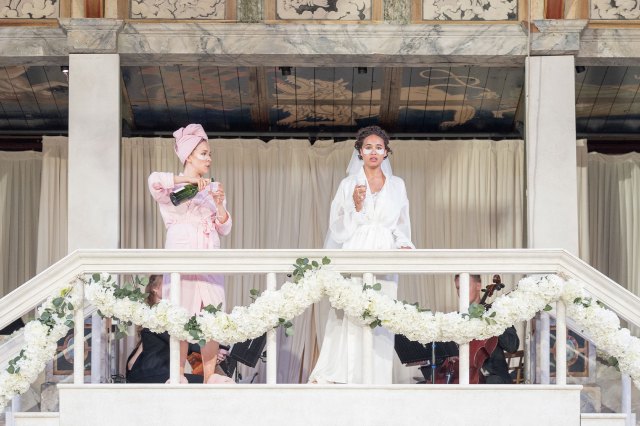
There are other smart touches too. Margaret the housekeeper (Matilda Bailes) realises her part in the deceit, and sneaks away before she is denounced; it doesn’t solve the problem of her inadvertent guilt, but it does recognise it. Don John, the villain, who sets the whole affair in action, isn’t just a caricature but, in Joseph Potter’s performance, a seriously dangerous man. Richard Katz makes the interminable Dogberry scenes actually funny, blending obsequiousness with arrogance in unexpected ways. Geraldine Alexander is powerful and compassionate as the gender-swapped cleric who saves the day.
The whole thing is set by Sami Fendall on a white-painted stage, with billowing curtains, and sophisticated summer clothes. The music by Angus MacRae modulates from jaunty to melancholy, underpinning the action with warning drum rolls and mournful strings. The dancing (movement direction by Aline David) is modern and fun.
It’s a recognisable world and one that skilfully holds the audience in its eternal story of love and betrayal, and a tentative happy ending.






source on Google
Related Articles
See all


Latest Reviews
See all






Latest Videos

West End vs Broadway: Paranormal Activity – Ami Okumura Jones and Cher Álvarez on transatlantic terror
‘Tis the spooky season, after all…