
Glengarry Glen Ross review – all-female revival in the round at the Old Vic
Patrick Marber’s production of the David Mamet classic runs until 18 July
 |
London
|
|
London
|
17 June 2026
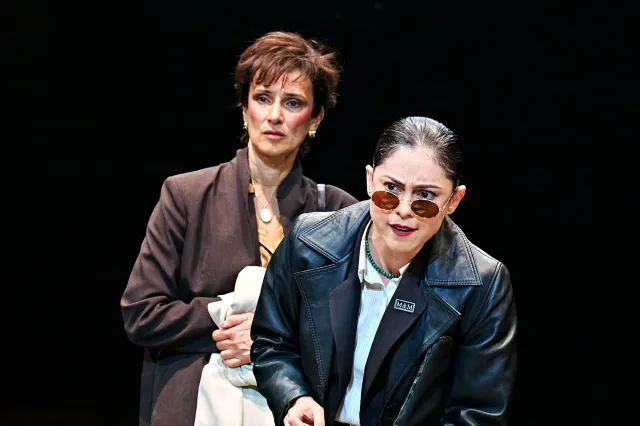
“It is not a world of men,” declares Ricky Roma, one of four grifter salesmen in David Mamet’s 1983 Chicago-set play. They are competing to sell tracts of duff Florida real estate, with the bottom two performers set to get the chop, and Roma’s laments are levelled at the working world, in which (as he sees it) the masculine art of selling is being lost to bureaucracy. But of course Mamet’s play, which won a Pulitzer the year after its debut, is very much a world of men, and about men – exploring their relationships to capitalism and competition, to each other and to their own masculinity. Until now.
This new production, directed by Patrick Marber, has an all-female cast and a shifted perspective that is bold and thought-provoking, if not always theatrically successful. The ferocity with which the saleswomen fight for the best “leads” (potential customers) feels all the more convincing given the sometimes woeful opportunities for women in our workplaces, for instance. And there is an added layer of confronting complexity in the form of our own implicit judgement and biases. If the characters’ words or behaviour feel too “male”, what does that say about what we expect from and are willing to accept from women?
As such, as well as individuals, the four saleswomen might be seen as different expressions of femininity to be evaluated. Rosa Salazar is bullish and seductive (although a touch too obviously underhand) as young top dog Roma, while Indira Varma’s Levene, a star performer on the wane, masks desperation with stories of her former glory. The disillusioned Moss (a standout turn from Niky Wardley), who masterminds an office robbery, is sly but performatively ditzy, and Nancy Crane’s excellent Aaronow, defeated and at the mercy of Moss’s manipulation, plays into the stereotype of a dithering and dismissible older woman.
Rob Howell’s fine 80s costumes add to the exploration of femininity with more androgynous looks for Roma and Levene, and skirt suits for Moss, Aaaronow, and the dispassionate office manager Williamson (played with cool cruelty by Dorothea Myer-Bennett).
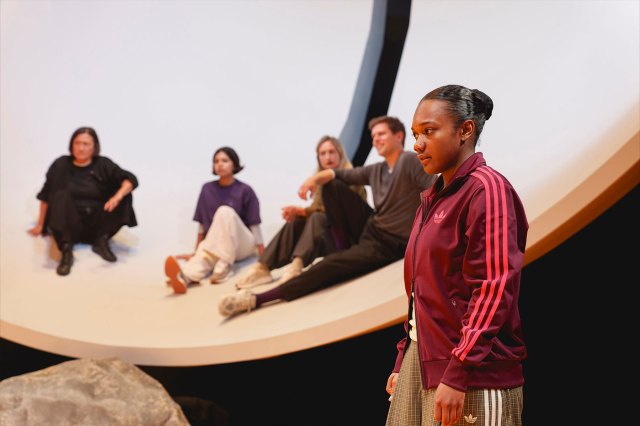
The cast rises to the technical demands of Mamet’s deliciously rapid and rhythmic script – all overlapping speech and half-finished thoughts, artfully drawn images and barked expletives. Moments of humour sing but the play’s pathos sometimes stalls, of which more later. They also deal ably with performing in the round, their constant movement akin to that of caged predators circling one another. There are, though, the inevitable frustrations of watching a killer line delivered to the opposite side of the room.
Howell’s smart, spare set transforms from a Chinese restaurant into the ransacked office (a sudden downpour of papers cleverly creates the post-robbery chaos) and while its sparseness gives Mamet’s scorching language ample room to screech about like wayward fireworks, more detail would give a richer evocation of the characters’ bleak circumstances.
But the production’s biggest challenge lies in Mamet’s insistence on the character’s names and pronouns remaining unchanged, leaving the spectre of masculinity hovering above the stage. A sudden shout of “John!” can momentarily break the illusion of the gender switch, make the more “masculine” performances suddenly feel like male impersonations, and scupper the chance to truly imagine how the play’s events, and its heart-breaking conclusion, would feel for a group of women.






source on Google
Featured In This Story

Related Articles
See all


Latest Reviews
See all





Latest Videos

Disney’s High School Musical revival releases new trailer
Soaring, flying to Wembley Park!