
Kimberly Akimbo at Hampstead Theatre – review
Maria Friedman stars in the European premiere of the five-time Tony Award-winning musical
 |
London
|
|
London
|
9 September 2026
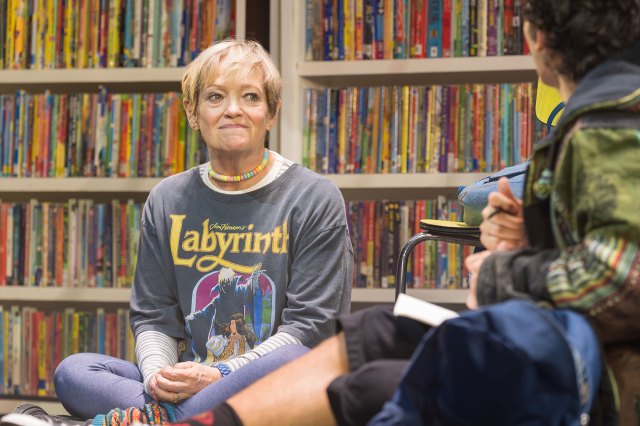
There’s a song in Kimberly Akimbo sung by the heroine’s riotously criminal Aunt Debra: “When life gives you lemons / You got to…go out and steal some apples / Because who the f*** wants lemons?!” Which more or less sums up the anarchic spirit of this astonishing musical.
With a book and lyrics by David Lindsay-Abaire (on whose play it is based) and music by Jeanine Tesori (who composed Fun Home and Caroline, or Change), it is entirely unexpected. It was their follow-up project to Shrek The Musical. Yet any resemblance to any other musical is absolutely not there. The word quirky might have been invented to describe it.
Walking a fine line between high-end farce and searing tragedy, it tells the story of Kimberly Levaco, a 16-year-old girl who is in the grip of a fictional genetic disease that makes her age more than four times faster than she should. But this is not a drama about the terror of dying in your teens with the body of a 60-year-old woman or the misery of growing up in an entirely narcissistic family who are uncapable of coping with your illness or with you.
It is both those things. But it is also a sort of love story and a supremely well-tuned (in every way) comedy of consistent error, of other teenagers who are muddling through, of people who don’t know themselves, powered not only by Kimberly but by her unpredictably outrageous aunt whose criminal endeavours both disrupt and power her upbringing.
No wonder that it won five Tonys, including Best Musical, when it appeared on Broadway in 2022 (after an off-Broadway run the previous year). It loses none of its originality or its impact in this British premiere directed by Michael Longhurst and starring Maria Friedman as Kimberly.
Soutra Gilmour sets the New Jersey scene with a slightly cumbersome revolving set, that incorporates a three-storey house, an ice rink, a high school and a garage (complete with car). In this space that represents her life, Friedman wisely underplays the teenage mannerisms, trusting a range of T-shirts and an adolescent stomp to create the sense of a child in an adult’s body. She relies on her voice, and Tesori’s flexible, subtle music to create the sense of someone who is struggling to make the best of everything against incredible odds.
There’s a wistfulness in songs such as “Make A Wish”, where she dreams of a more normal life, but also in the glances she casts towards her hopelessly dysfunctional parents – the drunken, consistently disappointing Buddy (Peter Hannah) and her hypochondriac mother Pattie (Niamh Perry). Her performance is full of carefully charted moments of disappointment contrasted with rising hope, especially when she meets Gilli Jones’ wide-eyed and gentle Seth, an anagram nerd, who teaches her that life can be viewed differently.
But Kimberly is also tough, and when her frenzied aunt Debra (an energetic, eye-rolling performance by Alice Fearn) tracks her down in the school library, she allows herself slowly to be seduced into a scheme to make the money that will enable her, briefly, to fulfil her heart’s desire.
Debra is a wonderful comic creation, totally at odds with the idea of serious illness and death that permeates the musical, but her arrival and the increasing sense that Kimberly is inhabiting a world where no-one quite fits in (there’s strong support from her misfit mates), allows the show to explore the themes that make it heartbreaking: the sense of snatching happiness from the events of lives that are often chaotic.
It’s this that gives the show – beautifully played by a small orchestra under the directorship of Nigel Lilley – its heart. It is moving because the music tugs that melancholy thread while also painting scenes of buoyant madness, and a wry acceptance that sometimes stealing apples is the only way forward.






source on Google
Featured In This Story

Guide

Related Articles
See all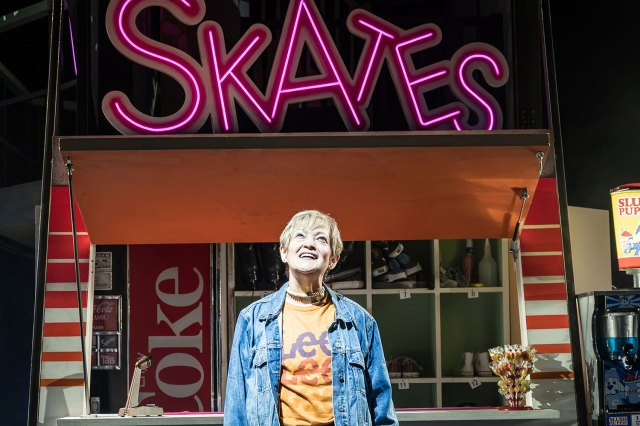
Latest Reviews
See all





Latest Videos
Pride musical – first look at new trailer
The hit show is heading down the Thames after its National Theatre debut