
Jesus Christ Superstar with Sam Ryder – review
Tim Sheader’s production at The London Palladium will also be staged at Theatre Royal Drury Lane this autumn, before heading on tour in 2027
 |
London
|
|
London
|
7 July 2026
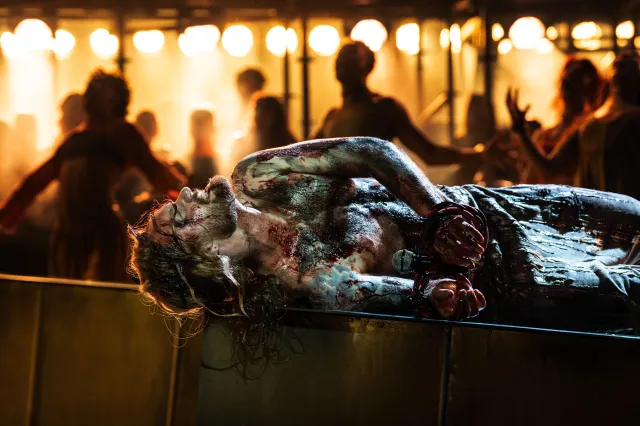
Tim Sheader’s initial production of Andrew Lloyd Webber and Tim Rice’s rock masterpiece Jesus Christ Superstar has been on a long journey since it was first unveiled in 2016 at Regent’s Park Open Air Theatre. It’s got bigger and more sophisticated with time.
But what has never altered is how intensely and intelligently it keeps its focus on the relationship between Jesus and his betrayer Judas, which makes the show so much more than a hard rock version of the bible story. When those characters are played by Eurovision’s saviour Sam Ryder and the exceptional Tyrone Huntley, Olivier-nominated when he played the part ten years ago, the production is in very safe hands indeed.
With its thrilling opening guitar lick blaring out, the show begins with the two men eyeballing one another from opposite sides of the Palladium’s stage, which Tom Scutt’s design expands with great towers of scaffolding. At the rear are more scaffolding balconies, the bottom layer filled with standing ticket holders who get to form the crowd watching the action, and the top with the superb, snarling band under musical director and supervisor Tom Deering.
A great metal walkway, in cruciform shape, bisects the stage, giving a platform for the all-singing, all-dancing cultish crowds who follow Jesus’s every move, spilling out into the auditorium with their jaunty Hosannas, and their peppering questions about “What’s the Buzz?”. The Pharisees (led by Bob Harms’ growling-voiced Caiaphas) line across the stage diagonally in gleaming black PVC, threatening and unmoving.
Both direction and design keep the idea that JCS was originally an album, with its hand-held microphones and wires as part of the impact. The ends of the mic stands are embellished with symbols of office, and instead of the wires being used for the lashing of the captured Christ, the chorus now symbolically throw the same golden glitter that they previously showered him with on Palm Sunday. The soldiers who come to arrest him wear white masks, like Roman statues, prowling threateningly.
There’s something tough and unsentimental about the production that leans into the questioning represented by Rice’s lyrics. This is a show that presents the final days of Christ not only as a state’s battle for power against an insurgent revolutionary, but also lets Judas raise the question of whether Jesus is really doing enough for the poor or simply enjoying being treated as the Messiah.
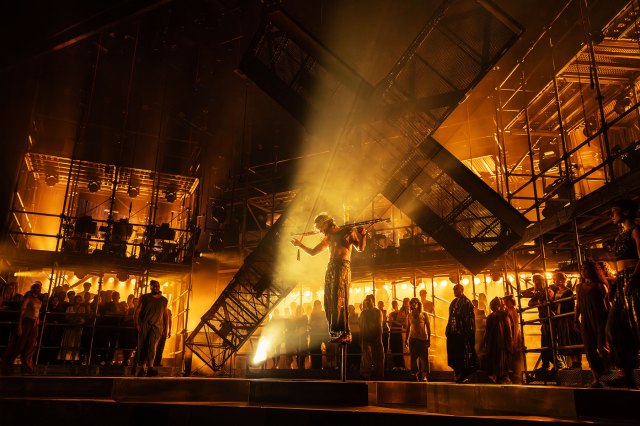
The show was released in 1970, two years after The Beatles had made their famous trip to see the Maharishi, six years after Pier Paolo Pasolini released his Marxist-inflected The Gospel According to St Matthew, and seven years after Bishop John Robinson wrote his controversial Honest to God. Re-assessment of religion and what it meant was in the air. It had a radicalism that caught the mood of the times – as well as chart-topping hits in the form of “Superstar” and “I Don’t Know How to Love Him”.
Sheader’s approach is to re-emphasise the boldness, to let the music carry the drama, and to let character emerge. The approach pays dividends in Ryder’s Jesus, a performance defined by his popstar presence and by the soar of his voice in that falsetto register. People respond to him because he seems genuine and nice; he brings both those qualities to his portrayal in his West End debut, but also finds true drama as the show reaches its un-triumphal conclusion of sacrifice and suffering.
Huntley, in comparison, is all sharp edges and anxiety, his restless energy propelling him around the stage, his desperation after he takes the payment to betray Christ – represented by dipping his hands in silver paint – palpable. The mixture of their voices – Ryder’s lighter-toned, gentle reason with Huntley’s soulful anger – is beautifully managed.
Around them, the chorus ebb and flow in Drew McOnie’s trance-like choreography, and other characters come into sharp focus for a moment or two: Desmonda Cathabel’s soft-voiced Mary Magdalene, David Thaxton’s tortured Pilate, and Jesse Tyler Ferguson’s cynical, showbiz Herod, popping in in billowing gold to deliver his showstopper.
Later performances feature different Herods (Richard Armitage, Boy George, Layton Williams and Julian Clary) and the show moves to Theatre Royal Drury Lane and then on tour after its performances at the Palladium. What it has shown on its travels is that it is one of Lloyd Webber and Rice’s most durable and brilliant musicals – and that this is a production that lets it shine.





source on Google
Featured In This Story

Related Articles
See all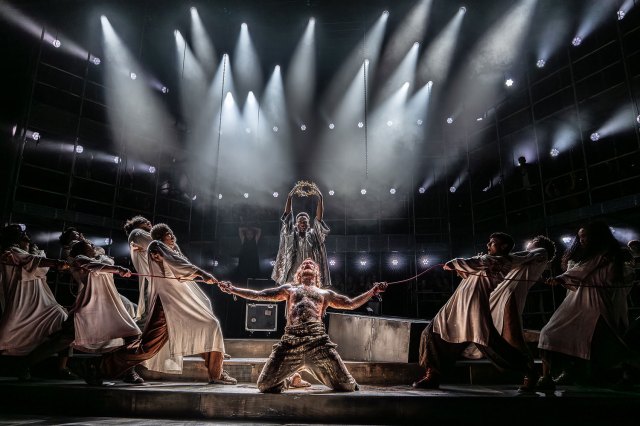




Latest Reviews
See all



Latest Videos

West End vs Broadway: Paranormal Activity – Ami Okumura Jones and Cher Álvarez on transatlantic terror
‘Tis the spooky season, after all…