
How do you solve a problem like not knowing the real story of Maria von Trapp?
The flibbertigibbet, will-o’-the-wisp clown was born on 26 January
 |
Nationwide
|
|
Nationwide
|
26 January 2026
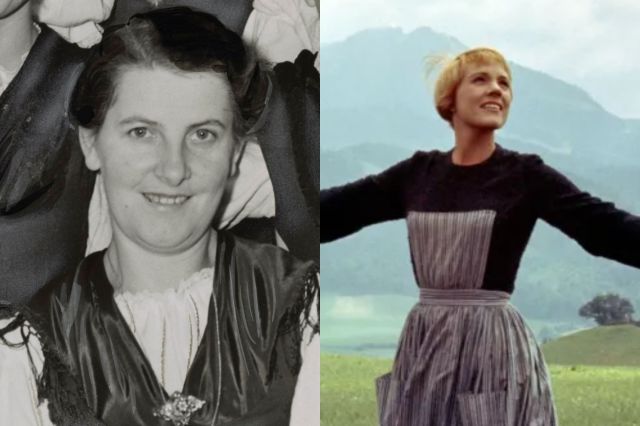
It’s important to know that there were actually two Maria von Trapps. The first (and the original) Maria is the reason why the one we think we all know ended up joining the family to begin with.
In 1926, a young Maria von Trapp was recovering from scarlet fever (which had recently claimed her mother), and her father, one Captain Georg von Trapp, decided to hire a novice nun – named Maria Kutschera – as her tutor. Living at an abbey, her health had deteriorated due to lack of fresh air and physical exercise, and a doctor advised her to help the family and, consequently, herself.
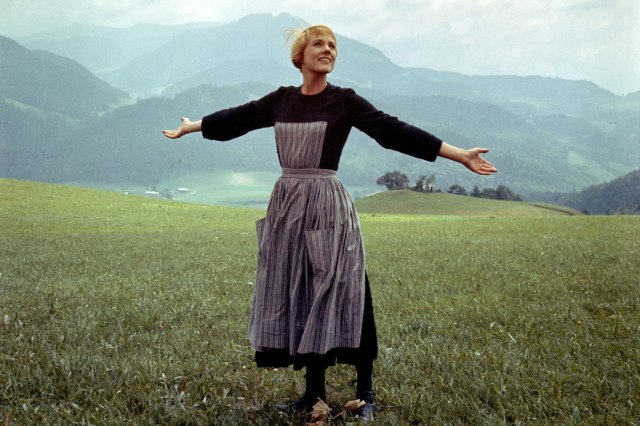
We’re all familiar with Julie Andrews’ Hollywood caricature of a free-spirited and curious young woman, who gradually thawed the patriarchal, strict Captain von Trapp, portrayed by Christopher Plummer. But who was the real Maria von Trapp?
The hit 1965 film The Sound of Music is based on the first section of her book, The Story of the Trapp Family Singers. It chronicles the true events of the family’s beginnings in Salzburg, their escape from Nazi-occupied Europe and their settling in America.
Going right back to the start, Maria Kutschera was born on a train en route to Vienna on 26 January 1905. As a child, she was sadly mistreated by her widowed father and left in the company of a strict relative. Intelligent, she had hopes of becoming a teacher and left home at 15 in search of a job. Unfortunately, however, her youthful looks worked to her disadvantage and she struggled to find a position. Instead, she worked as a tennis umpire, despite admittedly knowing nothing about the sport or about umpiring.
At the time, the talented musician was a part of an Austrian music group, which performed classical music as well as madrigals and folk tunes. She grew up as a socialist and an atheist. At college, a chance conversation with a priest changed the course of her life, and she devoted herself to Nonnberg Abbey in Salzburg as a postulant.

It is a movie myth that Maria’s arrival at the von Trapp’s villa introduced music into the lives of the seven von Trapp children: Rupert, Agathe, the aforementioned Maria Franziska, Werner, Hedwig, Johanna and Martina. In fact, they were all musical, largely inherited from their biological mother, Georg’s first wife, the heiress Agathe Gobertina Whitehead, who, as an aside, was the granddaughter of Robert Whitehead, inventor of the torpedo. This was the source of most of the family’s wealth, alongside Georg’s successful decade-long shipping businesses. However, Maria’s role as a tutor extended to teaching the children to harmonise, play viola da gamba, the recorder (which the von Trapp family is often credited with popularising in the US), and the spinet.
Maria has famously cited that she didn’t take to Georg initially, but much like the stage musical and the movie, she loved the children very much and eventually came to love him too. In her memoir, she wrote: “I really and truly was not in love. I liked him, but I didn’t love him. However, I loved the children, and so in a way, I really married the children.”
Contrary to popular belief, Georg was not as strict or cold as he’s seen in the musical. Johannes von Trapp described his father to the BBC as “a very charming man, generous, open, and not the martinet he was made out to be both in the stage play and in the film.” He added that Maria worked tirelessly to “alter that portrayal for the film, but she was not successful.”

Maria and Georg married in 1927, when she was 22, and he was 47. They were able to enjoy 11 years together before the family left Austria – in the fictional telling, the Nazi takeover of Austria took place mere months after. In fact, it was on the eve of Agathe’s 25th birthday, 11 March 1938, that Austria was invaded by Germany.
The couple welcomed a further three children: Rosmarie, Eleonore “Lorli,” and Johannes. In the musical tellings, the von Trapp children’s names and ages were changed for anonymity, and on set, the actors called themselves the “non Trapps”. One of the biggest differences is that the oldest child, Rupert, who was in his mid-twenties when they fled, became “sixteen-going-on-seventeen” Liesl. Due to the popularity of the story and the famed careers of their singing group, we can learn a great deal about Maria and the family dynamics.
She has admitted in interviews that she was often misbehaving and was “much worse” than any portrayal on stage and screen. Her antics included climbing on roofs and sliding down bannisters (she confessed to The Washington Post). Before the much-loved, award-winning movie, there were two German-language films – The Trapp Family (1956) and The Trapp Family in America (1958) – which achieved their own levels of success in Germany. In them, Ruth Leuwerik played the matriarch, while the real Baroness recalls selling the rights for $9,000 after finding herself in a spot of financial difficulty; in fact, von Trapp only found out about the 20th Century Fox movie while reading a newspaper. She told the BBC: “My long drawn out misery is, I can’t get these diverse Marias to be as wild and untamed as I was at that age – they are all very ladylike, you see, and I was not.” Despite this, she became firm friends with Andrews and even taught her how to yodel!
@rodgersandhammerstein Yodeling today in honor of the ✨real✨ Maria von Trapp’s birthday! Watch her teach Julie Andrews how to (properly) yodel on The Julie Andrews Hour in 1972. #soundofmusic #mariavontrapp #fyp
Her family and friends regularly comment on her “leadership” of the family. It was she who organised the tour logistics, handled money and ran the house. It’s suggested that as the children grew up, regular conflict led to the disbandment of the group. The von Trapp descendants have noted a fiery temper. Her daughter, Maria, perhaps said it best in the National Archives: “We took it like a thunderstorm that would pass, because the next minute she could be very nice.”
Her outbursts have been reported to include throwing items and slamming doors, all attributed to her being strong and doing everything from eating to driving quickly. Granddaughter, Kristina von Trapp, told 10 News+, “Listen, we called her Grandmother with a capital G. There was definitely a level of discipline and respect, but we also knew that she loved us.” While The Sound of Music Story by Tom Santopietro had Johannes empathise, “She had a very unhappy childhood. Someone with her background either becomes a very strong person or becomes a homeless person. She became very strong.”
This strength was useful when the family faced financial concerns. A visit from the famous German-Austrian opera singer Lotte Lehmann in the summer of 1934 encouraged them to sign up for a contest. In reality, pushy music promoter Max Detweiler was the von Trapps’ priest, the Reverend Franz Wasner, who acted as their musical director for over 20 years. Indeed, one of their early public performances was at the coveted Salzburg Festival, and offers rolled in quickly after – including one to perform at Adolf Hitler’s birthday celebrations. They declined.
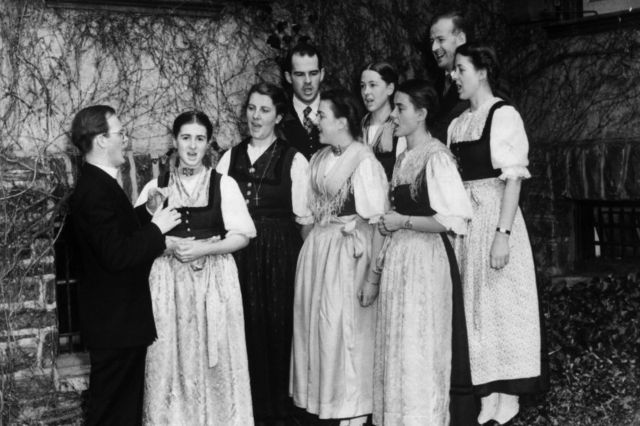
It was Wasner who pioneered the name change from “Trapp Family Choir” to “Trapp Family Singers” to avoid sounding too much like a church choir. This helped after the family’s move to America. Audiences warmed to them as a group of refugees and were heartened by their story and the courage of a fresh start in a new country. To reach wider appeal, they began to add commercial tunes like Christmas carols in December concerts and eventually landed a recording contract with RCA Victor.
The true turning point of adoration came by chance while they were on stage in Denver. A fly flew into Maria’s mouth, forcing her to stop singing. Instead of ignoring it, she told the audience, “I forgot the song because I just swallowed a fly!” Cue hysterics.
Maria’s bravery to flee Austria is widely respected. Unlike the dramatic exit over the hills, they left via Italy. Georg and the children held Italian citizenship, and an American booking agent helped organise their safe crossing from there over to Vermont. Daughter Maria told Opera News in 2003: “We did tell people that we were going to America to sing. And we did not climb over mountains with all our heavy suitcases and instruments. We left by train, pretending nothing.”
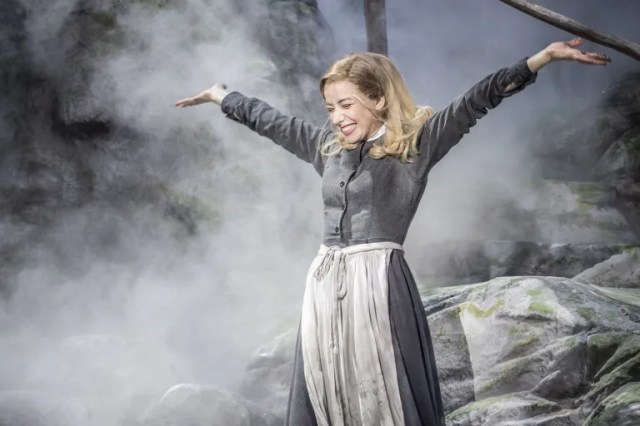
In the States, the family continued to perform for many years, travelling far and wide. The Trapp Family Lodge opened in 1950 as a ski lodge and, in the summer months, the family hosted four sessions of ten-day “Sing Weeks” offering training in music, singing, folk dancing, and playing instruments, including the recorder. The responsibilities of running a camp were split, with everybody chipping in to wash dishes, make beds, and do laundry. Devastatingly, a fatal fire in 1980 cost a guest his life and caused the lodge to close for three years for a rebuild.
Maria spent her days there running the gift shop until she died in 1987, and her body was laid to rest in the family’s cemetery on the property. After her death, 32 family members shared ownership of the lodge with her youngest son, Johannes, serving as president. Today, it’s his daughter, Kristina, who runs the now-named Von Trapp Family Lodge and Resort.

While fictionalising the story, producer Leland Hayward initially contemplated using the von Trapp’s own material. The music still had a contemporary audience at the time, but ultimately, he decided that they were unable to compete with classical musicians. Instead, Richard Rodgers and Oscar Hammerstein II put pen to paper, and the musical opened on Broadway in 1959 with the film following six years later. The erasure of traditional folk music has caused upset and controversy across Austria and Germany.
Maria, despite having a small cameo in the film, and her family were not invited to the film’s premiere. To the BBC, Johannes von Trapp recalled a family and friends screening of the film, remembering: “… it was very emotional and powerful… at the wedding scene, my mother got up from her chair and started walking towards the screen, she was so impacted.”
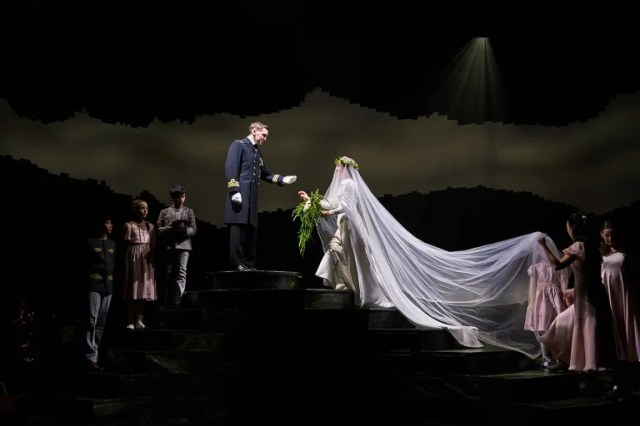
And Maria’s story, both true and fictionalised, continues to impact musical lovers around the world today.




source on Google
Related Articles
See all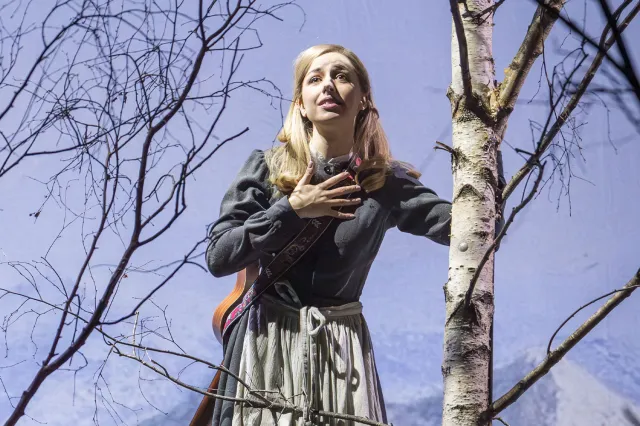

Latest Reviews
See all

Latest Videos

West End vs Broadway: Paranormal Activity – Ami Okumura Jones and Cher Álvarez on transatlantic terror
‘Tis the spooky season, after all…