
Mass stage adaptation at Donmar Warehouse – review
Fran Kranz’s debut play, based on his 2021 film, runs until 6 June
 |
London
|
|
London
|
30 April 2026
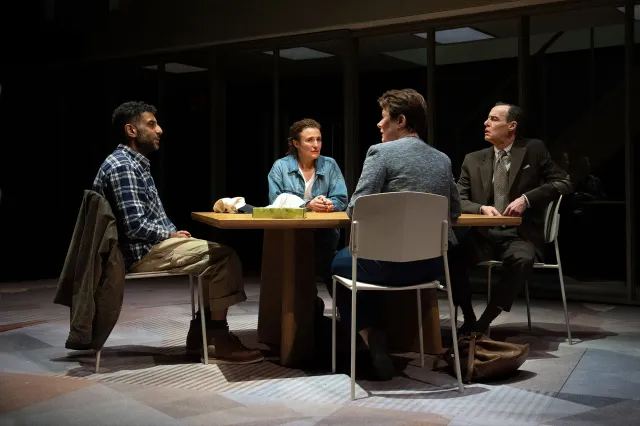
Four people sit around a table and talk. Franz Kranz’s lacerating play Mass is built from the simplest and least theatrical of ingredients.
Yet in this production, thanks to the skill of director Carrie Cracknell and the intense naturalism of its cast, it becomes something very special. As its title suggests, there is something of a ritual about it, as four people struggle towards forgiveness in the aftermath of tragedy.
It unfolds in real time, over an hour and 45 minutes, and begins with the anxious caretakers (Susie Trayling and Amari Bacchus) and a grief counsellor (Rochelle Rose) at an Episcopal Church preparing a meeting room for an encounter. Light glints through the skylight of Anna Yates’ detailed set, with an upstairs corridor and staircase glimpsed through the glass panels that contain the room. It’s institutional but calm.
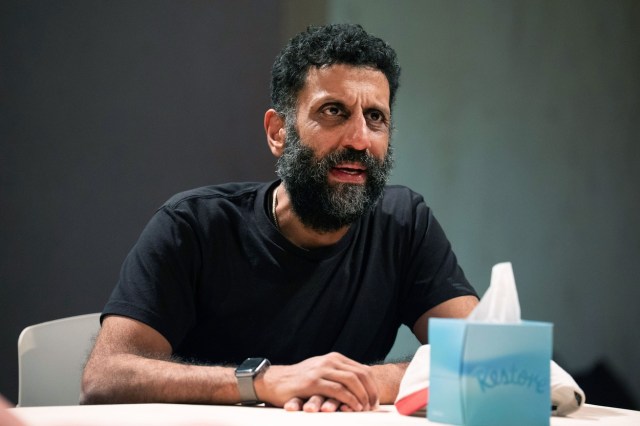
Then two couples arrive. First, Adeel Akhtar’s Jay, all nervous energy and warm greetings, and Gail, played by Lyndsey Marshal, who is already on the verge of tears, unsure whether to proceed. They are joined by Monica Dolan’s Linda, head and hand shaking as she awkwardly offers a vase of flowers, and Paul Hilton’s Richard, uptight in a suit and tie.
They sit down and begin to talk. As they do so, the table almost imperceptibly begins to turn: every word and every emotion of this damaged quartet is given equal weight. They barely move for the next hour. Attention must be paid to what they are saying.
The play has been adapted from Kranz’s film of the same name and follows the same setup. But once the characters begin to speak, the essential communion of theatre works its alchemical power; it is impossible not to listen and feel the terrible moral dilemma that gradually unfolds.
Jay and Gail’s son Evan is one of the ten victims of a school shooting carried out by Linda and Richard’s son Hayden, who shot himself after the killings. The meeting – created in a spirit that is “curious, not vindictive” – is an attempt to let both sets of parents come to terms with what happened. “Why do I want to know everything about your son?” Gail says at one point. “Because he killed mine.”
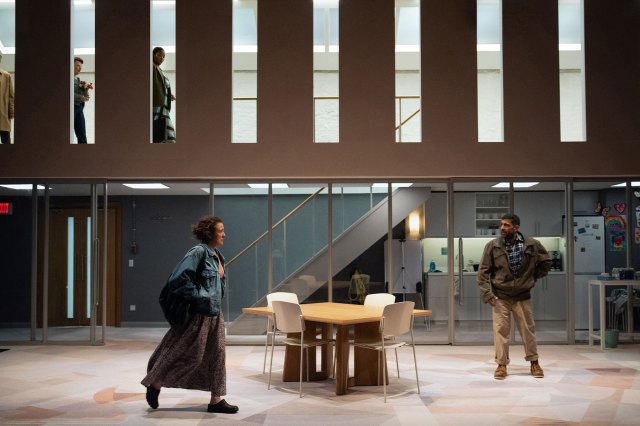
The conversation unfolds in unexpected, nuanced ways. There’s a brief conversation about gun control, which Jay has campaigned for, and which Richard still opposes, but it’s quickly shut down. The couples share stories of their children’s upbringing. The killer’s parents feel guilt and shame, the victim’s parents are in agony about the nature of his death and ask over and over again the question that can’t be answered: why didn’t you see what was going on? Why didn’t you stop it?
The questions Kranz asks are hard ones. What does forgiveness mean? How can people be reconciled if they are still trapped in the cycle of loss? All the parents share an overwhelming longing simply to have their sons back; all are lost in grief.
Like James Graham’s Punch, the reality behind the drama is deeply moving. Although Kranz’s parents are fictionalised, whereas Graham based his play on a true story, the immense courage of people who, in real life, attempt to reach forgiveness and understanding is the propulsion for the play.
But it is brought to life by performances of extraordinary truthfulness. Akhtar makes Jay a man who is being eaten from the inside by his anger and his sense of injustice; as he talks about his son, he holds his hands in front of his face, not wanting to reveal his fury. When it breaks, it is both terrifying and unbearable. Hilton’s Richard is similarly hollow, his assumptions about being a good father destroyed by his son’s actions.
But the women are even more exceptional. Dolan creates a portrait of a woman in whom sadness is stretched to breaking point. Under a civilised surface and a formal manner, she is haunted by the sense that she never knew a boy she loved, and her inability to answer the question of why he did what he did is tearing her apart. Her entire body seems taut with pain; her face full of tension, with little neurotic movements in her hands and body.
As Gail, Marshal is equally powerful. Her face seems made of glass, emotions passing across it as she listens intently to everything that is being said. It’s a performance based on being quiet and calm, while feelings swirl around her. She seems to absorb everything until finally she speaks.
Towards the close, lighting designer Guy Hoare floods the space with late-afternoon sunlight, and a choir sings offstage, underscoring the sense of peace. It could be corny, but it is the achievement of this outstanding production that it feels so momentous. Both characters and audience have earned that moment of release.





source on Google
Related Articles
See all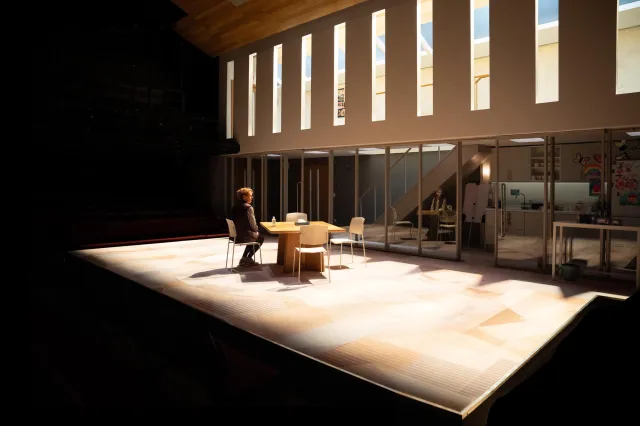

Latest Reviews
See all




Latest Videos
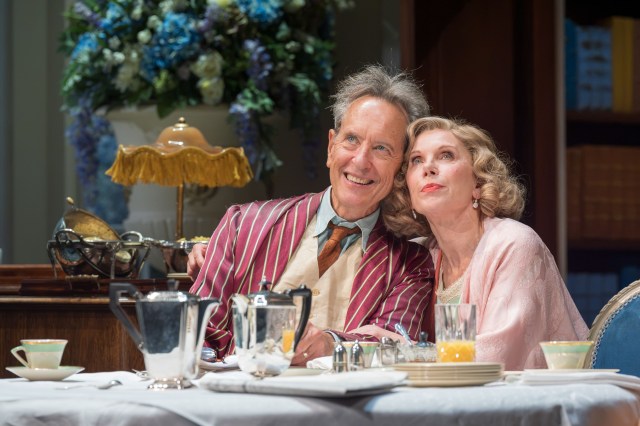
Christine Baranski and Richard E Grant on a blissful friendship, Anglophilia and onstage kissing – Hay Fever opens in the West End
The Noël Coward classic is back!