
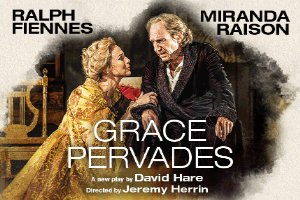
Grace Pervades with Ralph Fiennes and Miranda Raison – West End review
Jeremy Herrin’s production of the David Hare play runs at Theatre Royal Haymarket until 11 July
 |
London
|
|
London
|
1 May 2026

“All divine things run on light feet,” according to Nietzsche. That line is quoted by Ellen Terry, once regarded as Britain’s greatest actress, in David Hare’s sprightly-footed play about her life and times. It covers a lot of ground, but it does so with its own affectionate grace.
The actual quotation that gives the piece its title comes from a 19th-century novelist, Charles Reade, who was both attracted by Terry’s skill on stage and shocked by her racy background, as the 16-year-old bride of painter G F Watts (30 years her senior), who, after ten months of marriage, ran off with the designer Edward William Godwin and had two children out of wedlock.
Miranda Raison brings her to wonderfully spirited, clever life, as the play examines her relationship with Henry Irving, played by Ralph Fiennes, the great actor-manager of his day, dark to her light, tragedy to her comedy. From 1878, they played seasons at the Lyceum Theatre for 23 years – and went on triumphant tours – that changed the reputation of theatre from disreputable entertainment to a pillar of society, raising acting standards and conditions.
No one knows if they were ever romantically involved, yet the depth and power of their relationship – which often involved her submitting her talents and her will to his – had a transforming power.
All this and considerably more is examined in 25 scenes that span the years from 1878 to 1966, but the action is always clear thanks to Bob Crowley’s fleeting designs that set a fixed, painted proscenium arch at the back of the stage and fill it with videos (by Akhila Krishnan) that elegantly conjure time and place. Fotini Dimou’s costumes are detailed and rich.

Hare also weaves Terry’s two remarkable children through the action: the ghastly Edward Gordon Craig (Jordan Metcalfe), now best remembered (if he is remembered at all) as Isadora Duncan’s lover and the sweeter Edith (Ruby Ashbourne Serkis, following her stage debut in Indian Ink with another finely-etched performance).
Both were theatrical visionaries, of sorts. Terry believed in a theatre without actors and is shown mounting a production in Moscow where, after three years of rehearsal, he remarks: “Ideally we would never open.” He was an influence on the young Peter Brook. Edi lived with two other women and founded Pioneer Players, who staged radical plays about feminism.
In winding their lives into the story of their mother, Hare writes a love letter to theatre itself, at a time when it was defining its journey into the next century. He does so with great humour and excellent control, beautifully conducted by director Jeremy Herrin. There’s a scene early on where Terry tentatively suggests to Irving that his acting might be improved “if you directed your gaze at the other actors.”
It’s a lovely line, but what’s even better is watching Fiennes react to it, shifting his performance into one that is infinitely more subtle and meaningful. He is commanding throughout, both awkward and arrogant, full of the weight that reviewers of the time noticed in Irving’s performances. “I have a heavy leg,” he says, mournfully. Seeing both him and Raison give a Victorian-style performance of Shakespeare is fascinating, a tribute both to their talent and to the manner of the times.
Grace Pervades, Hare’s 32nd play, is in many ways unexpected, an insight into a semi-forgotten time. Playing at the same moment in the West End as his early play Teeth ‘n’ Smiles, it’s a reminder of what a varied writer he is, with a remarkable ability to portray Englishness in all its multi-faceted strands, and to understand both the cost of art and its importance.






source on Google
Featured In This Story
Related Articles
See all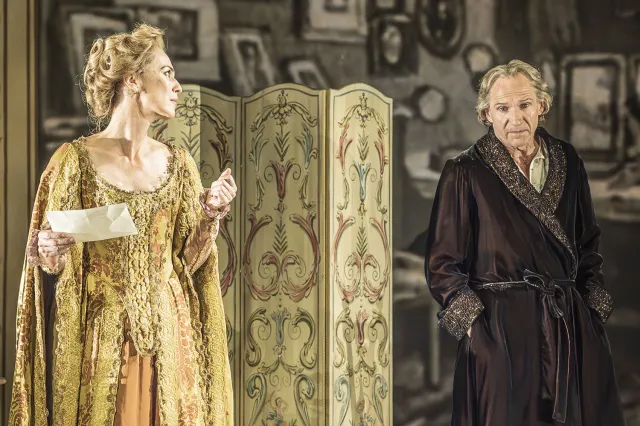


Latest Reviews
See all








Latest Videos

Christine Baranski and Richard E Grant on a blissful friendship, Anglophilia and onstage kissing – Hay Fever opens in the West End
The Noël Coward classic is back!