
Georgina Duncan on her Women’s Prize-winning play, grief and working class humour
We sat down with the latest winner of the Women’s Prize for Playwriting
 |
Nationwide
|
|
Nationwide
|
11 February 2026
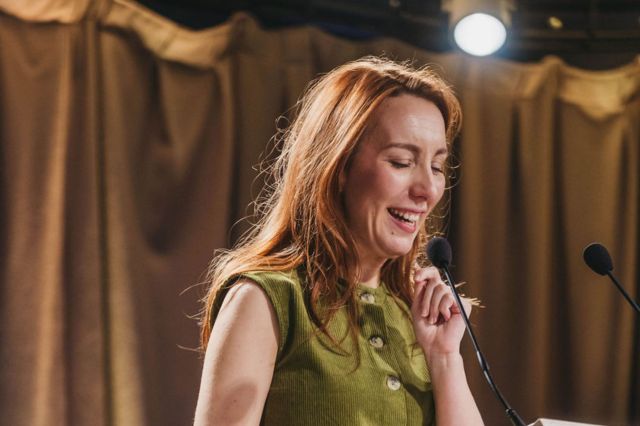
Georgina Duncan, like all of us, has a fear of death.
Well, maybe not death itself, but what comes after. The fear, bedded deep inside of her, is grief.
It’s this fear that propelled her Women’s Prize for Playwriting-winning script, Sapling. Set in Belfast in the 1990s, the coming-of-age story follows 16-year-old Gerry, whose brother, Connor, was murdered ten years previously by another ten-year-old boy.
“Someone described it as sitting in the scar tissue of grief, which I just thought was so eloquently put,” Duncan smiles, still high from the ceremony in central London where she was crowned, “And I’m really jealous I didn’t come up with that myself, because I think that describes it perfectly.”
“[Sapling is] about a family coming to terms with something difficult. It’s about an enigmatic stranger who comes, offering potential and risk, and what all that means. It sits in this community already scarred by years of violence, but it’s a personal story of a boy.”
Duncan never set out to write a play about The Troubles. Rather, when she first took part in the Soho Writers’ Lab, she thought she’d be writing a three-hander set in a flat that she and her mates would act in. The play started life titled In Memoriam (“It just sounded a bit dull and a bit dreary”), and received a self-funded reading (“I paid people with pints and a bowl of chips, and I’m eternally grateful”) and became Sapling over the years (“Young life and growth and roots just felt like they spoke to the play a bit more”). The piece unexpectedly turned out as the epic – the first scene opens: “Belfast. January 1990. One of those unmarked borders where tectonic plates grind. A dark stage. Sound FX: The sound of trees snapping, breaking. It sounds violent and relentless.”
The writer explains: “I like to make the familiar unfamiliar and the unfamiliar familiar when I write,” continuing, “I would hate to be restricted to writing only my story. And if only I could ever write things about being northern and skint, I’d be kind of frustrated with that. Although all of that is in all of my work anyway, I like to play with it and see what else it provokes… I love using provocations that I’ve experienced and then contorting them, changing them, and stretching them as far as I can to see how else they can express themselves.”
As for writing 16-year-old boys? “I really found it a lot easier than I thought I would,” she laughs, “…When I was 16, I was desperate to go clubbing and kiss boys and pretend like I had it all together… When you’re that age, you’re at the cusp of desperately wanting to be seen as an adult while not understanding you’re navigating things as a child.”
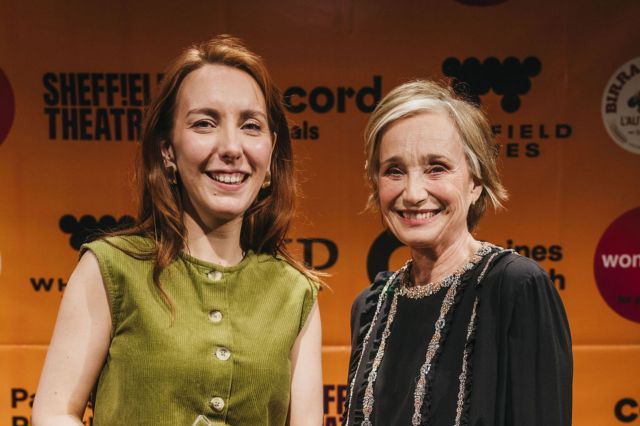
Duncan, a proud working-class northern lass, was drawn to the “incredibly knotty and difficult period of time,” and examined the memorialisation, inherited trauma, and destruction found within families during and following The Troubles. To make it as authentic as possible, the working class sense of humour and sentiment needed to be present: “I hope it’s quite tender and moving, and it’s also quite funny and quite acerbic in places.” When asked about her favourite lines, they range widely from a curse-heavy insult that only brothers can get away with (“I don’t even really know what it means!” she laughs, in almost admiration of these characters she’s conjured up) and heartwrenching monologues from that same lad struggling to remember his brother, that catch in your throat.
Confessing to loving a research project, Duncan met with a lot of Northern Irish people, allowed a lot of Northern Irish people to read the play, and took a black cab around Belfast with a driver called Cedric, who kindly shared his stories. As part of the trip, she also spent time visiting Belfast prisons and the communities. “On these streets, one way was Catholic, the other was Protestant, and it was happening literally outside their doors. Mums were still trying to take their kids to school, and people were still trying to do the weekly shop amongst it all. I just think that is so devastating and interesting to play with in terms of this striving for normality, despite what is literally on the cobbles outside your house.”
She breathes: “I hope that people feel I’ve done it justice.”
One of the challenges with Sapling was writing what could be considered “a masculine story,” one of brotherhood, boyhood and violence. Duncan says, “I think there’s such a horrible misconception with female and non-binary playwrights that they might write gentle plays or purely domestic soft plays. And that is so not fair.”

Gerry, being a teenager who had already experienced trauma through grief, violence and war, led him to “wanting a world of possibilities,” Duncan explains, “There’s so much ahead of him, and yet there’s so much behind him.” While his mother, Maggie, is stoical before she reveals to a friend that her insides are black and that she feels a creature has come and taken her real self, replacing her with all that is shallow (this monologue is particularly affecting to Duncan), before the arrival of the “charismatic, enigmatic stranger,” Ryan, who turns the family’s world upside down.
“I hope I’ve written something that’s kind of ugly, and dramatic, and angular, and masculine.”
As a self-confessed “nerd” about plays, Duncan coos about a recent watch of Guess How Much I Love You? (“It punched me in the gut”), and expresses a deep love for People, Places and Things (“Denise Gough. What a woman”) and is on a high after spending a night in the company of “incredible voices within theatre” at the prize giving.
These moments of euphoria – from confronting her fears to write about inevitable grief, to feeling brave enough to first submit the play, and then being surrounded by support as she claims the Prize – have all taught a lesson. “[These fears are] something that we have to live with and live life beautifully with,” she says, “And I think that frightens me and is what I’ve delved into in this play… Even the darkest things should be undercut with humour, because that’s how we live our lives.”
Day-to-day, Duncan lives her life working “many, many day jobs to pay the bills”, while writing during every spare moment. Winning the Prize is “a complete game changer.” She’s grateful, mostly for how supported she has felt during the whole process – a point she is keen to emphasise. “I feel giddy, and I feel galvanised, and I feel frightened. I cannot wait for the next stage.”




source on Google
Related Articles
See all


Latest Reviews
See all




Latest Videos

Disney’s High School Musical opens in London and the stars take a trip down memory lane
Bopping to the top at Troubadour Wembley Park Theatre!