
When We Are Married at the Donmar Warehouse – review
Tim Sheader’s revival of the J B Priestley comedy runs until 7 February
 |
London
|
|
London
|
18 December 2025
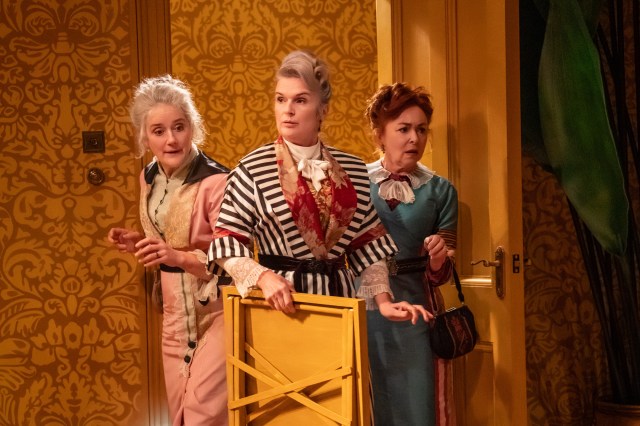
This revival of J B Priestley’s comedy of marital disharmony is a hoot, a joyful reminder of the power of supreme comic acting, and the way that humour can reveal truths with a light touch.
The play was written in 1934 but set 30 years early in solidly respectable middle-class Yorkshire where three couples are all celebrating their 25th wedding anniversary, having been married on the same day by the same clergyman, as a sort of job lot. Only, it quickly turns out, they weren’t. The minister wasn’t licensed to marry them. For a giddy two hours it turns out that these model citizens may all have been living in sin.
Tim Sheader’s direction is cleverly specific and general. Beyoncé’s “Single Ladies” blasts out between scenes when the mistake is revealed, a song revealing the generally liberating effect on the women in the house of the discovery. But each act opens with a music hall song accompanied on the piano, setting the goings-on within context and period.
Peter Mckintosh’s mustard yellow set, with its flocked walls and giant aspidistra, is both real and unreal; Anna Fleischle’s beautifully detailed costumes catch the period but also say quite a lot about the men and women wearing them.
Priestley’s point, gently but fiercely made, is that the problem with his three complacent, pompous husbands, dignitaries of the council and the chapel, and their respective wives, is not that they are in themselves laughable, but that their hypocrisy and pretension is. Just as in An Inspector Calls, he smuggles social satire into an apparently straightforward drama.
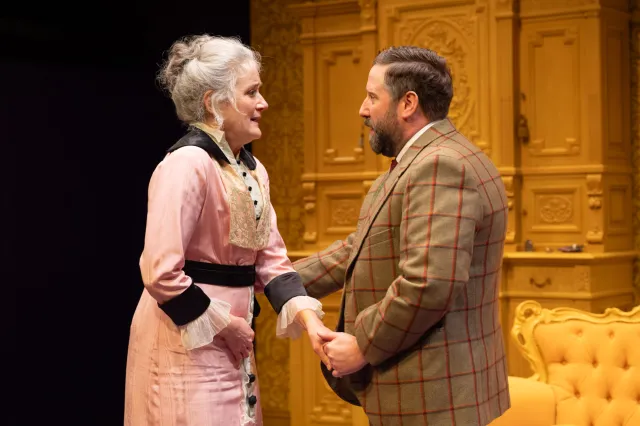
The couples are strongly differentiated. John Hodgkinson’s Alderman Helliwell is smooth and oleaginous, his wife (Siobhan Finneran) a raging snob, who runs the house and her husband with a firm hand. Councillor Albert Parker (Marc Wootton) is a pure bombastic bully, so full of himself and his own worth that he fails to notice the way his gentle wife Annie (Sophie Thompson) increasingly undercuts him. Hesitant Herbert Soppitt (Jim Howick) on the other hand, is himself bullied by Samantha Spiro’s Clara, her lips pursed in a permanent moue of disapproval of him and all his doings.
As events unravel, the power balances between them alter, as Annie suddenly sees an opportunity for freedom, Clara reveals herself terrified of losing her grip and an outsider Lottie (Tori Allen-Martin) – “a woman who dyes her hair” – turns up at the house on the off-chance that the man who has kept telling her that he would be with her if he wasn’t married, might actually mean it now he isn’t married.
The complications unravel at the speed and with the precision of farce. It is incredibly funny. The entire cast is superb, their performances full of detail whether it is Howick’s sudden twitches as he realises he has an opportunity to assert himself, or Finneran’s dignified, furious offer to hand over the house keys to Lottie. Allen-Martin lends a character who could be a caricature real emotional heft, with a warmth and innate gentility beneath her surface brashness.
Ron Cook brings precise, physical comedy to the small role of the photographer from the Yorkshire Argus who turns up to take an anniversary photograph that will represent marriage as “the backbone of decent, respectable life” and gets slowly drunker as the mayhem unfolds around him. His sudden slide from the sofa is a cherishable moment of pure slapstick.
But proper emotion courses underneath the ridiculous, as when Finneran asks with simplicity and heart: “Do you love me?” Or when Thompson’s Annie breathily says to Herbert: “You haven’t forgotten the wagonette?” and reveals an entire world of feeling.
Thompson grounds the production, her mobile face registering every moment and mood. The scene where she listens to Albert’s endless self-justification, and replies with absolute truth while, by her timing and intonation, totally reversing his meaning, is a small masterpiece in a play that comes up sparkling and honest in an excellent revival.






Related Articles
See all

Latest Reviews
See all





Latest Videos
Once on This Island West End concert – watch performances in rehearsals
Check out the cast in action ahead of Sunday’s big night