
The Misanthrope with Sandra Oh at the National Theatre – review
Martin Crimp’s adaptation of Molière’s dark comedy, directed by Indhu Rubasingham, runs until 1 August
 |
London
|
|
London
|
24 June 2026

Martin Crimp clearly loves Molière’s The Misanthrope. In the published text of this, his third contemporary update of the 17th-century French dramatist’s satire, he argues that “reinvention, rewriting of one writer’s work by another, is ‘fidelity’ of the truest and most passionate kind.”
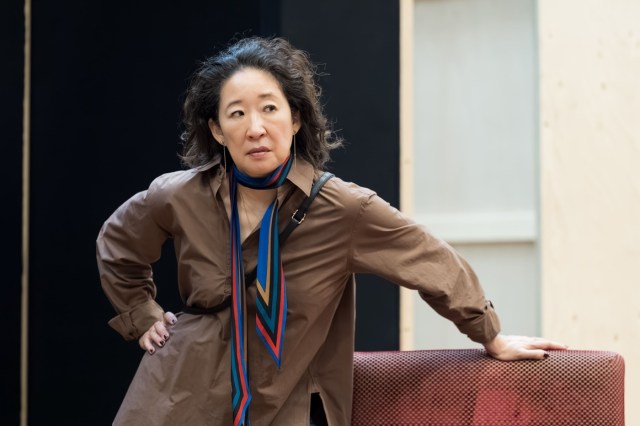
The twist in this version is that Alceste, Molière’s angry and truth-spitting hero, has become a woman, Alice, and she is played by Sandra Oh, the Canadian star of Killing Eve, making her UK stage debut.
It’s Oh who enters first, face screwed up in a familiar look of contempt and dismay, as she berates her friend John (a superb Paul Chahidi) about his insincerity in greeting a woman he barely knows with hugs and smiles. Alice is a Booker Prize-winning novelist and John’s a playwright, but they differ on how much and how often an artist must tell the truth.
She argues it is a moral duty to be honest on all occasions – so much so that she is about to be barred from receiving a major prize for her outspokenness. “Sometimes I dream of a clean white space/entirely disinfected of the human race.” John, on the other hand, is, as he says, just a playwright, the kind of man who (in one of many jokes about theatre) is always on his feet applauding on first nights. He loves Alice but accuses her of misanthropy.
The dialogue in that first scene positively crackles, and the overlaying of modern concerns – the lack of debate encouraged by social media, the instant categorising of opinion – seems neatly made. But as the play progresses, the target of the satire becomes more blurred.
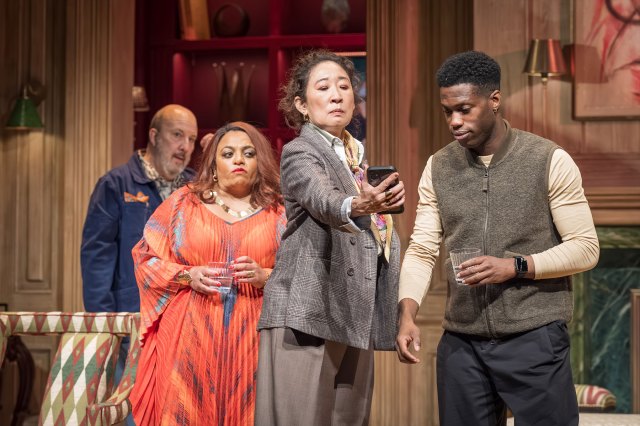
The point about Alceste (or Alice here) is that he/she is both correct in the analysis of the corrupt state of society, but also deeply human (she’s in love with an ex-addict, vain and conceited film star Stefan) and often ridiculous. Oh can’t quite find that range. She is affecting at moments and hilarious at others, but sometimes her characterisation doesn’t cut through. Her low-key presence means she sometimes vanishes from scenes in which she should be the centre.
She isn’t helped by Crimp’s adaptation that (unlike his astonishing Cyrano de Bergerac in the West End six years ago) is blurred at times in its wit and intent. The transformation of characters into an agent, a publicist, a female conductor, and an online image manipulator (and hacker) makes smart points about the world today, but introduces too many hares of attack. Often, Alice feels less like the scourge of a society gone to rot and more like a dispassionate analyst.
Of the characters surrounding her, only Chahidi cuts through, his command of tone, the poetry of the lines and emotion exemplary. Abigail Cruttenden is also impressive as Stefan’s long-suffering agent, but her appearance is only fleeting.
Indhu Rubasingham’s direction keeps the action fast on Robert Jones’s handsome designs, which set the story in various rooms of a boutique hotel full of baroque extravagance in its rich cushions and red-painted walls. The final coup de théâtre – when all the lavish trimmings are stripped away and the characters enact a masque in a bare blue space beautifully lit (like the rest) by Tim Lutkin – is stunning. But as Alice renounces the world and walks away, the impact is muted.
That sums up the production. This is a Misanthrope full of interesting ideas and fine effects, but not quite enough bite or fury.






source on Google
Featured In This Story

Related Articles
See all

Latest Reviews
See all





Latest Videos

Thelma & Louise – Amy Lennox and Rachel Tucker give us a sneak peek at the world premiere musical
The Oscar-winning movie’s stage adaptation begins performances next month!