
The Hunger Games stage show – 12 key differences between the book, film and show
For our fellow mega-fans!
 |
London
|
|
London
|
13 November 2025

The long-awaited stage adaptation of The Hunger Games has arrived in London!
Suzanne Collins’ much-loved first novel in the series, and subsequent blockbuster film, has been adapted by Conor McPherson as the world premiere, directed by Matthew Dunster, plays in a purpose-built theatre in Canary Wharf.
This new telling was bound to be different, with four novels that follow the original book, and a further four films (plus one in production!), our knowledge of Panem has expanded far beyond the 74th Games.
With that, here are 12 key differences between the play and the original text and film! Please note, this article may contain spoilers.
If you happen to think of any others that you’d like to share, let us know on social media!
The reaping
Everyone can recall the iconic line, “I volunteer. I volunteer as tribute,” from The Hunger Games. In the stage show, the reaping scene includes a fan favourite detail from the book – previous victor Haymitch Abernathy (played by Joshua Lacey) falling off the stage drunk. This distraction allows our heroine, Katniss Everdeen (Mia Carragher), who has stepped into the bloody battle to the death for her little sister, a moment to compose herself and not appear weak to the nation watching the televised event. Appearing cool, calm, and confident is a trick that Haymitch learnt in his own games.
On stage, Haymitch also plays a pivotal role, guiding Katniss and Peeta Mellark (Euan Garrett) not only through coaching but through training and introducing their competition and combat skills.
The Mockingjay pin
The stage show does, like the films, miss an opportunity to include Madge, the daughter of the Mayor of District 12. Fans will know the significance of this important but forgotten character, whose family connections are explored even deeper in Sunrise on the Reaping, set for a cinematic release next year.
In the book, she gives her friend the all-important Mockingjay pin, whereas in the film, it was changed so that Hob seller Greasy Sae first gives it to Katniss (who then gifts it to Prim before she returns it in their final moments together). The District 12 trading place and the vendor, though not named, are briefly alluded to in the play when a character asks for wild dog meat. Other missing characters include the Avox, Lavinia, hiding other tortures the Capitol way of punishment includes.
On stage, it is Gale (played by Tristan Waterson) who hands Katniss the pin. It seems to be a device to further the relationship between the two of them – which I’ll discuss in more detail later…
Music
Music is a big part of the Hunger Games world. It’s how the Covey make their living and leave their mark, and Katniss, who we later learn is of Covey descent, grew up with her father, Burdock, who made “the birds fall silent when he sings,” teaching her songs. Several tunes from the films – with lyrics from the books – are used on stage, including “The Hanging Tree” and “Deep in the Meadow” alongside new additions, including the national anthem, a short lullaby from Rue (Aiya Agustin) instead of her explaining how Mockingjays are used in District 11.
The stage show goes a step further by adding musical interludes, for the Capitol citizens marking the tribute’s arrival to this otherworldly place, and for the unnamed Prep Team, who come across as particularly vapid in their beauty standards. This is a shame, as it devalues the relationships forged with the Capitol citizens, including Cinna in parts, who Katniss did trust.
Spoiler alert: A dance break does cut off an important three-fingered salute to demonstrate how the Capitol celebrates a child’s death and their disconnection to the slaughter. But on the whole, contemporary dance is used on stage rather effectively and works theatrically.
Narration
On stage, Carragher does a wonderful job narrating the story akin to Suzanne Collins’ original books. She recites passages, providing context to the days that pass in the arena and her innermost thoughts and feelings. Barely leaving the stage, she’s an absolute force and to me portrays more book Katniss than film, while adding a new and previously unexplored calm, almost shell-shockedness, to the character. You can get to know Carragher more here in our exclusive video!
Caesar Flickerman’s interviews
Caesar Flickerman, presented on stage with his sapphire blue hair and played by Stavros Demetraki, has an extra responsibility in the stage show. During the interview sequence, Caesar reveals the tribute’s training scores. It’s an effective way to save time, but it does feel rushed. Similarly, the stage show isn’t owed the luxury to give justice to certain sequences – the days spent in a cave, hours hunting, and gruelling, long deaths. When Katniss and Rue join forces, their plan to destroy the supplies is slimmed down.
Another change from the book and the film sees Peeta joining Katniss for his interview, where he declares his affections publicly for the very first time. As a result, all of Peeta’s conversation revolves around Katniss, diminishing his original, overly friendly rapport with Caesar.
The stage show does, however, include interactions between the voice of Claudius Templesmith, the Hunger Games commentator, as well as unnamed Gamemakers. One does bear a resemblance to Seneca Crane, a large presence in the films and, of course, behind the scenes in the books. Plus, Caesar himself makes a trip to District 12 to interview the Everdeens – a part of the Games only alluded to in the Catching Fire book.
Retro aesthetic
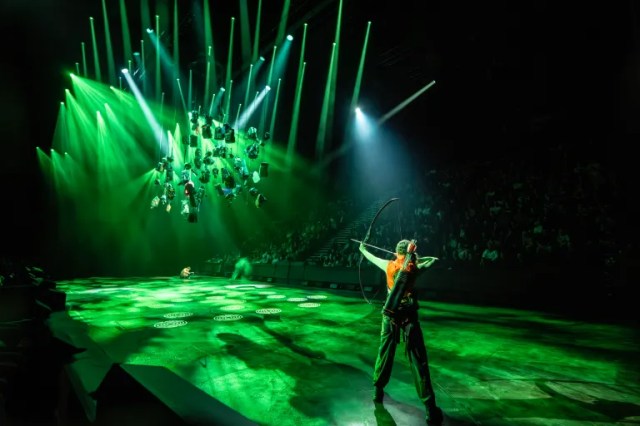
While the aesthetic of the Capitol is known categorically to be over the top, eccentric, and extravagant, the kitsch gaucheness is really amped up in the stage show, without the mahogany. Designer Miriam Buether, alongside video designer Tal Rosner and a whole team, has designed 80s-esque graphics for Caesar’s show, complete with jarring tinned laugh tracks. It’s a fun contrast to the futuristic dystopia associated with the title. Costume-wise, there are some shell suit-esque training outfits. These new creative directions are a welcome addition to worldbuilding and a new interpretation of the original text. There are also some excellent design choices in the hanging backpacks resembling school rucksacks, and the disjoined wooden homes of District 12.
Speaking of design, kudos must go to the minds behind the illusions and movement presented on stage! Combat sequences are impressively gory and detailed, and very cleverly done in front of a live audience.
Snow addressing Katniss

While in the book, Katniss doesn’t meet President Snow until the very end, when he warns her about the upcoming Victory Tour, he is more present in the film and in the stage show. Portrayed on stage by John Malkovich via video screen, he speaks directly to Katniss after the Opening Ceremony scene. Throughout the play, he observes and instructs the Gamemakers – and Caesar Flickerman, who appears here to have a role in the workings of the Games – based on his concerns about uprisings after discussions with his young granddaughter, who wears her hair in a braid.
Love triangle

The supposed love triangle between Katniss and having to “decide” between Peeta and Gale is pushed quite heavily in the stage show. Like the Capitol viewers, I guess theatre audiences love a love story! Flashbacks help provide history between the two hunting partners, and television crews visit District 12, already calling Gale Katniss’ cousin. However, the stage show highlights Peeta’s strength and abilities more closely to the book than the film, while Gale, in comparison, seems to be portrayed as weaker. It feels almost like a role reversal. Garrett says his Peeta is “sassy” in our exclusive video!
Fellow Tributes
With Katniss and Peeta, 12 other tributes feature in the Games in the play. This means that almost half of the 24 tributes are never seen, named, or mentioned, and it downplays the stakes and makes the space feel empty at times. Additionally, the fallen’s faces aren’t shown in the sky each night, just their district numbers, so it’s tricky to form an emotional connection with these unfortunate children. However, the show has made an effort to name more Tributes, including changing who Katniss refers to in the books and film as Foxface to Fossa, humanising her a little more for viewers. Plus, the Capitol commentary adds extra information, like the ages of some Tributes.
Injuries
Some fans are disappointed that Peeta’s leg injury is downplayed in the film. Katniss helping care for him and risking her life at the Feast is a pivotal point in their relationship, and the lasting impact is that Peeta originally loses a lower limb. On stage, the extent of his injury is heavily implied towards the end as he uses a walking aid. However, on stage, Katniss doesn’t experience a loss of hearing in the aftermath of the explosion. One potentially picky plot hole is the lack of the lake in the arena – so much so that Haymitch’s famous advice doesn’t include “find water”.
The Muttations
It’s very impressive how the Mutts are played out on stage, and they are more book-faithful in their deadly nature and how they’re described. Video screens provide context about the Capitol’s modified animals, like the Tracker Jackers, and in the final bloodbath on the Cornucopia, Katniss recognises the Mutts as the fallen Tributes – played by a stellar ensemble – by their eyes. This is also foreshadowed rather brilliantly during deaths!
Effie and Cinna presented as a team
The stage adaptation does draw on the wider Hunger Games canon. I think fans will enjoy a line delivered by Effie Trinket (played by Tamsin Carroll) on the train to the Capitol, which indicates the significance of the reaping date, learnt in Sunrise on the Reaping.
It’s also Effie and Cinna (Nathan Ives-Moiba) who brief the two victors to keep up the charade of being “two kids in love,” strengthening the alliance at the end of the play, which we know long continues throughout the franchise…




Related Articles
See all


Latest Reviews
See all




Latest Videos
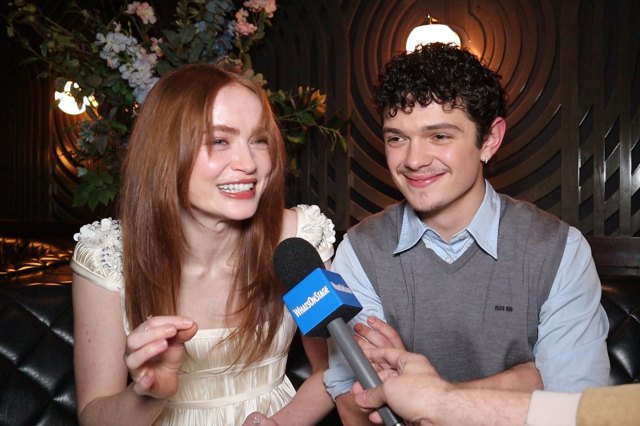
Sadie Sink and Noah Jupe make their West End debuts in Romeo and Juliet – watch the highlights
Robert Icke’s new production is officially open at the Harold Pinter Theatre!