
Barnum with Lee Mead on tour – review
Jonathan O’Boyle’s revival of the P T Barnum musical is on the road until October
 |
Tour
|
|
Tour
|
13 February 2026
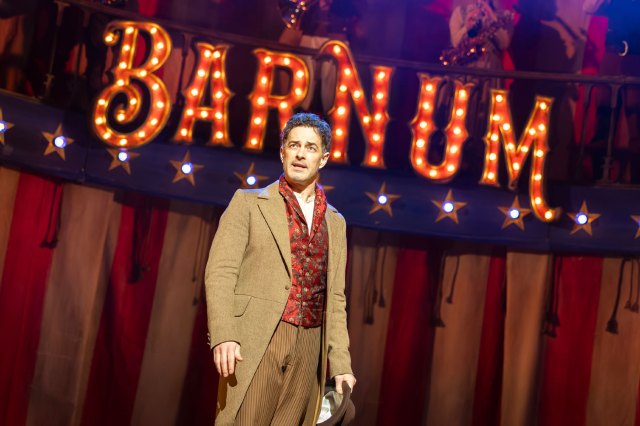
Barnum arrives at Manchester’s Palace Theatre with a huge fanfare, promising a cast of 20 all-singing, all-dancing performers playing 150 instruments. There is no shortage of talent, ticker tape and high-wire ambition. What it delivers is high on stimulating spectacle, but unfortunately, what it struggles to deliver is a scintillating script to fully engage the audience or do justice to the hard-working cast.
As P T Barnum, Lee Mead is an affable ringmaster, beaming with that particular brand of twinkling sincerity that makes even blatant humbug feel like a public service. Vocally assured and physically nimble, Mead navigates the score with ease, especially in the rousing “Come Follow the Band”, which lands like a brass-polished pep talk to the gods of showbiz. He handles the production’s circus demands gamely too, striding the tightrope with commendable confidence. There is real commitment here, and plenty of charm.
Where this production truly flexes its muscles is in the choreography by Oti Mabuse and circus direction by Amy Panter. The ensemble whirl, tumble and vault with exhilarating precision, transforming the stage into a living carousel. Acrobats thread through dance numbers; silks unfurl; bodies stack and spin in human architecture that feels both playful and perilous. The circus sequences pulse with colour and velocity, and for long stretches, you forget you are watching a musical at all. Instead, it feels like the theatre has temporarily shape-shifted into a big top, complete with glittering peril and gasps from the stalls. The set design by Lee Newby works beautifully within the Palace, with the staging almost seeming to mirror the grand old theatre onstage.
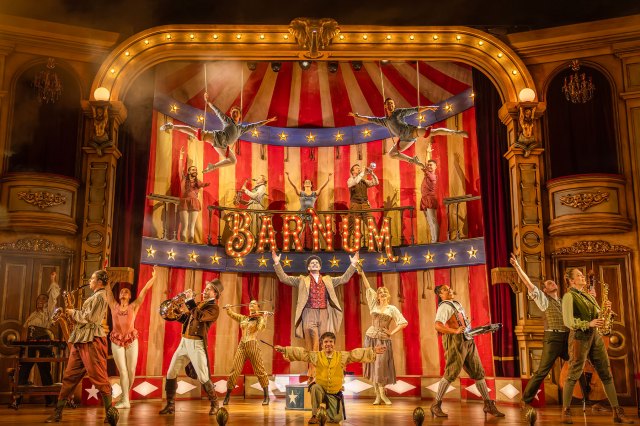
Yet once the applause for each feat subsides, the narrative spine reveals itself to be rather fragile. The book has always been episodic, but here the storytelling feels particularly patchy. Barnum’s moral compromises and personal contradictions are touched upon rather than interrogated. His relationship with wife Charity, often the emotional ballast of the piece, lacks the cumulative weight it needs. The chemistry between Mead and Monique Young never quite lands, though this may be due to the weak script. Scenes drift in and out like parade floats: bright, buoyant, then quickly gone like candyfloss at a carnival.
There is an odd emotional flatness at the heart of the evening. For a story about ambition, reinvention and spectacular failure, it rarely risks genuine darkness. The show gestures toward Barnum’s ethical murkiness without ever truly stepping into it. As a result, the stakes never quite soar as high as the aerialists.
Still, as a night of pure theatrical glitz, it is likely to be a crowd-pleaser on tour. The musicians swing with gusto, the visuals sparkle, and Mead’s genial presence keeps the whole enterprise bubbly even when the narrative current runs shallow.
Barnum is a production that dazzles the eye and tickles the senses, but never quite persuades the heart to queue up for a second ticket.






source on Google
Featured In This Story

Related Articles
See all




Latest Reviews
See all





Latest Videos

Kimberly Akimbo musical releases UK premiere trailer
The five-time Tony Award-winning musical is currently on stage at Hampstead Theatre