
The Price at Marylebone Theatre – review
Arthur Miller’s classic is given a rare revival, directed by Jonathan Munby
 |
London
|
|
London
|
24 April 2026
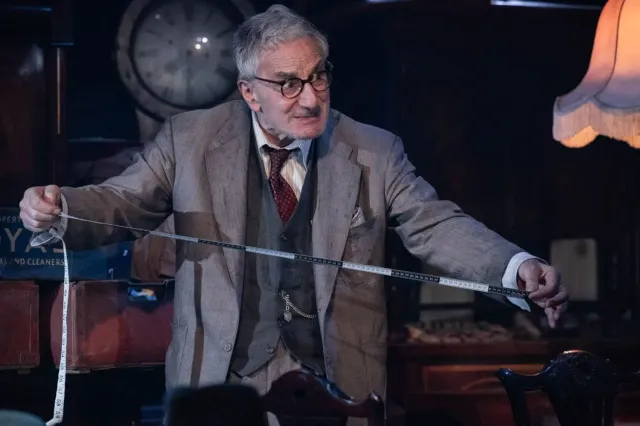
I hope Elliot Cowan is a forgiving man. I mean, we know he is a consistently superb actor, but he must have broad shoulders to cope with carrying this overlong but ultimately riveting revival of Arthur Miller’s 1967 family drama on his back, only to have Henry Goodman walk off with it. Still, I suppose that if you’re gonna have your thunder stolen, it may as well be by a double Olivier Award winner and one of the greatest living theatre actors of his generation.
I’m slightly exaggerating of course (though not about Goodman’s brilliance), but this is the first time I’ve watched The Price and realised what an epic role embittered good-guy NYC cop Victor Franz actually is. Cowan gives a towering performance in his own right, his face clenched, body language defeated, his voice a muted growl, and his eyes kind but desperately sad. He inhabits this living embodiment of the adage that good guys come last to such an extent that his emotional breakdown, when it comes, is really tough to watch, yet you can’t look away.
Victor is selling an attic full of furniture and heirlooms inherited from the father for whom he sacrificed his youthful ambitions when care was apparently needed. His estranged brother Walter, a high flying Manhattan doctor, has had no part in the process while Victor’s increasingly frustrated wife Esther (a brittle, volatile Faye Castelow) seems to be focussing on the money. It’s the late 1960s and the Franz family, like so many Americans of the time, still bears the scars and financial insecurities of the Great Depression decades earlier. Enter Gregory Solomon, a wily, loquacious, octogenarian antique dealer, brought in by Victor to give them a price for the family furniture. The “price” of the play’s title also to the toll responsibilities have taken on these people’s lives, on the brothers’ relationship, and the waste of Victor’s intellect (he had been set for academia before duty and scarcity of funds got in the way).
Jonathan Munby’s production is rich in detail, from Jon Bausor’s exquisitely cluttered set, dominated by oppressively dark furnishings, antique lamps and a haggled-over full-sized harp, atmospherically lit by Anna Watson, to the note-perfect acting. Castelow’s physicality, like a mechanical doll starting to wind down, is a fascinating distillation of the discontent growing inside Esther; the way Cowan’s Victor navigates around his late father’s empty armchair as though the old man is still present (which, in a way, he is) is infinitely moving. In another impressive performance, John Hopkins invests Walter with an oil-smooth self confidence and urbane ruthlessness but makes fully credible the notes of unhappiness and instability roiling just under the surface. As the revelations and recriminations fly in the much stronger second half (the first act is a bit of a plodder until Goodman’s Solomon appears), Cowan and Hopkins convince so thoroughly as brothers, however dysfunctional their relationship, that they even start to look alike.
Gregory Solomon is one of Miller’s most irresistible and flamboyant creations. Who is this stagey old chancer, who claims to have been an acrobat and a member of the British navy, and prone to producing a snack or a fainting fit from apparently nowhere when confronted about anything? I’ve seen David Suchet and the late Warren Mitchell tackle this gift of a role in earlier revivals and both were terrific, but neither inhabited him with the same aplomb as Goodman achieves here. It’s a stupendous, magnetic performance, one foot in the schtick of Jewish vaudeville turns and the other in the hardbitten realities of a man who has had to fight for everything he has. This is a masterclass, but it says much for the quality of the other three actors, that you don’t miss him when he’s offstage for extended sections of the second half.
Nobody strips bare carefully constructed characters and the downside of the American Dream like Arthur Miller, and if this isn’t one of his absolute best, it’s still a damn satisfying evening in the theatre, especially in as fine a production as this one. Highly recommended.






source on Google
Related Articles
See all

Latest Reviews
See all





Latest Videos
Christine Baranski and Richard E Grant on a blissful friendship, Anglophilia and onstage kissing – Hay Fever opens in the West End
The Noël Coward classic is back!