
‘That is a ridiculous idea for a musical’: Kiss of the Spider Woman is back on UK stages
We spoke to stars Anna-Jane Casey, Fabian Soto Pacheco, and George Blagden
 |
Bristol | Leicester | Southampton
|
|
Bristol | Leicester | Southampton
|
27 April 2026
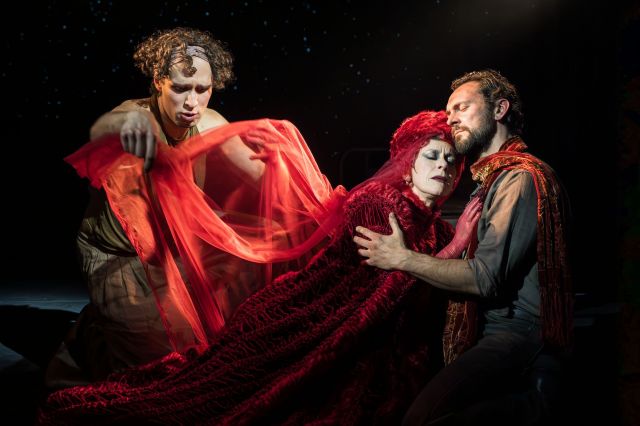
“They are literally two of the best songwriters of the 20th and 21st century.”
If you were to hear this in conversation, who would you think of? Theatre fans will undoubtedly have their minds pulled towards certain pairings: Stephen Sondheim and James Lapine, Andrew Lloyd Webber and Tim Rice, Benj Pasek and Justin Paul. Anna-Jane Casey, Fabian Soto Pacheco, and George Blagden are unanimously celebrating John Kander and Fred Ebb.
“Who would have thought that a musical about women in a prison murdering people: Chicago, or the rise of Hitler: Cabaret, and then two men in a horrific prison in 1970s Argentina, would be phenomenal musicals?” Casey laughs. She’s talking, of course, about Kiss of the Spider Woman, a rarely-staged musical being revived in the UK after more than 30 years.
“The idea of anyone in a New York lab now being like, I’ve got a good idea for a musical and coming up with any of those three. Everyone would be like, that’s ridiculous,” Blagden adds. But it has earned its cult status and respect among theatre aficionados.
Molina and Valentin meet in a shared cell, and their relationship grows as Molina shares his love of movies and a glamorous star named Aurora, who once played a Spider Woman with a deadly kiss. Pacheco says that, among things like policing, power, and politics, the drama follows “two men in prison, diametrically opposite in their feelings and their thoughts,” learning to inhabit the same space. With this fresh mindset, I revisited the show, focusing not on Molina’s escapism and imagination from a gritty and grimy life in prison, but on the dynamics and shifts between the boys. As Molina flicks through Aurora’s back catalogue, he transports to faraway lands and vibrant technicolour.
I learned from the cast that there is one audience member who will have seen the show eight times while in Leicester, and in the Studio Space, they can recognise faces of people who return. With so much at play, on first watch the show can be enjoyed for its fantastic dance routines, choreographed by Joanna Goodwin, the costuming and staging, before honing in on the love story, or the police brutality, political war, or even the question of identity.
“There’s more that you learn every single time you watch it,” Blagden says, “I’m doing new things every single show every night. The material allows you to do that as performers. It’s very special.”
Pacheco adds: “That’s the beauty of theatre. Some things will be slightly different every night, and things that will move people differently.”
Casey comments: “Let’s face it, we all need to feel a little more. If we felt more and weren’t so aggressive, the world wouldn’t be in such a mess.”
Pacheo has been singing “She’s A Woman” for years as his go-to musical theatre number: “It’s a pleasure getting to know it intimately,” he says, as this staging has new arrangements by Sarah Travis. “This is my biggest dream role ever. It’s incredible to be here because I have been obsessed with this score and this story for years.”
Having read Manuel Puig’s novel (“it’s very different to the musical”), he couldn’t wait to get his hands on this script ahead of audiences. “I was so excited reading it on the train to London because I had never read that specifically. I was in love with it.”
The show has had the same effect on the other lead cast members, who were previously not all that familiar with the material, as Casey says: “In rehearsals, George and I had to put our fingers in our ears because, as parents, we can’t listen to ‘You Could Never Shame Me’ as it’s so heartbreaking. You have to look after your children, whatever they offer you.”
Another tearjerker is “Dear One”. Blagden explains: “Whatever walk of life you’re from, that song just moves you. You’re forced into an emotional state,” before confessing that he was a skeptic at first, but after watching a cover run that afternoon, he found himself sobbing. “When you’re watching it, it’s that perfect accident where you’ve got incredible material, direction and performers. Nobody’s phoning it in.”
Casey agrees, saying that throughout the show, there’s no chance for anybody to be distracted: “When you’re on, you’re on.” There is no point in this relentless staging where the three of them get to return to the dressing room.
The whole team and the cast have done a lot with the small pieces they’re working with. Realistically, there’s one set piece that moves in and out, some impressive video by Andrzej Goulding, stunning costumes by Gabriella Slade, a live band and ten cast members. That’s almost half the size of the original cast, which was led by the inimitable Chita Rivera on Broadway and in the West End.
“I was a 21-year-old having a nice time in the 90s, I wish I’d have gotten my skinny ass in there to have seen our lady Chita,” Casey confesses.
There’s a claustrophobic feeling in its intimacy, the idea that you are a fly on the wall in this cell, an omnipresence like Aurora herself seeping into Molina’s mind.
“Paul [Foster, director] is obsessed with ensemble,” Blagden, who has done three shows with him before, says, “He tells everyone’s story. I’ve seen musicals in big theatres where by nature, the ensemble is designed to be invisible. But this is the complete opposite. I think the audience must care about every single person who comes out on stage.”
And it’s impossible not to be caught in the web of Molina, Valentin and Aurora after seeing this revival.




source on Google
Related Articles
See all
Latest Reviews
See all


Latest Videos
New musical Nero releases first listen with Andrew Barth Feldman
It is from the writers of Spring Awakening