
The Hunger Games: another new generation of stars enter the on-stage arena
Neil McDermott’s take on Haymitch offers new revelations from Sunrise on the Reaping
 |
London
|
23 October 2026

A new set of actors is set to join the great lineage of stars in The Hunger Games franchise.
Your mind may instantly jump to Joseph Zada, Mckenna Grace, Whitney Peak, and co., who are currently doing the rounds of press ahead of the release of the film adaptation of Sunrise on the Reaping. The upcoming prequel centres on a young Haymitch Abernathy and the events that led him to become the drunken, disillusioned man we meet in The Hunger Games: District 12’s troubled victor tasked with helping keep the latest tributes, Katniss and Peeta, alive.
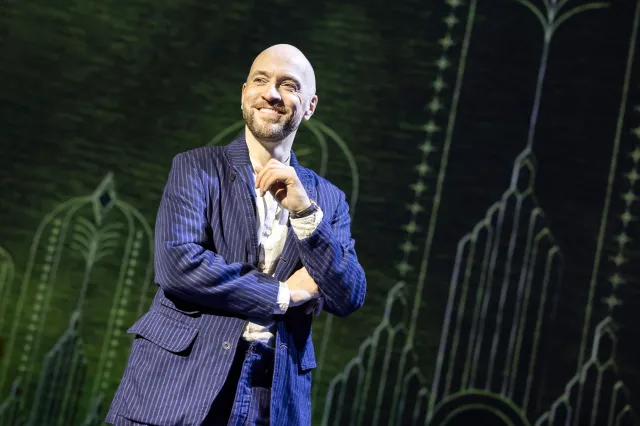
Elsewhere, in London’s financial district, a new set of performers are warming up for The Hunger Games on Stage. That includes Neil McDermott, who, from this evening, will take on the role of Haymitch at Troubadour Canary Wharf Theatre.
“[Haymitch] has been through so much, and he still turns up, and tries to do his best in his own way,” McDermott says. “He’s so flawed as a human. But in his heart, he just desperately wants to keep these two young children alive and to get them back to their homes in a way that he wasn’t able to do for himself.”
It is an interesting time to join the company as the production enters its second year and the new film reignites interest in the franchise and offers audiences a deeper understanding of the beloved residents of Panem. McDermott follows in the footsteps of Woody Harrelson on screen and Joshua Lacey on stage, and will be building on Zada’s upcoming performance.
“My character has got the limelight at a minute!” McDermott laughs. More seriously, he adds: “It has been so useful to have a whole novel basically telling you why your character behaves the way he does.” He will have played Haymitch for a few weeks before seeing Sunrise in cinemas and is curious to know whether it will influence his performance afterwards.
In particular, he is interested in the relationship between Haymitch and the “girl on fire”, Katniss Everdeen. Elizabeth Anderson is taking on that lead role, and as the pair have read Suzanne Collins’s prequel novel, they have had a lot of fun in rehearsals building on what they have learned.
“Neil and I have created moments in the show where he is looking at me a bit differently…” Anderson says excitedly. Fans will understand why, but we will leave the spoilers here. “There is so much interesting stuff to play around with, and I love exploring Haymitch’s reaction to Katniss. Suzanne has written both of their stories incredibly well. She is a genius. As an actor, it is gorgeous to play.”

Thankfully, the oppression central to the story doesn’t extend to the creative process. McDermott continues: “We’re so lucky, the creative team here have given us license to make quite a lot of changes. The design of the show has changed quite a lot, and so has the text. Our interpretation of the character has been encouraged.”
Anderson is equally enthusiastic about a large briefing book provided to each cast member by the dramaturg. It charts the expanding world of The Hunger Games, and cast members past and present are encouraged to add their experiences and thoughts and theories. As a Hunger Games fanatic, it’s something this interviewer would very much like to take a look at!
Audiences may recognise McDermott from playing Ryan Malloy in EastEnders, or in various hit musicals including comedies Shrek the Musical and most recently Matilda The Musical, where he played the iconic, almost Caesar Flickerman-esque, Mr Wormwood. Haymitch surely offers a new challenge to the actor, and he is being guided by his Hunger Games-loving teen children.
“This is a very dramatic piece, of course… But I definitely wanted to bring a bit of the humour out of the character, if I could,” he explains. “I also wanted to make sure he was dangerous enough to be believable that he’d won his own games.” He points specifically to the scene on the train when Haymitch meets Katniss and Peeta for the first time: “It is quite a raw, wild scene.”
The stage adaptation comes from multi-award-winning writer Conor McPherson and has its own “theatrical language,” differentiating it from the novels and films. “[McPherson] is really, really good at writing about survival and the exhaustion and fatigue that all of these people are going through, just hoping for change,” McDermott enthuses. “And you get this bright spark of a character coupled with a formidable friend or foe, in Peeta, that can help make something amazing happen.”
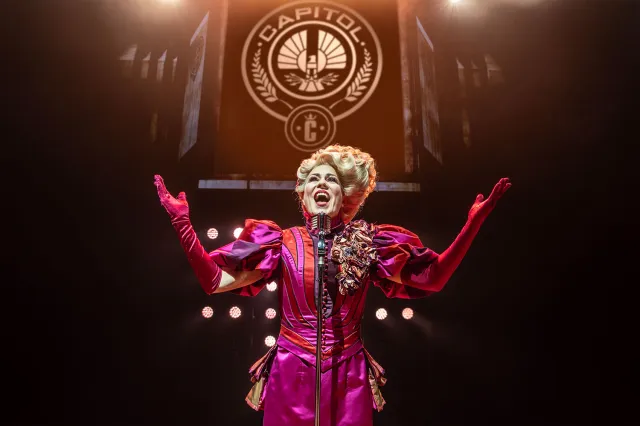
Walking through Canary Wharf to reach the theatre can feel a little like entering the Capitol of Panem. Inside, the custom-built playing space is arranged like an arena with the audience spectating from all around. It is an apt backdrop.
For McDermott, being a part of the legacy of The Hunger Games brings a responsibility that extends beyond the expectations of the fan base. Instead, it is the story’s themes of power, oppression and resistance that resonate outside the theatre.
“It’s certainly a story about hope, and Katniss represents that; meanwhile, for Haymitch, it is what he has been devoid of for the last 25 years or more. When he meets this person who can be a symbol of change in the society that they live in, it’s a really important thing. There is a lot for people to take away from that.”




source on Google
Featured In This Story

Related Articles
See all

Latest Reviews
See all





Latest Videos

Disney’s High School Musical opens in London and the stars take a trip down memory lane
Bopping to the top at Troubadour Wembley Park Theatre!