
More than ‘just’ a regional theatre – Tom Wright and Shawab Iqbal on the next chapter of Leeds Playhouse
We met the pair at the launch of the new season
 |
Leeds
|
|
Leeds
|
1 May 2026
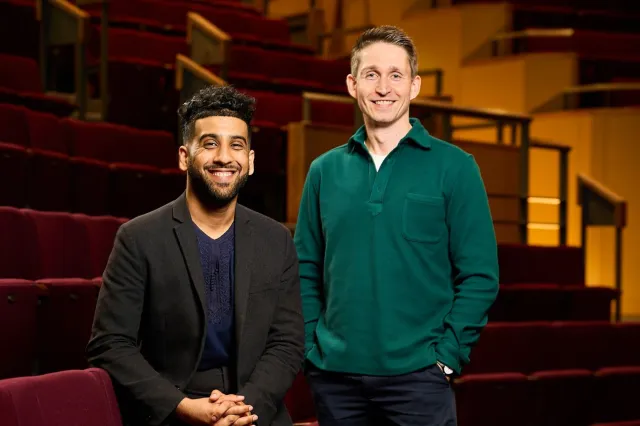
It isn’t surprising that Leeds Playhouse earned the title of the UK’s friendliest theatre. This is a building that is both showered with and showers with compassion and care.
Under Tom Wright’s artistic direction and with Shawab Iqbal’s leadership, Leeds Playhouse is entering a new phase. They’ve even unveiled a new logo, focusing on the bold tiles that adorn the front of the city centre building and have programmed four new works: two original stories and two new adaptations. Also in the mix are four revivals of seminal texts, including pieces by August Wilson and Shakespeare, and epic musicals Little Shop of Horrors and The Grinch.
“There’s a notion of being a regional theatre and we’re trying not to use that language internally anymore,” Iqbal said, “The kinds of communities, artists and audiences that we’re representing in Leeds absolutely deserve just as brilliant and epic works that might be in London. And sometimes it’s better than work in London.”
They continued: “We need to change the binary rhetoric in the industry. Leeds is becoming more diverse, younger, more dynamic, and more innovative. It always has been. To programme this work in that context is really exciting in the context of 2026 and everything that’s happening in the world, and to see how those particular iconic titles will land in the time that we’re in.”
Many of the shows programmed are co-productions with theatres across the UK, including Manchester, Kingston, Coventry (which happens to be Wright’s hometown, and the Belgrade is the co-producer of his play, Sirens), and more.
“There’s such variety outside of London. There can’t be a very simplistic hierarchical approach to it. London cross-fertilises the rest of the country and vice versa. It’s something we’re going to push.”
Several productions that started life in Leeds have gone on to be seen by audiences not only across the country but across the world. A recent example is the stage adaptation of Paranormal Activity. “It’s an ecology, but when you’re not in London, you do need to shout ten times harder.” It’s part of the reason they’ve hosted such a fantastic launch event, complete with a local piano prodigy and access to tour the entire impressive building.
There are economic politics at play with programming: “The industry is in a tough economic climate. We need to get bums on seats.”

Big-scale revivals of fan favourites like Little Shop and family festivities with The Grinch are the most naturally eye-catching to audiences.
“If we’re going to do new writing in a time where it’s under threat, we have to balance that out with titles that are popular and that people want to see,” they explain. However, all four directors in the Quarry space will be working in there for the first time. “It’s about giving new directors, the next generation, access to those texts. And allowing them to tell it through their lens. They’re all doing really interesting progressive takes.”
We’ve revealed further details about a casting decision with Little Shop, and we are told that the casting teams are ensuring a commitment to cast locally as well as in London.
“As much as possible, we want to use this building to keep talent here, to retain talent here, if they’d like to, and if they wanted to go somewhere else, that’s absolutely fine. We do have a responsibility in what we’re doing.” It comes at a time when GCSE drama is being decimated, and working-class representation is regressing in the industry, they observe. “Using diversity in its broadest sense, it is regressing because there’s a binary of there’s less money, so you can take less risks.”
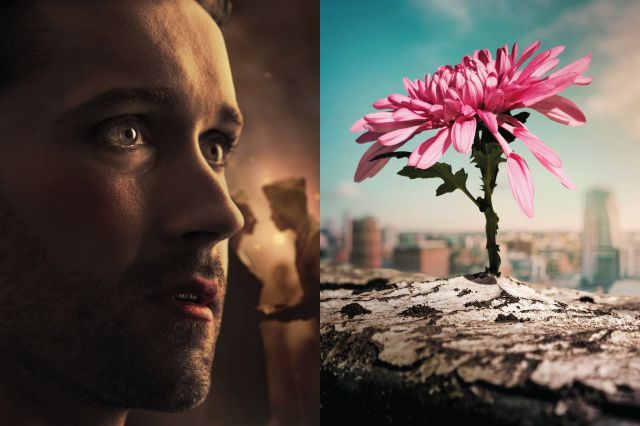
Nobody dares say that these two are all talk. In a vow of commitment to being the first Theatre of Sanctuary, offering safety and support for refugees and asylum seekers, their new revival of The Secret Garden tells Frances Hodgson Burnett’s classic through the eyes of refugees who find and nourish land on a tower block rooftop in the city. It is reimagined by Linda Marshall Griffiths.
Additionally, as the first theatre to ever offer relaxed performances, and a history of what they call “embedded creative access,” the production is an example of the type of work they make and who it’s for. Directed by Amy Leach, it moves between English, BSL, SSE, and Arabic, with integrated subtitles, “so that accessibility and storytelling are completely intertwined from the outset.”
It’s crucial for the pair that everyone can see themselves on these stages. “We’re not going to stop until this theatre reflects the city on our doors, and looks as diverse and lively as the Kirkgate Market across the road,” they declare.
Suhaiymah Manzoor-Khan introduced her play, Peanut Butter and Blueberries, by explaining that she was driven to write about something she never sees: a Muslim love story where both people enjoy being Muslim, and crucially, one with a happy ending. Also on the programme is a queer love story, Sirens, and a revival of Wilson’s Fences, directed by Daniel Bailey, which examines “racial inequality and how we are still trying to figure it out as a nation here in the UK,” he says. Frankenstein will evaluate today’s technologies and impacts, and Romeo and Juliet is described as “Shakespeare meets Netflix’s Adolescence,” as an interrogation of youth and consequence.
“When you’re a producing theatre, you have to be even more unapologetic about getting those words on stage. Otherwise, you do sleepwalk into decline and regression.” Iqbal says, acknowledging that a lot of these messages come not only from retellings but new writing, “I think we’ve got a duty and a responsibility to make sure new writing doesn’t just disappear. So we are kind of being quite bullish about that.”
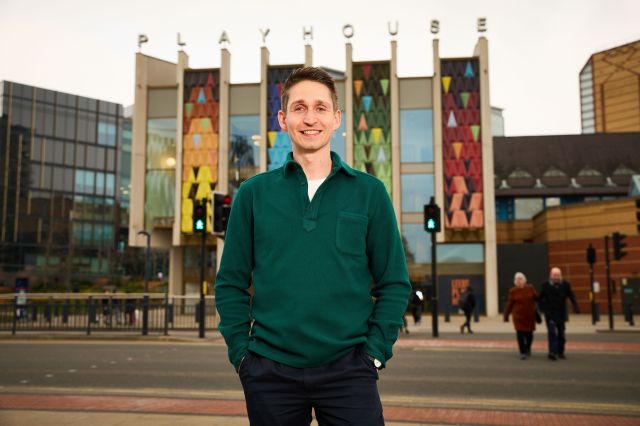
Wright himself will also direct his own world premiere play, Sirens. The story follows East End pub owner Charles and his friend, local copper Willie, who host illicit drag shows together under the bar, which doubles as a bomb shelter. “As a director, my aim is absolutely to nurture a multitude of voices. But when I’m lucky enough to get to be the playwright, it’s all about the LGBTQ stories.”
It was written when Wright, along with the rest of the world, faced being trapped in our houses during the pandemic, facing existential questions – just like these characters hoping for their own survival. Wright says that he enjoys particularly “writing from a very specific lens that is sometimes othered and not seen mainstream, so it feels really important to make this play here and invite audiences to get to know my work as a writer.”
It’s then more special that it is being produced in association with the Belgrade Theatre, which is where it all began for him in his hometown of Coventry. That theatre to a young Wright was not a regional theatre; instead, and like Leeds Playhouse is now, it was so much more.




source on Google
Related Articles
See all

Latest Reviews
See all
Latest Videos
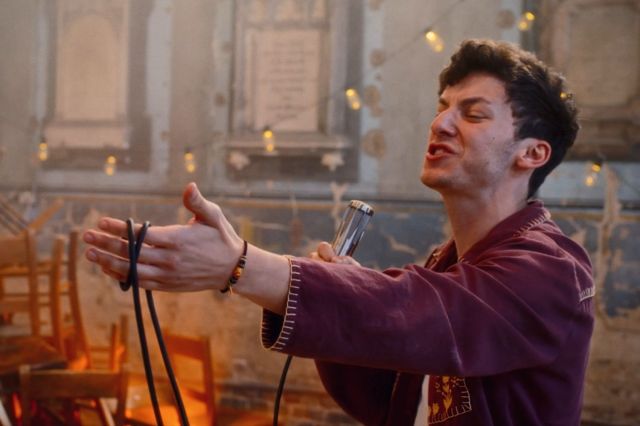
New musical Nero releases first listen with Andrew Barth Feldman
It is from the writers of Spring Awakening