
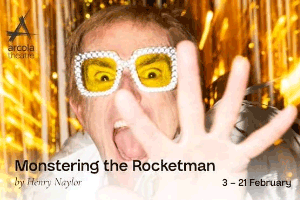
Monstering the Rocketman at the Arcola Theatre – review
Written and performed by Henry Naylor, the solo show runs until 21 February
 |
London
|
|
London
|
6 February 2026

Written and performed by former Spitting Image writer Henry Naylor and first performed at the Edinburgh Fringe in 2025, Monstering the Rocketman is a highly entertaining and sharply observed cautionary tale. While it can be tempting to romanticise old school journalism prior to social media, the tabloid press of the ‘80s just as much of a sewer and fake news is nothing new. The Rupert Murdoch-owned The Sun, like most tabloids, had no interest in informing its readers and was all about stirring the pot, triggering an emotional response in the consumer (that’s what gets people talking), and turning a profit.
In 1986, The Sun has surpassed The Mirror as Britain’s biggest selling paper. Rottweiller-like editor Kelvin Mackenzie is locked in a vendetta against Elton John (né Reginald Kenneth Dwight), then the biggest pop star in the world, accusing him of drug-fuelled orgies with rent boys in a mansion in Berkshire, despite him being in Australia having surgery on his vocal cords at the time. Fact checking is an anathema for the amoral Mackenzie – if it sounds true, that’s good enough. He remains unrepentant to this day.
The multi-roling Naylor gives a superb performance, switching between characters with flair and clarity. Outwardly an ‘Everyman’, his persona quickly switches to something seedier as he embodies various shady characters, and he’s pretty frightening as he portrays the boss-from-hell Mackenzie.
The Rocketman himself is presented as a shadowy figure with a handful of lines, usually in response to his mum’s interrogations. The primary narrator is 22-year-old cub reporter “Lynx,” so nicknamed due to his liberal application of a certain antiperspirant, who wants to follow in his late father’s footsteps as a foreign correspondent. However, The Sun has no interest in his pitches for stories about the destruction of the Brazilian rainforest and notions of journalistic integrity are irrelevant.

Director Darren Lee Cole maintains a brisk pace and the newsroom is evoked with minimal furnishings and projections of headlines and articles, contributing to a multimedia feel. The narrative compellingly captures the adrenaline-fuelled nature of muckraking that takes place in smoky Soho clubs, the hectic newsroom with its colourful language and larger-than-life characters, and at John’s characteristically OTT 40th birthday party. The young Lynx is ambitious for bylines and is drawn into the world of digging for dirt, especially when it involves daredevilish stunts, such stealing a rival hack’s car keys and then leaping into his colleague’s moving car, and stalking John to America by booking out Concorde.
It is perhaps questionable that Lynx would be oblivious to The Sun’s rampant homophobia in the age of AIDS until he’s encouraged to read Mackenzie’s editorials and has the revelation that the personal crusade against John is part of a wider agenda. It’s also the era of “Rear of the Year,” but Page 3 curiously is never mentioned.
The Sun is ultimately forced to pay damages when it overstretches itself following a bizarre story about John’s non-existent guard dogs, leading to a fudged right to reply on John’s part. If the story has a hero, it might be the Mirror veteran reporter who has a sharp word in John’s ear about how to use his platform for good – any editor now would surely clamouring to give him space.






Featured In This Story
Related Articles
See all
Latest Reviews
See all







Latest Videos
Ben Platt and Mark Sonnenblick discuss cabaret, clubs and bringing Midnight at the Never Get to London
The duo is bringing a new musical to the Menier Chocolate Factory