
Dance of Death at the Orange Tree Theatre – review
Richard Eyre’s adaptation of the August Strindberg classic runs until 7 March
 |
Richmond
|
|
Richmond
|
7 February 2026
In the list of most depressing plays ever written, August Strindberg’s Dance of Death has to be in the top ten. It might even make the top three. There is little grimmer than this portrait of two people locked in a loveless marriage, condemned to a hell of their own making.
Written in 1900, its nihilistic realism it was hugely influential. You can see traces of Who’s Afraid Of Virginia Woolf? in its portrait of a couple who have been slugging it out for so long that they have forgotten how to live without each other. But Edward Albee’s play has a leavening of humour, a sense of a world outside its dependent relationship.
Dance of Death is exactly what its title suggests: a waltz to the end. A whirr of hatred and unhappiness that will only stop when one of the combatants falls to the floor. The difficulty with this new production at the Orange Tree, adapted and directed by Richard Eyre, is that its darkness makes it almost unwatchable. Everyone is so loathsome it’s hard to care.
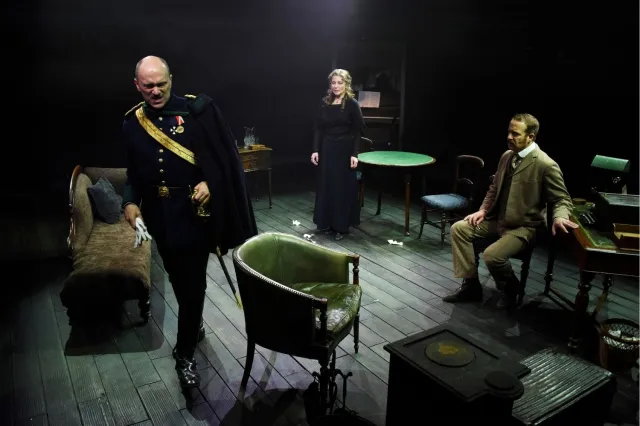
Eyre has cleverly updated the action to the Spanish flu epidemic of 1918-9, when Edgar, an artillery captain is living on a remote island with his wife Alice. They have been married for almost 25 years but are bitterly unhappy. Will Keen plays Edgar as a petty tyrant, stomping around in his uniform, barking out his words. His face is a mask broken by ticks and spasms of pain and anger.
As Alice, a former actress, Lisa Dillon is all birdlike head movements and biting dissatisfaction. At first, she appears a victim of her husband’s authoritarianism, but as the story progresses, she emerges as an equal combatant, constantly sniping, questioning and biting back at every simple statement. This is a woman who loathes her husband so much that she won’t even given him water when he thinks he is dying.
Ashley Martin-Davies’s set deliberately crowds the Orange Tree’s small space with furniture, making the setting intensely claustrophobic. Doors close off the entrances. Peter Mumford makes the light glint murkily from outside and from subdued lamps on desks and tables. John Leonard provides a soundtrack of seagulls and waves.
When Geoffrey Streatfeild’s Kurt, the third player in this painful menage, arrives he is masked in his role as quarantine officer for the island. But that cannot disguise the stench of unhappiness that permeates the relationship into which he is reluctantly drawn. “There’s so much hate in here you can hardly breathe.”
As the plot of one-upmanship and malice unfolds, drawing Kurt into its clutches, he too loses his bearings. Streatfeild is brilliant both at conveying his complete befuddlement faced with such epic spitefulness and his essential weakness, the way he too – for all his sense of morality – can be manipulated by desire.
It’s a grim vision of human relationships and it is to Eyre’s immense credit as a director and adaptor that it is so superbly conveyed. Watching Dance of Death has an immense sense of horrified oppression. It’s brilliant but bleakly so.






source on Google
Related Articles
See all

Latest Reviews
See all


Latest Videos

Disney’s High School Musical opens in London and the stars take a trip down memory lane
Bopping to the top at Troubadour Wembley Park Theatre!