
Fiddler on the Roof’s Matthew Woodyatt on the pioneering spirit of a musical revival
Woodyatt has taken Tevye across the nation
 |
Birmingham
|
|
Birmingham
|
9 December 2025
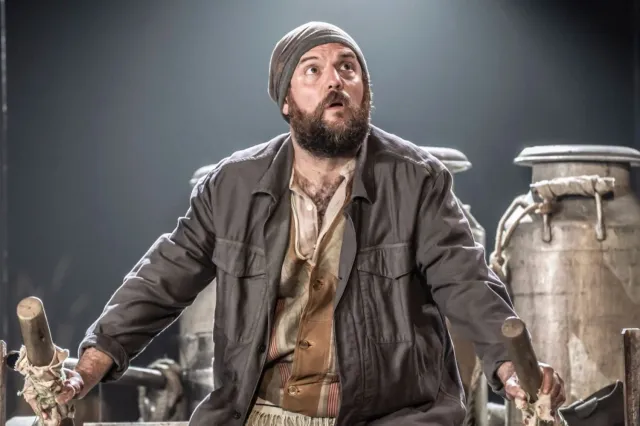
The acclaimed production of Fiddler on the Roof, which earned rave reviews during its runs at Regent’s Park Open Air Theatre and the Barbican and matched an Olivier Awards record, is currently on the final leg of its UK tour. Matthew Woodyatt, who plays the iconic Tevye, reflects on the show’s success as it settles into a four-week stint in Birmingham.
The production, helmed by director Jordan Fein, earned significant praise for its fundamental rethinking of a Golden Age classic. The revival, Woodyatt explains, is driven by an engine of urgency and immediacy that only intensified when the production moved indoors.
“I definitely think there’s an added intensity, especially in act two when the pressure starts to ratchet up,” he says. “Having a lid on it, literally having a roof and a redesigned space [for the proscenium arch tour] provides that pressure. Nothing about this ever felt like a compromise after the open-air run; it felt like a new avenue.”
Woodyatt describes Fein’s process with reverence, noting that the director “almost feels like an archaeologist with those little brushes, chiselling away.” The show, featuring a script that holds up remarkably well, was pioneering in its day for granting three young women the agency to challenge tradition. Fein’s brilliance, according to Woodyatt, lay in stripping away any layers of “costume drama” that might have accrued over 60 years of revivals. One key element has been allowing the company to use their own voices and accents.
“We were simply asked to say the lines and listen to each other,” Woodyatt recalls. “No falling into patterns of shtick or Borscht Belt comedy. Taking away that layer of performed accent means the resonance, the laser beam of the story goes into the audience’s hearts much more immediately.” This approach has allowed the core theme – the clash between community, tradition, and change – to land with startling power across the country.
“It’s about community,” Woodyatt stresses. “On a regional tour, in places with such strong identities, people see themselves in it. Everybody has been a part of one of those father-daughter conversations. Allowing it to sound like people you know, that is an absolute stroke of genius from Jordan.”
Woodyatt himself is in a unique position, having played a smaller role in a previous Fiddler production in Chichester eight years ago. Coming back as Tevye has allowed him to dig far deeper into the central character’s humanity. “I have absolutely changed,” he admits. “Having a teenage son now, as opposed to a four-year-old then, gives me so much more to bring. I can get under the skin of Tevye much more; I understand how vastly different my son’s experience of the world is.”
This raw honesty is critical for Tevye, who acts as both protagonist and narrator. “You have to bring your own humanity to the role, or the audience will sniff out a rat a mile off,” Woodyatt says. “You are literally laid bare, walking downstage at the beginning to talk to 2000 people. That relationship is a real gift.”
The conversation naturally shifts to the modern trend of radical musical revivals. From Daniel Fish’s revolutionary Oklahoma! to this Fiddler, directors are increasingly granted the licence to dismantle old visions. Woodyatt believes this is the truest way to respect the original creators – be they Rodgers and Hammerstein or Bock, Stein and Harnick.
“I think the great musicals – the ones that are really well written and well-structured – are equally as strong as a piece of Shakespeare and can take it,” he asserts. “We forget these Golden Age musicals were often radical, sometimes scandalous works at the time they were written.”
He argues that the “faux reverence” that can settle over classics is dangerous, turning them into “museum pieces rather than living, breathing theatre.” The director’s job, therefore, is to channel the original pioneer spirit.
“If we remember that these things were groundbreaking at the time, it allows us the freedom to not feel we’re walking in the same old footsteps,” he explains. “We have to acknowledge the real world outside the theatre. If there is anything in the text that resonates now, we have to understand that certain things will land in different ways. And that, I think, is respectful of the work.”
This approach is clearly paying off. Woodyatt notes that audiences speak about the show like they’ve seen a “groundbreaking drama, not a big Broadway musical.” The focus is on the human relationships and the book of the musical, rather than solely on the iconic tunes.
As the tour winds towards its conclusion, Woodyatt is reflective, praising the company’s collective spirit. “The heartbeat and the humanity of the show are still so strong. It feels like leading from the middle, not from the front.” While he looks forward to a well-earned rest, Woodyatt is adamant that a production this profound deserves more life. “It’s too good to let go of.”




Featured In This Story

Related Articles
See all



Latest Reviews
See all

Latest Videos
Rosamund Pike in Inter Alia – watch the West End opening night highlights
The National Theatre’s hit production follows in the footsteps of Prima Facie