
 |
London
|
|
London
|
24 February 2026
Bird Grove is a George Eliot origin story that doesn’t quite carry itself without the title of its famous heroine.
Though Eliot would become one of the greatest writers of the 19th century, we meet her long before she’s set pen to paper, when she is still only known as Mary Ann Evans (Elizabeth Dulau). While her father (Owen Teale) and brother (Jolyon Coy) plot to marry her off to a wealthy church-going man, Mary Ann swallows books whole and rubs shoulders with the “radicals” of the community, slowly coming closer to the articulate freethinker we know her to be.
Writer Alexi Kaye Campbell has pinpointed this time in Eliot’s history as a watershed moment, but while there is some meat to the story in the second half, for the most part, if one didn’t know it was about Eliot, it would be a very simple story of a girl who longs to do more than fulfil the role society has deemed appropriate for her. Not especially revelatory.
The first act in which Mary Ann is farcically matched with Horace Garfield (Jonnie Broadbent), a very dull, unattractive man who is currently suffering from diarrhoea, is a facsimile of Elizabeth Bennet and her dull cousin Mr Collins, with scatological jokes in place of Austen’s biting wit.
Thereafter we see Mary Ann realise that every book on her shelf is written by the same circle of privileged men, and perhaps someone should do something about that. This, Campbell suggests, is when the cogs start turning. But really, so what. If this is truly Eliot’s origin story, perhaps we’re best left without it. Let her literature speak for itself.
As I say, though, there’s an interesting tension in the second half, or rather in the last half hour: Mary Ann’s father now dead, she discovers that she has been left nearly nothing in his will, not even his books, despite her caring for him in his last months. This appears to be a punishment for turning away from the church. Mary Ann struggles to place this action with a man she loved most, and whom she understood to have forgiven her for rejecting Christianity. It’s complicated and necessarily unresolved, and here Campbell has finally hit on something worthy of a story.
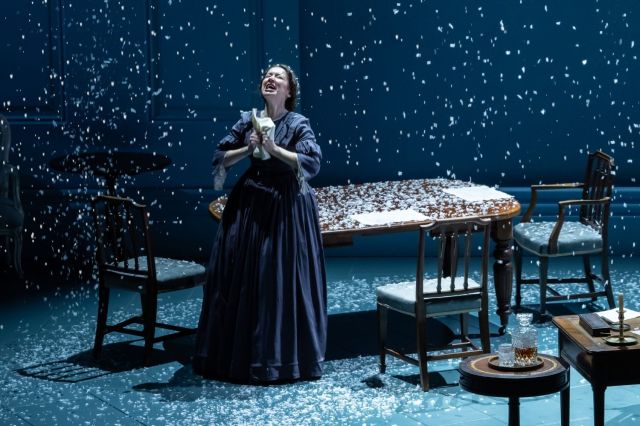
Sarah Beaton’s design appears, at first, a little drab though very clean. A high-ceilinged manor house, all in grey, bar the wooden furniture and the books on the shelf. But what makes it eventually spectacular is the floor to ceiling window at the back of the stage, which, at some point in the first half shows snow falling, beautifully lit by Matt Haskins. These days it could easily have been a digital screen, but Beaton has chosen something simpler and far more poetic. And when, at the end of the first act, the window blows open, and the blizzard comes whipping through, it’s all the more spectacular.
The performances are fine across the board, but the script is lacking in chances to shine. It’s a lot of pressure to place on oneself to write a play, not simply about a well-known historical figure, but about a well-known writer. While I wouldn’t suggest Campbell should have reached the literary heights of Eliot, I would request a much tighter plot to distract from the lack of Eliot’s words, and perhaps a refocus on what really makes an interesting story, besides simply saying, that fairly ordinary girl is going to be extraordinary some time after this story ends.






source on Google
Featured In This Story
Related Articles
See all
Latest Reviews
See all


Latest Videos
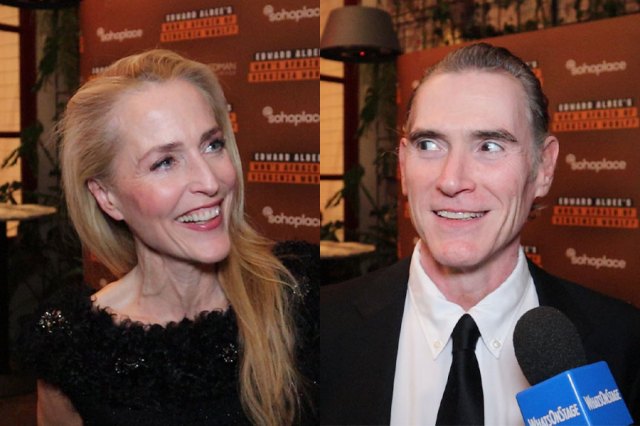
Gillian Anderson and Billy Crudup on staging a ‘boxing match’ in the round in Who’s Afraid of Virginia Woolf?
Marianne Elliott’s revival of the Edward Albee classic is running at London’s @sohoplace