
A Night to remember – Michael Grady-Hall, Daniel Monks and Gwyneth Keyworth bring Shakespeare’s comedy to the Barbican
The trio discuss taking Shakespeare’s classic to the Barbican!
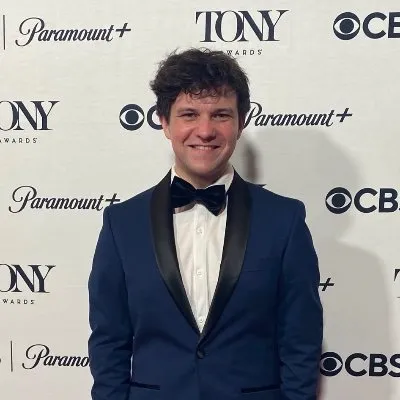 |
London
|
|
London
|
8 December 2025

The Royal Shakespeare Company’s joyous, heart-tugging production of Twelfth Night comes to London, transferring from Stratford-upon-Avon to the Barbican Centre for a limited run.
Directed by Prasanna Puwanarajah, the show has already picked up a UK Theatre Award and rapturous acclaim for its humane, complex take on Shakespeare’s comedy of misplaced desire and profound grief.
We caught up with three of its stars – Michael Grady-Hall (Feste), Daniel Monks (Orsino), and Gwyneth Keyworth (Viola) – to discuss the shift to a new venue, the role of the fool, and why this play’s blend of darkness and dazzling light feels so vital right now.
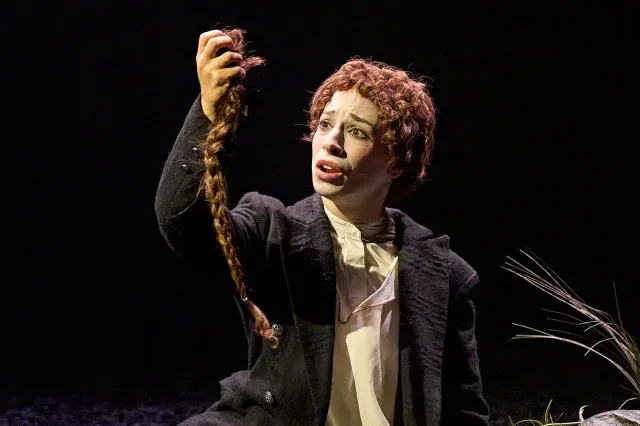
According to our review, Grady-Hall’s Feste (normally a more peripheral figure) is at the show’s vibrant, unpredictable core. “Feste is arguably one of Shakespeare’s most liberating creations,” Grady-Hall explains. “The fool is an outsider; they don’t fit neatly within Elizabethan society, and that gives you incredible licence. You can truly make the character your own, playing in ways other roles just don’t allow.”
The rehearsal process was built on beloved influences from comedic figures through history, Grady-Hall explains: “It became far more clown-like than we first imagined. We were stealing jokes, watching endless YouTube clips, and stitching together nods from Keaton, Chaplin, old music-hall routines, even borrowing piano tricks from Victor Borge. The result sounds like it’s the Bayeux Tapestry of clowning – woven from a thousand sources.”

But this Feste is no passive observer. Grady-Hall reveals a deeper interpretation agreed upon with Puwanarajah: “There’s a backstory: Feste’s been away and returns to Illyria. Why? I think he has a mission – a feeling that he needs to fix problems or aid the recovery of people stuck in grief. That idea gave me a way in, framing him as someone who isn’t just poking fun at Malvolio but actively shaping the world.”
The transfer from the intimate Stratford thrust stage to the vast Barbican is a challenge Grady-Hall is relishing. “The Barbican is huge, and it completely changes how you connect with the audience. Even our pre-show and interval games will need rethinking to fill that space. But having the company back together, with Daniel joining us, is a gift. He’s funny, heartbreaking, kind, playful, and dangerous – the perfect addition.”
Taking on Duke Orsino for his RSC debut is Daniel Monks, an actor known for some spellbinding work across stage and screen – from The Seagull, to Teenage Dick. Monks admits the role wasn’t one he’d considered, but Puwanarajah’s “humane” vision was too compelling to refuse.
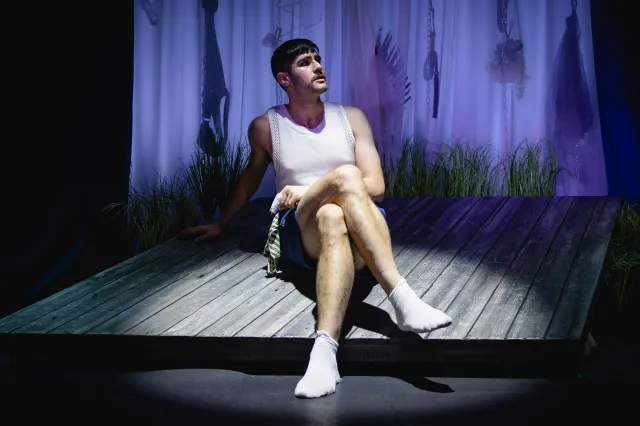
“Orsino was never on my radar,” Monks says. “But Prasanna’s approach, which is so deeply empathetic, excited me. When I reread the play, I realised this role is so different from what I usually play. He’s often remembered for that early pomposity – ‘If music be the food of love…’ – but he melts in a really specific, almost innocent way.” Monks stresses the need to play the Duke’s emotional life truthfully. “He’s complex, not just a standard love interest. He’s weird, led by raw emotion rather than intellect. Prasanna always says: ‘Play the truth – that’s where the comedy lives.’ And it’s true; the comedy comes from people’s honest, desperate situations.” For Monks, who says he maintains a commitment to one theatre production every year despite a wealth of new screen opportunities on the horizon, the stage remains his “home.” When asked about his favourite scenes, his answer is immediate: “Anything with Gwyneth! She’s incredible. And Michael’s Feste, honestly one of the most beautiful performances I’ve seen in Shakespeare.”
Speaking of Keyworth, the WhatsOnStage Award-winning star’s portrayal of Viola/Cesario is filled with both resilience and wrenching vulnerability. Keyworth suggests the production’s success lies in its embrace of contradiction. “Prasanna plays with the idea that while Twelfth Night is full of joy, it begins in grief,” she notes. “The comedy is derived from that truth – from people in desperate situations trying to find a way through. That’s why it moves me so much.”

Keyworth finds Viola’s experience with gender disguise strikingly relevant today. “Viola moves into a masculine shape, Cesario, and in doing so, she gains an agency she would never have been permitted as a woman in Illyria. The question is: how can she ever go back after that experience? Gender exists on a spectrum, and Shakespeare understood that complexity.”
Viola’s journey is a microcosm of the play’s larger theme: the necessity of processing pain. “You can’t avoid grief; you have to go through it. That’s what the play shows,” Keyworth concludes. “The darkness is what makes the light brighter, and Shakespeare knew that deeply—he wrote this after losing his son. You feel that ache beneath all the silliness and the music.”
As Monks summarises, “When times are cold and lonely, people come together to find light and silliness. That feels so resonant right now. Watching it feels like turning on fairy lights in the depths of winter. I laugh and I cry every time.”




Featured In This Story

Related Articles
See all
Latest Reviews
See all



Latest Videos
I’m Every Woman – The Chaka Khan Musical releases new trailer
Performances begin at Hackney Empire this week