
The Assembled Parties at Hampstead Theatre – review
The European premiere of Richard Greenberg’s play runs until 22 November
 |
London
|
|
London
|
24 October 2025

To my recollection, the last play I reviewed at Hampstead Theatre was Tom Stoppard’s The Invention of Love. I believe I said something like, If you don’t speak Latin, you won’t understand half of it, but the other half is still well worth a watch. I could say the same for The Assembled Parties, except instead of Latin, it’s Yiddish you best be well versed in, and the other half is…a mixed bag.
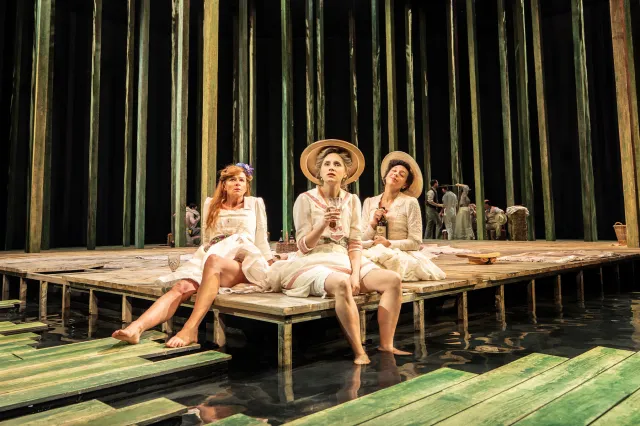
It’s 1980, and the family is gathering for Christmas – never mind that they’re Jewish – with one new addition, Scott’s friend from college, Jeff. Through Jeff’s young eyes, we see the romance of this quick-witted, politically vocal, somewhat glamourous New York family, with a former movie star, Julie (Jennifer Westfeldt) as its matriarch. But secrets abound as they often do, and drama thus ensues. When we meet again in the second act, 20 years have passed and half the cast has died, young Scott included. But the mysteries of the past are finally coming into play. Except not quite.
Writer Richard Greenberg has succeeded in creating a very funny, very clever dialogue-heavy family drama with numerous intricate subplots weaving through one another. But he seems to get stuck in the idea of a big messy story, and many of the plot points are confusingly glanced over or, it transpires, entirely irrelevant anyhow.
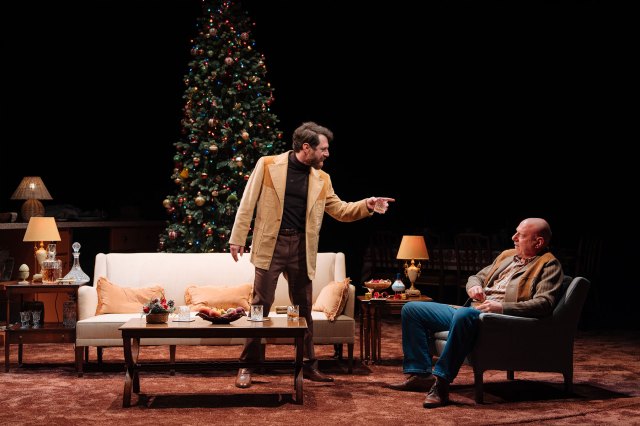
At the heart of the script, though, is a rich, heartening story of two women, both charismatic and endearing, but spiritually opposite: Westfeldt’s Julie, a sprite-like, poetic dreamer, with no pragmatic understanding of the world and yet a very necessary presence in it, and Tracy-Ann Oberman as Faye, Julie’s sister-in-law, a hard-nosed, no-nonsense old-school New Yorker who understands the compromises of life and has had to make a few herself. As Faye says, she should hate Julie. But instead, they spend their lives wishing the very best for each other. And when the opportunity arises, they do their very best as well.
These women feel whole in a way that’s quite rare in theatre, and their story is plenty to be getting on with, without the red-herring additions of Scott’s dying of AIDS, for example, or Jeff’s unrequited love in Illinois; Tim’s pregnant girlfriend, or Shelley’s mean boyfriend. Who are these last two people, you ask? Basically, it’s not important, is what I’m trying to say.
But while there’s plenty to be confused by, and a sense that you may have missed the point entirely, there’s also plenty to be entertained by. The dialogue is sharp, the plot, while sometimes bizarre, is well-paced, and the overall effect is utterly charming.






Featured In This Story

Related Articles
See all


Latest Reviews
See all




Latest Videos

Miss Saigon releases new trailer as West End run goes on sale
The heat is on… with a West End run next year!