
Pride musical review – bold brilliance on a bigger canvas at the Bridge Theatre
Following a successful run at the National Theatre, the stage adaptation of the beloved 2014 film has now transferred to the Bridge
 |
London
|
23 November 2026
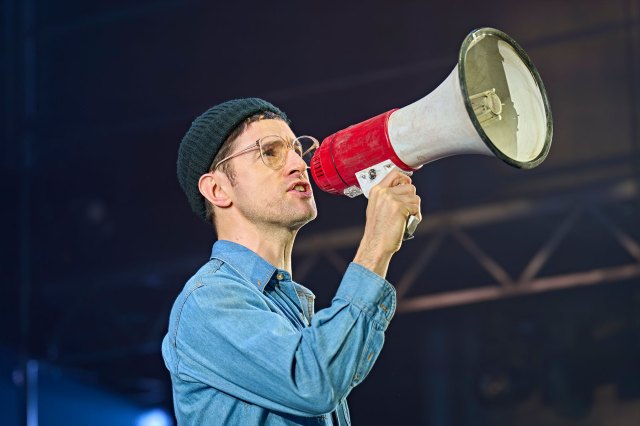
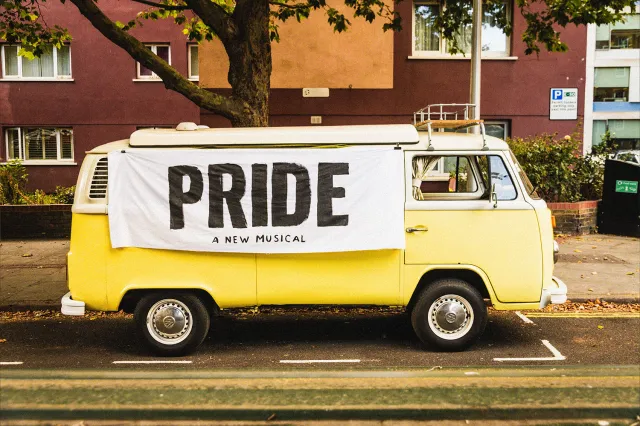
Following record-breaking, sold-out runs at Cardiff’s Sherman Theatre and the National Theatre’s Dorfman Theatre, Pride has marched along the South Bank to launch a new (and ideally much longer) chapter at the Bridge Theatre.
As the 900-seat riverside venue begins life under its new owners, Trafalgar Entertainment, there could scarcely be a more fitting transfer to inaugurate the space. Reuniting writer Stephen Beresford and director Matthew Warchus – the creative forces behind the beloved 2014 film – the stage adaptation turns a slice of 1980s British social history into a deft, incredibly moving offering of musical theatre.
Retelling the true story of a group of queer London activists who aligned themselves with the 1984-85 miners’ strike by fundraising for a picket line in the Welsh mining village of Onllwyn in the Dulais Valley, the show intentionally throws up the less glitzy and glamorous side of Pride (though there is plenty of both glitz and glamour on display) that many have come to associate with the term.
Calling themselves Lesbians and Gays Support the Miners (LGSM), the young campaigners navigate the thorny intersections of LGBTQ+ liberation and trade union solidarity. It arrives on the London stage just weeks after Sylvia similarly fused the suffragette movement with left-wing activism at the Royal Albert Hall, reiterating how political history remains a rich tap for contemporary British musicals (that’s before we even mention Billy Elliot or Standing at the Sky’s Edge).
Warchus directs with the same rapidity and dogged clarity that served him so well on Groundhog Day – a show Pride bears a distinct structural resemblance to, charting as it does a metropolitan outsider arriving in a tight-knit small town to transform both himself and the community he encounters – as well as Matilda the Musical.
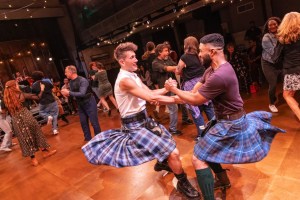
Across the Bridge’s broader canvas (when compared to the much more intimate Dorfman or Sherman Theatres), blocking never feels repetitive, and sightlines remain crisp throughout. Lizzi Gee’s choreography takes full advantage of the expanded stage footprint; watching it now, it is hard to imagine how the company’s kinetic energy could have packed quite the same punch at the National. This is a story with an epic sweep, particularly in its rousing closing moments, and it never feels under-equipped for the larger scale.
Even Bunny Christie’s notably sparse set (anchored by industrial scaffolding and shutters) thrives inside Warchus’s whirligig staging. Hugh Vanstone’s lighting design proves genuinely effervescent here, fizzing with warmth and sudden bursts of colour when the show taps into the more “fabulous” passages.
Beresford, riding high on the critical acclaim of Elsinore, leans boldly into the theatricality of the tale. Deploying a form unavailable on film, the musical’s book is framed by an ensemble of narrators who playfully recount the events with retrospective oomph, winking at the audience while keeping the historical stakes clear. While Pride is markedly more sentimental than Elsinore (especially once the second act hits its stride) it makes necessary amounts of time for the grit, prejudice and Thatcherite friction of the mid-1980s.
Musically, the score – written by Christopher Nightingale, Josh Cohen and DJ Walde, with orchestrations by Nightingale and music supervisor Tom Kelly, alongside additional orchestrations by Cohen and Walde – blends 1980s synth-pop, disco, protest anthems and soaring Welsh choral harmonies.
There are a few perfunctory tunes scattered across the two hours and 40 minutes, and you could probably wrangle a way to trim one or two without losing narrative momentum. Yet most numbers genuinely justify their presence, and with an ensemble this innately likeable, it is simply a joy to sit in their company.
Standouts include “Ordinary”, a quietly devastating solo delivered with crystalline sincerity by Sarah Pugh as local strike committee organiser Siân, yearning for a life beyond domestic expectation, and the exuberant act two showstopper “Paint the Revolution Pink”, which sees LGSM reclaim tabloid hostility with rock-fuelled defiance.
Stepping into the role of lead campaigner Mark Ashton for the transfer, Ryan Kopel attacks the part with infectious bravado, running riot across the Bridge stage whenever the revolution demands it. Watching him command the room with fiery speeches and boundless swagger, you would hardly guess he made his musical breakthrough as an anxious Evan Hansen.
Among the ensemble, Courtney Stapleton is thoroughly committed and a genuine blast of energy as Stephanie, the lone lesbian in LGSM. She brings sharp comic timing and fierce loyalty to the role, even if Beresford’s script leaves you wishing she had been afforded a little more personal backstory beyond serving as the group’s token “L”.
Elsewhere, Kirsty Malpass as no-nonsense strike stalwart Hefina, Gillian Elisa as Gwen, Caroline Sheen as hesitant villager Maureen, Matthew Durkan as Mark’s steadfast lieutenant Mike, and Darren Lawrence as gentle union leader Cliff all etch vivid portraits that ground the comedy in lived reality – Onllwyn does not feel caricatured. Quiet newbie Bromley, Dan Hand, also gets a barnstormer concluding number with “Face It, Mum”, while there’s a rollercoaster ride through Soho in the form of “Bloody Good Night Out”.
One actor, however, truly rules the evening. Samuel Barnett is utterly incredible as Jonathan, the flamboyant older activist staring down his own mortality following an HIV diagnosis and resolutely choosing the messy, glorious life available to him for as long as possible. He balances camp wit with flashes of vulnerability. His opening number at the top of act two, turning a confrontation with mortality into a defiant, sequinned cabaret, is exquisite.
It also provides a spellbinding launchpad into a much stronger, more deeply felt and far more rewarding second half, where the political camaraderie forged in act one is tested by grief, prejudice and industrial scheming.
If you’d indulge a broader point, it’s hard not to see the contemporary pertinence – the incontestable proof that being inside a community, aligning oneself with others, standing hand-in-hand can, fundamentally, change you for the better. Be that in a union, in an activist group, or sitting together in a theatre. In times of digital isolation, with the erosion of LGBTQ+ spaces, that timeliness has newfound urgency.
Pride isn’t without its rough edges; act one is saddled by the scene-setting when the historical friction could bite a little harder. It isn’t perfect, but it’s the perfect story for a musical, perfectly told.





source on Google
Featured In This Story
Guide

Related Articles
See all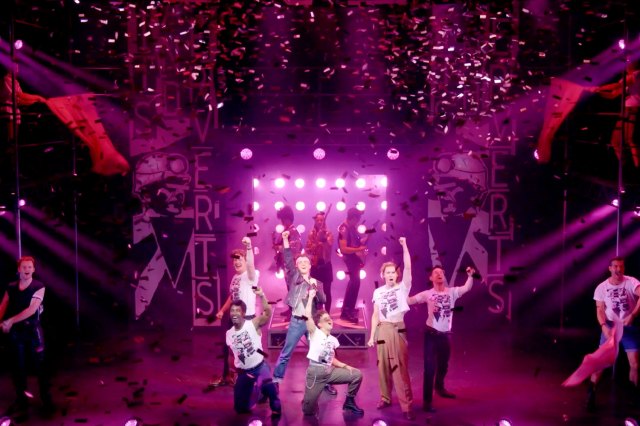
Latest Reviews
See all



Latest Videos

WhatsOnTour with Heathers the Musical star Gerardine Sacdalan
Calling all Corn Nuts!