
Oasis vs Blur comedy The Battle at Birmingham Rep – review
John Niven’s debut play, exploring the ’90s rivalry between the Britpop bands, will also be staged at Manchester Opera House next month
 |
Birmingham | Manchester
|
|
Birmingham | Manchester
|
18 February 2026
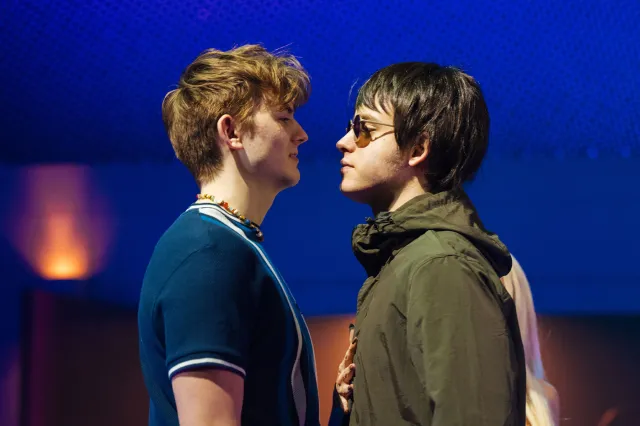
This new play by John Niven takes us back to the summer of 1995, when two of the UK’s biggest bands, Blur and Oasis, went head-to-head in a battle for number one by both releasing their singles on the same day.
While the media loved the hype of the war between “Roll With It” and “Country House”, the drama, which premieres at Birmingham Rep, takes us into the lives of the various band members and music executives as the tension rises.
Where Niven’s play excels is in showing how the stress frays everyone so that, at times, they all seem to regret the decision. There’s Noel Gallagher mouthing off to journalists in what he thinks are off-the-record comments full of hate for Blur members. There is Graham Coxon hiding in the bathroom, downing the booze. There’s Damon Albarn laughing at the newspapers while secretly dissecting every word. And there is Liam Gallagher swaggering and cursing like there’s no tomorrow.
As each day passes, we realise the battle isn’t just between the two bands – the conflict has spread to every relationship of the people involved.
Niven, who worked in the music industry at that time, is pinpoint sharp in his writing, accentuating each of the characters’ real-life traits and throwing round quickfire witty responses while ensuring the audience warms to each person and their oh-so-visible foibles. Every now and then, he also brings us back down to earth, reminding us how insignificant a Britpop battle was in a world that was seeing real war and mass murder in Bosnia.
Mathew Horne is suitably ruthless as Andy Ross, the executive who puts fame and profit above all else. He’s the one who springs the idea and then sticks to it through thick and thin, cynically observing that both bands win from the publicity it brings but underestimating the personal consequences.
George Usher has clearly been studying Liam Gallagher and has the Oasis singer firmly in his grasp, mirroring his body language as well as his colourful vocabulary. It’s an impressive professional debut for Usher, who adds plenty of humour to the role, evoking laughter as he throws out the expletives.
As the pressure heats up, Paddy Stafford’s slightly more measured Noel is also cracking, arguing with his then partner Meg Mathews and, of course, with his own brother.
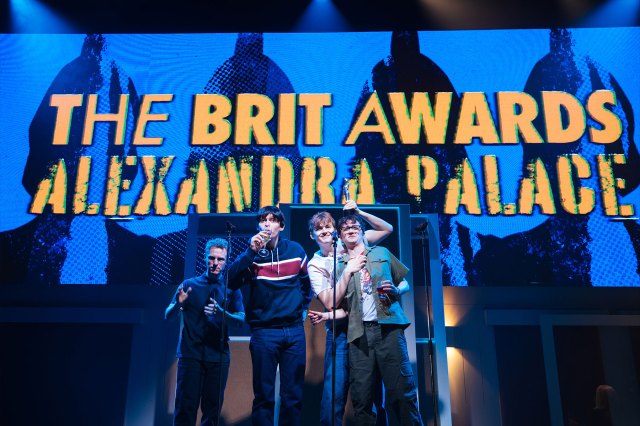
On the other side, Oscar Lloyd’s Damon Albarn gives us an intellectual who worries that the band’s middle-class origins could alienate the record-buying public. Meanwhile, Brandon Bendell’s Alex James throws himself into the party life and Will Taylor’s wonderfully unbalanced Graham Coxon becomes a nervous wreck.
Louisa Lytton as Meg Mathews and Harriet Cains as Damon’s then partner, Justine Frischmann, are the two voices of reason in all this absurdity, attempting to bring perspective to the battle and keep their relationships on track.
Directed by Matthew Dunster, the production is stylish and full of attitude. The action shoots back and forth like a ping-pong ball, with the various characters also vacillating between believing they will win and lose, so the entire show feels like a finely balanced competition.
Unsurprisingly, every element is firmly set in the mid-90s with a soundtrack featuring not just Oasis and Blur, but the likes of Del Amitri, Lloyd Cole, Pulp and the Chemical Brothers, and digital imagery of newsreels and celebrities of the period.
Video design by Tal Rosner and animations by John O’Connor play out on a screen above the main action with some comical caricature DJ cameos of the likes of Jo Whiley, Danny Baker and Chris Evans underlining how the media grabbed onto the story and heightened the stakes.
Fly Davis’ physical sets reflect the décor of the time with some humorous references to Blur’s notorious video for “Country House”. The costumes are also spot on, with Liam’s trademark anorak almost being a character in itself.
Produced by Birmingham Rep, Melting Pot and Gavin Kalin Productions, the tale takes on a weird alter-ego following the announcement of which band has reached number one. Reviewers have been asked not to reveal this ending, but it will split audiences between those who think it’s a smart and funny take on the whole story and those, like me, who feel it’s so off-the-wall that it detracts from the main focus.
The Battle is a hugely nostalgic tale which will be loved by those of us who remember that week and who sat by their radios with bated breath for the big announcement. Even though most, if not all, of the audience surely knows the outcome, we are still pulled into the pressure cooker of this war of words and music.






source on Google
Related Articles
See all

Latest Reviews
See all




Latest Videos

Michael Ball performs “Pure Imagination” from Charlie and the Chocolate Factory
What you’ll see will defy explanation!