
 |
London
|
|
London
|
3 February 2026
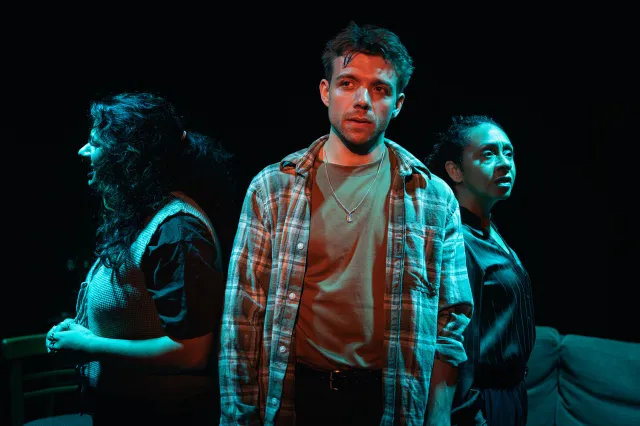
Farah Najib is a writer who can make words dance. Her play Dirty Dogs was longlisted for the 2022 Bruntwood Prize for playwrighting; this new piece continues to reveal her talent.
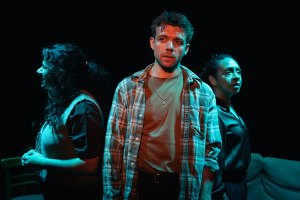
It is small-scale and simple but manages to suggest worlds, a piece of collaborative storytelling where three actors step in and out of multiple parts while all the time sustaining a narrative which begins when a terrible smell starts to seep through a small block of flats.
“What does death smell like?” one of them types into Google. From that onset, it is fairly clear where we are likely to end up as a flat where the resident does not answer the door or pick up her mail becomes the centre of her fellow flat-dwellers’ concern. But they did not know her other than to say hello, and they do not know what to do.
The insects of the title make an appearance early on, populating the block. “Pest control, they don’t do maggots,” says the unhelpful man at housing, when Linda, whose flat is infested, rings to complain.
But the play, beautifully directed by Jess Barton, isn’t really about uncaring bureaucrats, though they make occasional appearances. Or about neglectful local authorities, though they are held to account. Rather, it paints a delicate and careful picture of a community that doesn’t quite function, where people use WhatsApp groups but can’t communicate.

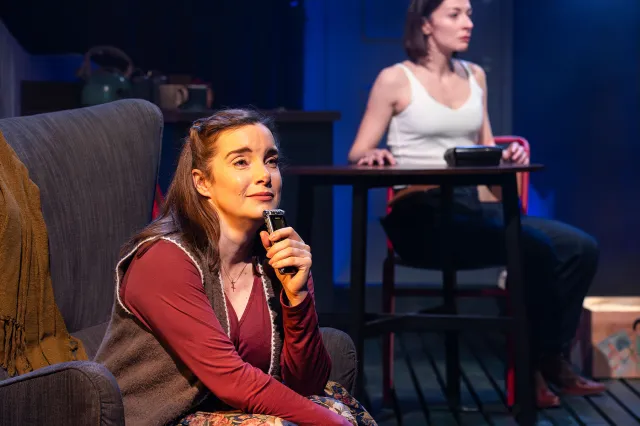
Thanks to three easy, compelling performances from Sam Baker Jones, Safiyya Ingar and Marcia Lecky, the characters we get to know – the boy studying for his GCSEs, his care-worker mother, the single mum, the father and daughter locked together in grief – all spring to colourful life. Their loneliness is expressed, but so is their liveliness, as they all skirt around the terrible silence in their midst.
There are moments of brilliant humour – Darren from housing with his business degree (“a 2.2”) and his attitude problem; the bored girl on the phone, twirling her hair. But there’s also real sadness and frustration as no one can quite bring themselves to investigate Flat 61 until it is far, far too late.
Every element of the production works hard to carry the tale, to let the words breathe, from Duramaney Kamara’s unobtrusive but effective score to Peter Small’s clever lighting that creates mood and event with a minimum of fuss, lights flashing among the dried flowers that hang over Caitlin Mawhinney’s simple set.
There’s nothing fussy here, just an engrossing story cleverly told. Najib works hard and fluently to ensure every word counts, making the small compromises of everyday life and its multiple imperfections into a piece of controlled and revealing theatre.






Featured In This Story

Related Articles
See all

Latest Reviews
See all




Latest Videos
Once on This Island West End concert – watch performances in rehearsals
Check out the cast in action ahead of Sunday’s big night