
Hadestown creator Anaïs Mitchell: ‘We are all out here recycling the same handful of notes and trying to find meaning in them’
The live recording of the hit musical recorded in the West End arrives in cinemas from 13 October
 |
Nationwide
|
|
Nationwide
|
1 October 2026

When Anaïs Mitchell began to write Hadestown in her early twenties, she identified most with the young lovers.
Those are Eurydice, a poor girl, and Orpheus, a boy working on a song and infatuated with her: “There’s this idealism and this youth…” she says.
Another twenty years on, Mitchell confesses: “I have begun to identify more and more with the older characters. Nowadays, I feel like my real spirit guy is Hermes. He’s the storyteller. He stands outside the story and tells it, but is also invested. That feels close to where I’m at.”
Additionally, Mitchell sees something maternal in Hermes. “I have two kids now, and there is that thing of you want to protect them, and also you got to push them out into the world and onto their adventure,” just as Hermes does with Orpheus.
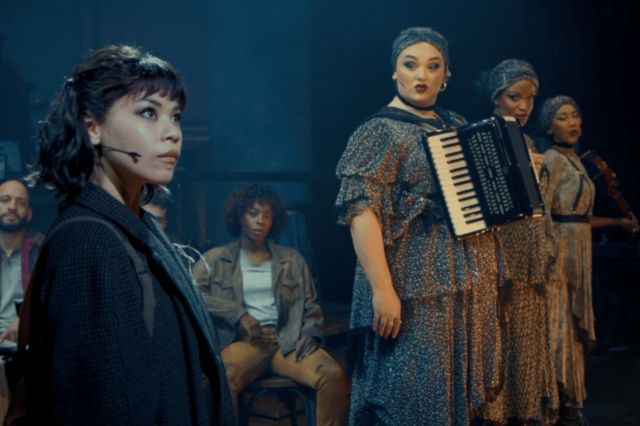
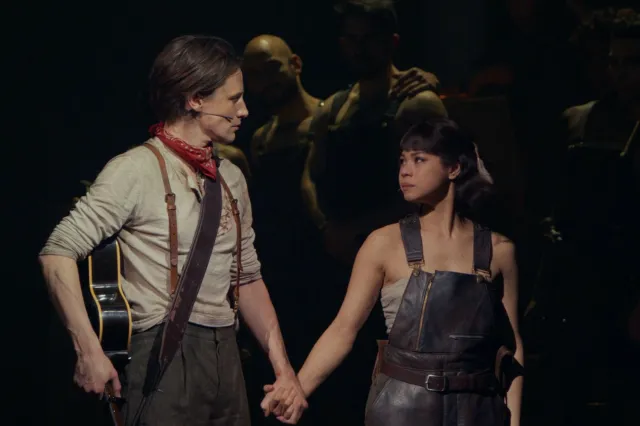
In 2025, original Broadway cast members reunited in London – where the show was first conceived at the National Theatre with a cast of UK Workers and Fates. Hadestown: The Musical was filmed across three performances, starring André de Shields as Hermes, WhatsOnStage Award nominee Eva Noblezada as Eurydice, Reeve Carney as Orpheus, Amber Gray as Persephone and Patrick Page as Hades.
“They were returning to the story, but with years of life under their belt,” Mitchell smiles. Since meeting on the show, Noblezada and Carney have married in real life, having gotten engaged in London. “They got their happy ending, after having had to play the tragic ending so many times.”
“It felt like they brought the innocence of the early years and also the kind of experience of the time that elapsed in between.”
When filming the show, a collaboration between director Brett Sullivan of Steam Motion and Sound and the show’s director Rachel Chavkin, Mitchell recalls: “The language that we often talked about was like being a concert documentary,” she adds, referencing Stop Making Sense by Talking Heads and The Last Waltz.
“There’s something about that style with the feeling of what the event is. It’s like it’s happening on a night. And all of us wanted to preserve that feeling around this live capture. So it didn’t get too perfect; it was understood as a snapshot of a thing that’s alive.”
Filmed live at the Lyric Theatre, “you get access to the actors in a way that I don’t think anyone ever got,” Mitchell says.
She talks happily about her favourite moments: “In ‘Epic III’, Patrick is trying so hard to maintain his composure, you see the cracks begin to form all over his face… There’s a moment where Reeve has just a single tear… Eva’s performance of ‘Flowers’ is just one continuous shot, and it’s stunning; it feels like a different level. And Amber and André are such masters, with such depth in the relationship of their characters.”
“There’s a really special intimacy… Plus, there is all this really gorgeous visual information in a world that Chavkin built with our designers, and now people can see what that is and what that was.”
One of the great things about Hadestown is that the original cast recording, which features these five stars, captures every word spoken on the stage. But the film has made the show even more accessible. Mitchell, a Grammy winner who comes from music primarily, is fascinated and overjoyed by how the music has become so prominent in some fans’ lives.
“I always have had this feeling about records in the way that they become a soundtrack of your life. They can be a time portal. And I love that music can sort of underscore our real lives and really be part of it.”
She shares that some fans have repurposed Hadestown numbers for weddings, funerals, graduations, and protests. “It really keeps it alive; [the story] is an ancient story, an old song. It is really beautiful to see young people embracing it because in a lot of ways, it is a story about young people and the way that they can see the world and the possibilities for it.”
The writing process started in Vermont, where she called me from. “I don’t know if you know Vermont, but it is not a very diverse state,” she says, explaining that she moved to New York City to continue writing, and it was there that she met director Chavkin: “Diversity is an extreme value for her.” The experience allowed her to expand the breadth of the music and storytelling.
Last week, a certain pop star released an encore to her hit album. I tentatively approach the subject without actually saying her name, Taylor Swift. Mitchell instantly knows who I am referring to.
“A bunch of people have sent me clips about it.”
Online, comparisons have been drawn between one number, “Patient Zero”, and Mitchell’s “Wait For Me” from Hadestown.
“I don’t really want to get into that stuff, but I will say that that pop star is very important in my household. I have two daughters and we’ve gotten so much joy out of her records and I also feel like she’s been a really powerful role model for them as a woman in the arts and living life on our own terms.
“It’s tricky, I mean, we are all out here recycling the same handful of notes and trying to find meaning in them. So, yeah, that’s all I’ll say.”
Later, Mitchell references her own musical journey, saying that while writing the music for Hadestown, she developed a love for 1930s protest music – a genre that many fans have gone on to explore. It is another example of how Hadestown has gone beyond the stage, with its songs becoming entry points into stories, sounds and politics.




source on Google
Related Articles
See all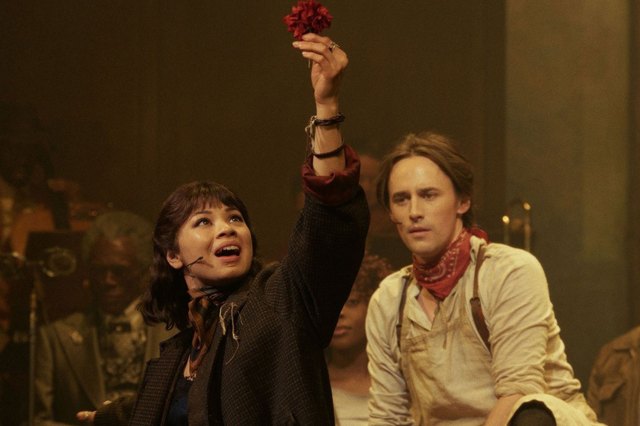
Latest Reviews
See all


Latest Videos
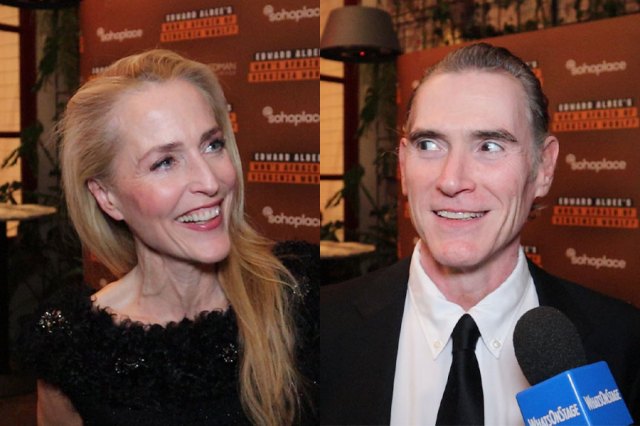
Gillian Anderson and Billy Crudup on staging a ‘boxing match’ in the round in Who’s Afraid of Virginia Woolf?
Marianne Elliott’s revival of the Edward Albee classic is running at London’s @sohoplace