
Between the River and the Sea at the Royal Court – review
Yousef Sweid’s one-man show continues in the Theatre Upstairs until 9 May
 |
London
|
|
London
|
21 April 2026
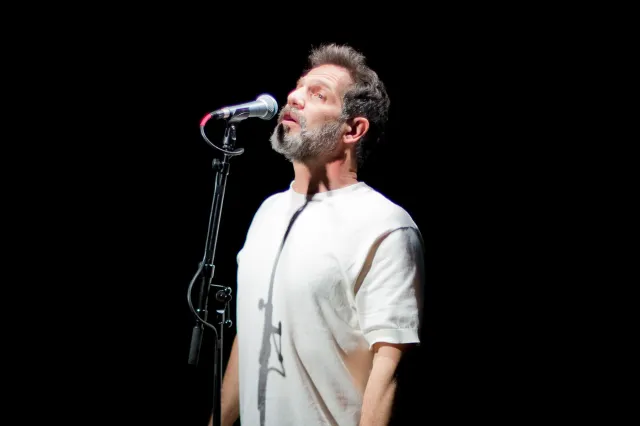
Yousef Sweid is absolutely clear of the difficulties. “I am sure you came with doubts. Maybe even with a bit of fear. What am I going to say? What is this play exactly about?… And why this provocative title?”
As if to calm our expectations, he follows the opening lines of this monologue, co-written with and directed by Isabella Sedlak, with a demonstration of a series of banners that have been raised in objection. “I don’t think we will need to use these… because I am not going to talk about October 7th or the war in Gaza. I am going to talk about…” There’s a long pause. “My divorce.”
This both is and isn’t true. It is the case that Between the River and the Sea is a deeply personal show that examines Sweid’s history as a Palestinian man living in Berlin, who grew up as an Arab with an Israeli passport, who has married two Jewish women, and who has two children. “We are a completely normal family. An Arab-Palestinian-Jewish-Israeli-Austrian-Romanian-Christian family,” he says at one point.
But he then uses this complicated background as a way of examining questions of identity, in the context of the fact that constant conflict in the Middle East, culminating in the murderous Hamas attacks on Israelis on October 7 and the punitive destruction of Gaza by Israel that followed, has led to each group seeing the other as monsters.
The show is a plea for understanding, but also a humane questioning of entrenched beliefs and the assumptions that underlie them. It is the only show in the Royal Court’s current Upstairs season that didn’t come from open submission: it has previously been seen at the Maxim Gorki Theatre in Berlin and then at the Edinburgh Festival where it won great acclaim.
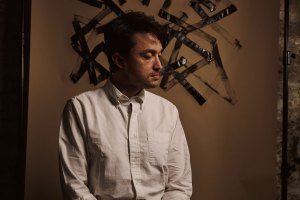
It’s written and directed with much sophistication and quite a lot of humour, unfolding like a cross between stand-up and a lecture demonstration. On a stage bare except for a chair covered in protest posters, and a microphone stand, Sweid is haunted by ghosts, whom he subtly embodies by slight changes of voice and gesture.
His father, in exile in Canada thanks to tax evasion charges (another of the multiple ironies of the show) is a booming voice from behind the microphone, asking his son to explain about the ‘Arabs of 48’ – the small group of Palestinians left in Israel. This explains why Sweid is sent to a Jewish pre-school – the nearest to his home in Haifa – which is where a bullying boy called Avi (whom he represents with a snivel and an aggressive stance) first makes the distinctions between Arab and Jew. It is also where he meets his best friend Daniel.
Later, when working with an Arab Israeli theatre group in Tel Aviv, he meets his other best friend Salma, a Palestinian. “We were all just actors playing together, like innocent children in a sandbox.”
This sense that identity and ideology is imposed on people and can be altered is devastatingly undermined in the final scenes, where the lights grow dark, and both Daniel and Salma challenge him to take sides. Humour freezes; battle lines are drawn within his own life.
Sweid is an extraordinarily engaging presence. He flirts with the audience, turning emotions this way and that, never losing the thread of the complexity of the ideas he wants to convey. His final plea for a utopian tolerance feels like a forlorn hope. But it also feels like a hope worth asserting, a demand for understanding on all sides.






source on Google
Related Articles
See all
Latest Reviews
See all





Latest Videos

Disney’s High School Musical opens in London and the stars take a trip down memory lane
Bopping to the top at Troubadour Wembley Park Theatre!