
Bengal Tiger at the Baghdad Zoo – Young Vic review
The European premiere of Rajiv Joseph’s Pulitzer and Tony-nominated play runs until 31 January
 |
London
|
|
London
|
10 December 2025
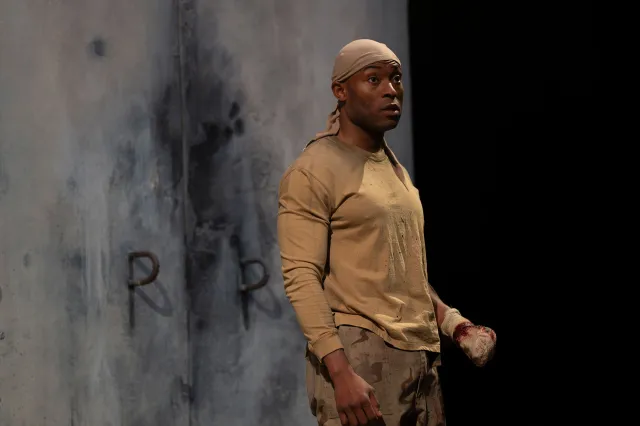
In September 2003, during the invasion of Iraq, a US bomb exploded in a Baghdad zoo, sending zookeepers fleeing and leaving a Bengal tiger starving in its pen. When a US soldier tried to feed it and got a mauled hand for his troubles, it was shot dead by another soldier. So far, so fever dream.
Rajiv Joseph’s Pulitzer-nominated play, here getting its European premiere under director Omar Elerian, takes this bizarre incident as inspiration and supercharges the surreality, with Tiger’s anthropomorphised ghost coming back to haunt the soldier who killed it, while questioning its own bestial instincts and the existence and motives of God, given all the horror.
It’s a neat lens through which to explore war’s chaos and cruelty – the three men at the play’s heart slide towards base impulses and mental collapse as they fumble for meaning in the absurd aftermath of Saddam Hussein’s overthrowing.
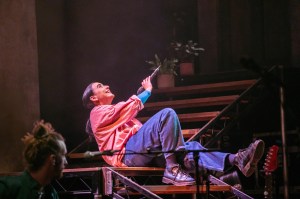
Patrick Gibson’s mercenary soldier Tom, who has looted a gold gun and toilet seat from Uday Hussein’s palace, becomes increasingly embittered and grasping once he has one less hand to grasp with. Arinzé Kene is particularly strong as Kev, Tom’s hyped-up young colleague who’s desperate to shoot something, even if it’s only a tiger, but finds his boyish bravado unravelling amidst the realities of war. Ammar Haj Ahmad’s Musa is an Iraqi gardener-turned-translator, who is haunted by the ghost of his murderous former employer Uday (played with maniacal glee by Sayyid Aki), and whose struggle to retain his humanity is one of the play’s most affecting throughlines.

Rajha Shakiry’s crumbling concrete set, with sandbags scattered and fires smouldering, sets us on unnervingly shaky ground, while Jackie Shemesh’s lighting and Elena Peña’s sound design combine to evocative effect. We’re bathed in soft sunlight as birdsong fills a garden, and blinded by torches during a messy night raid, as thundering helicopters drown out the increasingly frantic shouts of both soldiers and civilians.
Through it all stalks Tiger, played by Kathryn Hunter, who is covering for an unwell David Threlfall until further notice. Given that she stepped into rehearsals only a week ago, her performance is impressively steady – she gives the autocue installed overhead only the occasional glance. She is also winningly unsentimental in her delivery of Joseph’s unflinching script, deadpanning her way through the play’s many moments of gallows humour, and puncturing any poignancy with a shrug and stream of expletives.
In fact, the whole play rails against sentimentality, an admirable tactic that forces us to face war like grown-ups but which has its downsides. The first act, grounded in the men’s experiences, might not let us weep, but it does let us feel. However, after the interval, as Baghdad fills with ghosts, the action becomes more abstract, the focus turns more intensely to existential and religious musings, and the philosophical overtakes the emotional.
For a play that, on many levels, is about its characters’ failure to connect – with each other, with the suffering of others, with their own humanity – it is fitting but nevertheless frustrating to find our own connection to it hamstrung.






Featured In This Story

Related Articles
See all


Latest Reviews
See all

Latest Videos

Kinky Boots with Johannes Radebe – watch the London Coliseum cast in action
Step into the Land of Lola!