Wicked: For Good – all the easter eggs we spotted in the new film
Impress your friends with these amazing details!
 |
Nationwide
|
|
Nationwide
|
21 November 2025
Please be warned: there are spoilers ahead in this article. Come back after you’ve seen the film, or proceed at your own peril!
Wicked: For Good has landed in cinemas! We’re absolutely buzzing. With that in mind, we’ve meticulously gone through the film and found an absolute deluge of easter eggs and hidden details.
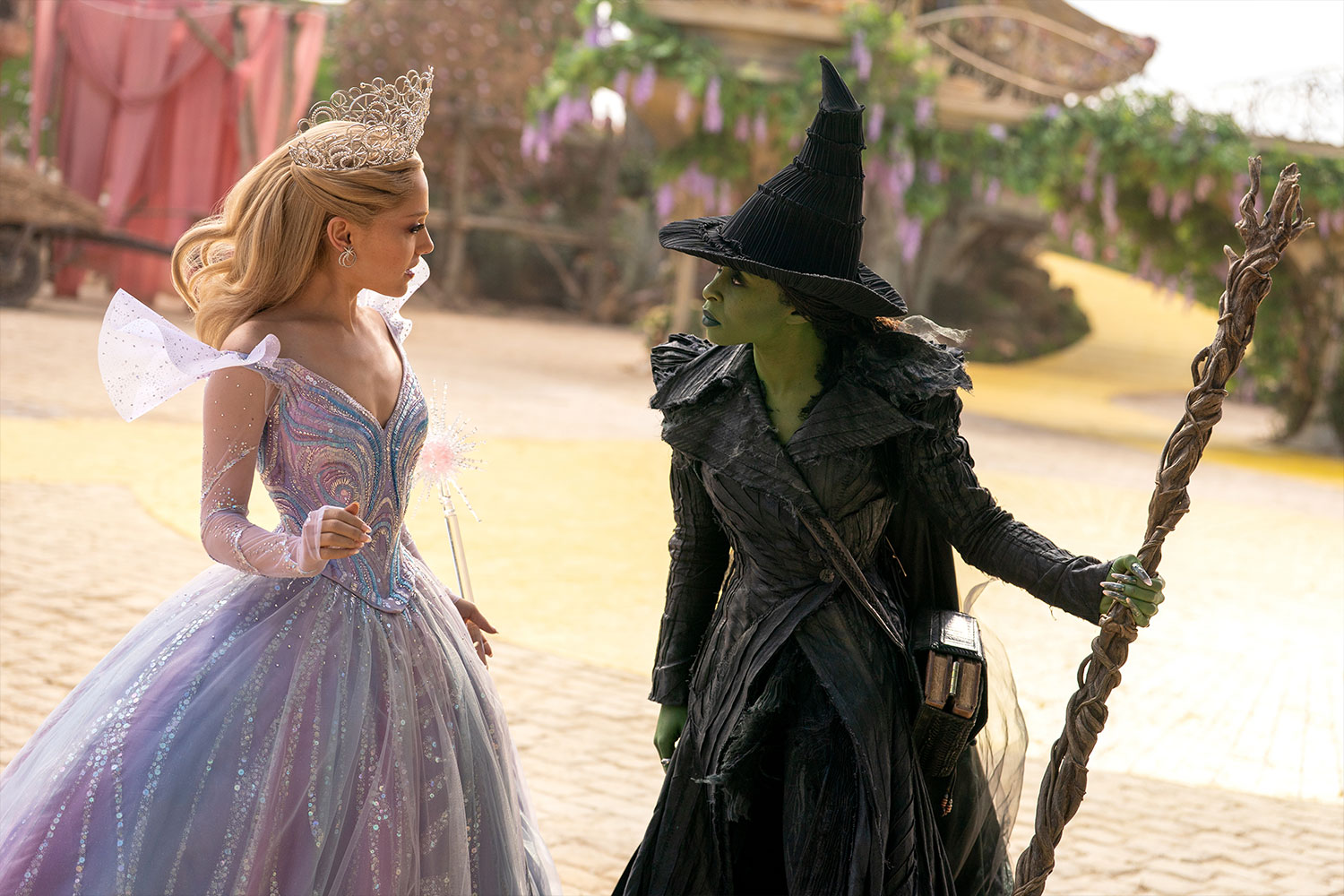
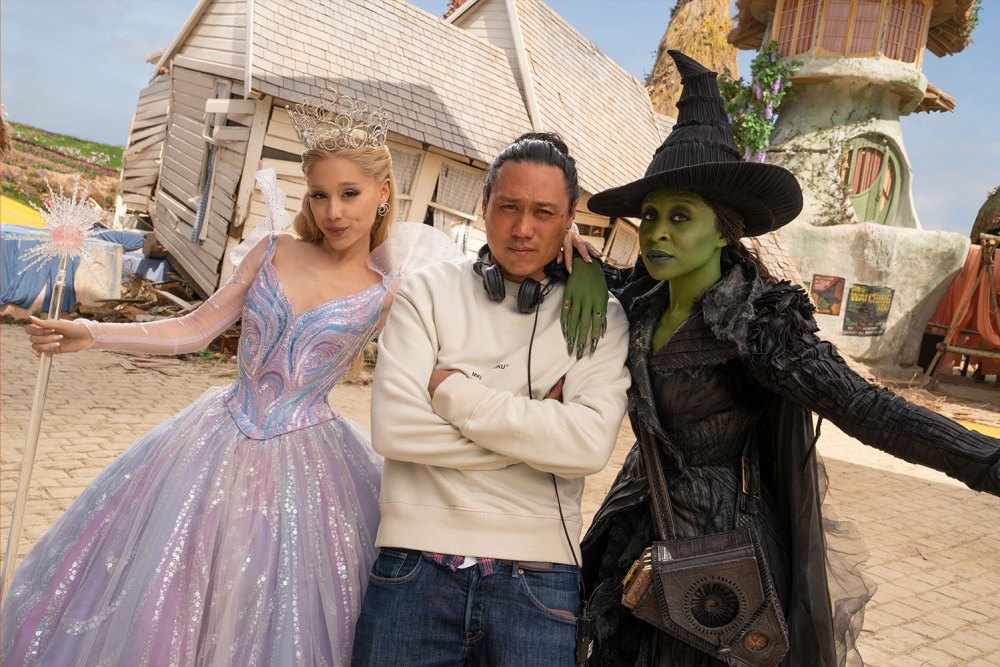
We’re going to insert a lovely photo from the film, just to make sure that you actually want to read on. Otherwise, turn back now.
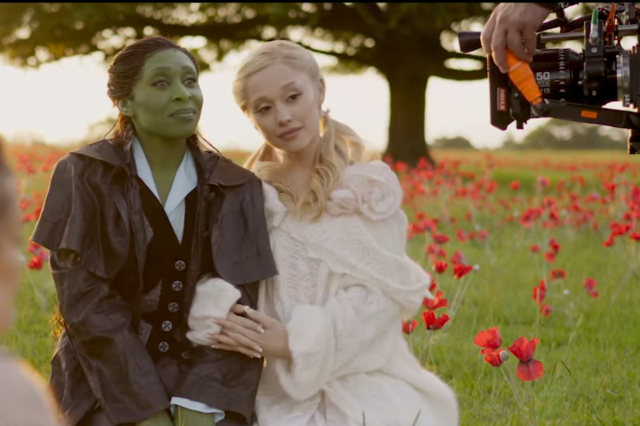
Still with us? Great.
What we intend to do in this article is run through all the key easter eggs that turn up in Wicked: For Good, another instalment in the Wicked film adaptation based on the much-loved stage musical. We’re going to be tapping into easter eggs from the Wicked stage production, the original novel, The Wizard of Oz film, and other films that might be referenced throughout Wicked: For Good.
Opening scenes
So Wicked: For Good opens with a completely new opening compared to the stage production. The new film begins with a scene of the Yellow Brick Road being constructed and animals being forced into servitude.
1. Interestingly, the first time we see Elphaba, flying in to help, is from behind, pulling her hair across her shoulder. In fact, this is an identical way that she’s introduced in the first film, allowing for some consistency between the two flicks.
2. What’s different, and also an easter egg, is that this time Elphaba is flying in rather than stepping off a boat. So there she was grounded, but now she is defying gravity, hinting at a change in the character.
3. Another fun easter egg about this hair pull – make-up artist Frances Hannon says Elphaba’s nails were designed in progressive stages, with each length and shape reflecting her evolving confidence and command. Given Cynthia Erivo has iconic nails, this feels apt.
4. Before we launch into the plot – let’s alight on Elphaba a bit more: at Shiz University, her rigid skirt suits, with pointed sleeve caps and chevroned pinstripes, are said by designer Paul Tazewell emphasise her guardedness and outsider status. In For Good, she sheds that stiffness, adopting trousers and a more agile shape.
5. Then, there is a rearrangement of the opening number: “Every Day More Wicked”. This features a series of callbacks to the hit numbers from the first film, including “What Is This Feeling,” “Popular,” “The Wizard and I,” and “No One Mourns the Wicked.”
6. There’s also a callback to Glinda’s book dance that became a viral sensation from “What Is This Feeling,” but this time around, there are even more books involved, suggesting that the literacy levels of all of those involved have really improved.
7. One of the interesting easter eggs that’s established in this number is how Elphaba and Glinda are shot differently throughout the films. Cinematographer Alice Brooks says that Elphaba is shot through a 65mm lens, whereas Glinda is shot through a 75mm lens, adding a subtle difference between the two and establishing distance between them.
8. In some bits of this opening, Elphaba is also shot with a steadicam for some of this opening number, whereas Glinda is on a locked tripod, again emphasising their disparity in situation. “Glinda is always centered, surrounded by circles, mirrors and bubbles,” Brooks has said, with Glinda’s scenes filmed as if in 1930s musicals.
9. Another fun nod: Elphaba’s hat has actually gotten bigger since the first film, which is an interesting way to again establish how her personality has shifted. She isn’t the only one – Madame Morrible’s costumes have broadened, reflecting her growing influence and veiled menace.
10. Elphaba doesn’t wear glasses in this film, after her curvy specs in part one: implying she sees clearly now, through the lies of the Wizard. I guess the Grimmerie magic might be cheaper than laser eye surgery!
11. After this opening number, you also see the Wicked: For Good title font, which is styled in exactly the same way as The Wizard of Oz, as Wicked Part 1 was.
12. One interesting thing that you see here is that Bowen Yang’s Pfannee, is accompanying Glinda as she walks through the Emerald City. Pfannee asks for some pastries to be sent to his room that have been offered to Glinda. Interestingly, this is a direct callback to the first film where Pfannee appeals for Glinda to have some pastries after she faints whilst encountering Madame Morrible for the first time. Neat throwback to a throwaway line.
13. One other discovery is that Fiyero has joined the Gale Force, which is a military group tasked with tracking down Elphaba. The Gale Force is a reference to Dorothy Gale, who is the character that flies into the world of Oz in The Wizard of Oz.
14. The Gale Force is also a reference to Gregory Maguire’s novel, where they are styled as an SS-style police squad. That’s something that has been taken out of the stage show, but brought back in for the film.
15. Glinda has a flashback early on in the film: what we see during this scene is a return for Alice Fearn playing Glinda’s mum. Fearn was a former Elphaba, appearing in the West End for a number of years.
16. During the flashback, a young Glinda tries to do some magic and fails. Then, to distract everyone, she pretends that she’s made a rainbow appear outside her window. The rainbow is obviously a reference to The Wizard of Oz.
17. But before we move on, one quick final note courtesy of Brooks. Colours mean everything in Wicked, and she’s also spelled out what each of them represent: red for bad choices, orange for transformation, yellow for intuition and power, blue for love, purple for consequence and destruction, pink for desire and popularity, and rainbow for possibility.
“Thank Goodness”
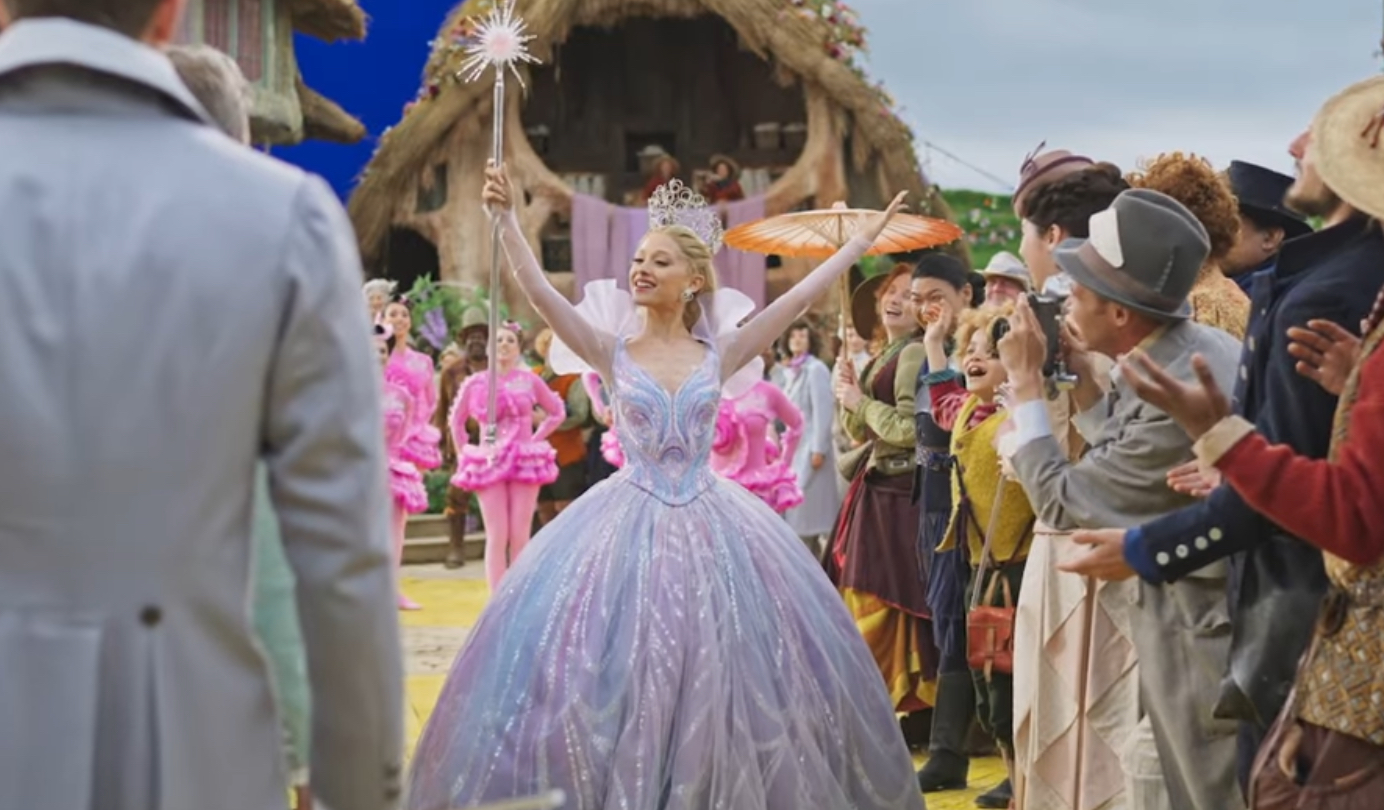
18. After acquiring her special bubble, Glinda flies to Munchkinland to meet the Munchkins and reveal her engagement.
19. Speaking of the bubble – as Glinda stands in her device for the first time, her dress leaves the shape of an inverted witch’s hat – the opposite of Elphaba, who has true magic rather than trickery.
20. One of the “Misinformed Munchkins” that performs during “Thank Goodness” is Summer Strallen, who also appeared as part of the ensemble in the first film. Strallen is interestingly the sister to Zizi Strallen, who currently plays Glinda in the West End, and her mum, Cherida Langford, is the librarian in part one of Wicked, keeping it in the family.
21. We also see a fun, small appearance from the Lollipop Guild during this scene.
22. At the end of “Thank Goodness,” Elphaba appears and spells out the words “Your Wizard Lies” in the clouds above. This is a direct reference to the Wizard of Oz film where the Wicked Witch spells out the words “Surrender Dorothy” in the clouds.
23. Speaking of clouds, the profiles of both Margaret Hamilton (the Wicked Witch) and Clara Blandick (Aunty Em) from The Wizard of Oz are said to pop up throughout the film.
24. Elphaba then hides out in the forest to escape from the Gale Force and the flying monkeys. She does this by “blending in with the foliage”, which is a direct reference to the first time that Elphaba and Fiyero met each other in the forest in the first film. Fiyero even made a joke about the fact that she could blend in with foliage due to her skin colour, something that she now has done.
Thropp house / No Place Like Home
We then head over to the Governor Thropp House, where Nessarose has established herself as the new governor following her father’s death.
25. Fun little aside about Nessarose: she’s actually adopted her mother’s hairstyle. Rather than having her own loose hair, it’s now constricted and bound. At Shiz University, she also wore bright colours and lots of bold saturation. But here she is in very muted tones, again reflecting how she has evolved and been hardened by her father’s death.
26. We also have a lovely appearance from Avaric, played by Aaron Teoh, who is a student from Shiz that actually appears in the first film, though does not have any lines in that part. Notably, he did actually have a storyline in the original script and was said to be a potential romantic suitor for Nessarose, but she ignores him so that she can focus on Boq (clad in a grey uniform, foreshadowing!). It’s almost more tragic in a way that he goes on to then work for her, and she’s still oblivious to the fact that he might be romantically interested in her – while her attention is on someone who simply wants to escape.
27. There’s a small bonus scene where Boq tries to escape to the Emerald City, but is unable to do so because of new rules that have been put in place by Nessarose. The guard here is played by Adam Pearce. This isn’t the first time that Pearce has been in a Stephen Schwartz musical – he also originated the role of Hotep in The Prince of Egypt when it opened in the West End.
28. In For Good, Boq’s hair gets very contained as he is more and more controlled by Nessarose – when he tries to escape he ruffles his hair, suggesting freedom. Alas – not for long.
29. He’s also chopping wood – a nod to his future inclinations…
30. We then have the scene where Elphaba performs her new number, “No Place Like Home,” whilst some animals try to escape through a hole in the Yellow Brick Road. Amusingly, “No Place Like Home” is obviously a reference to The Wizard of Oz, but that isn’t the only reference to The Wizard of Oz in this scene!
31. Among the animals appearing to Elphaba are lions (of the Cowardly variety), tigers, and bears – in the form of the lovely Dulcibear, voiced by Sharon D Clarke.
32. The Cowardly Lion that appears here is voiced by Colman Domingo and bears a startling resemblance to the MGM Lion that is at the start of the Wizard of Oz film.
33. The Cowardly Lion interrupts the final riff of “No Place Like Home,” which actually features the tune from “Home” from The Wiz‘s soundtrack. It can be heard on the For Good soundtrack but isn’t actually an easter egg in the film. So I guess it’s a semi-secret easter egg.
34. I’m going to pause here for a moment and talk about the incredible work done by John Powell alongside Schwartz on the show’s orchestral soundtrack. There are so, so many references to other films, other numbers, and more. He does some really smart things for the animals, including a passacaglia, which is a theme that always circles back on itself. It may seem like it’s starting to take shape and move forward, but it actually means that it returns to the beginning: trapped and unable to escape.
Back at Thropp
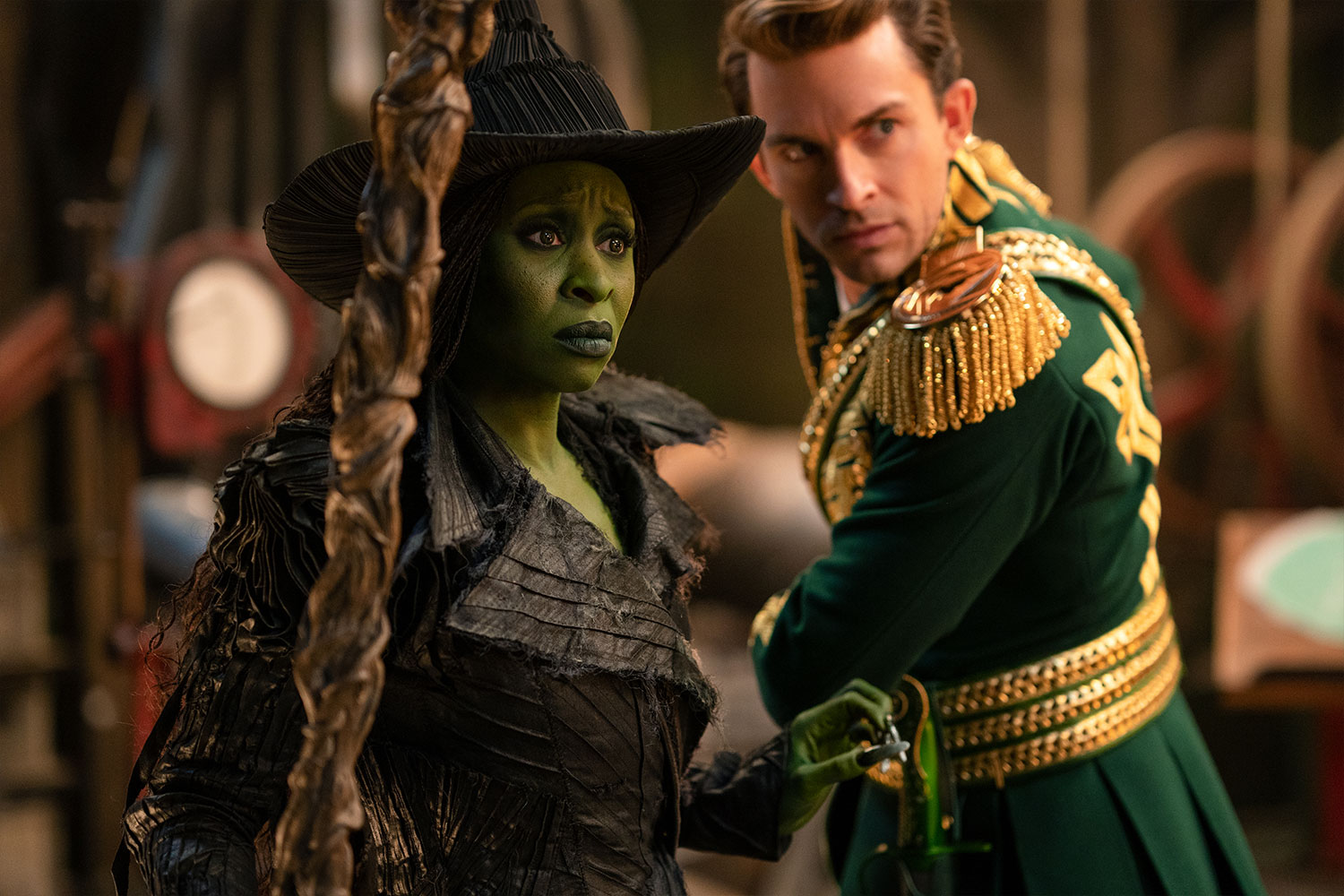
35. We then return to the Thropp mansion with Elphaba this time. When Elphaba arrives at her sister’s house, she shatters the glass of a wardrobe: in the stage version she appears inside the wardrobe and then it cracks.
36. There are so many easter eggs here. When Elphaba enchants Nessarose’s slippers, they glow bright red just like the ruby slippers in The Wizard of Oz.
37. The chance for Nessarose to fly is also a direct callback to “Defying Gravity,” where Elphaba says that everyone deserves a chance to fly.
38. You also see the striped stockings that the Wicked Witch of the East wears in The Wizard of Oz being worn by Nessarose.
39. After finding out about Glinda’s engagement, a newly re-employed and trapped Boq holds a pink heart-shaped image on a piece of paper close to his heart, similar to the one that the Wizard gives to the Tin Man in The Wizard of Oz. What a coincidence…
40. Boq then has his awful transformation into the Tin Man after Nessarose plays around with the Grimmerie. After this transformation, he cuts through her door with his axe, just like the one that the Tin Man does when trying to liberate Dorothy in The Wizard of Oz.
41. This is in fact a double easter egg! It also pays homage to The Shining where Jack Nicholson tries to cut through a door with an axe. And obviously, Boq, made of tin, is now shiny!
42. Elphaba now leaves the Thropp mansion and says the famous line, “I’m off to see the wizard,” which is obviously a very famous line in The Wizard of Oz.
Visiting the Emerald City / “Wonderful”
43. We see inside Glinda’s apartment where a series of costumes from the first film are featured in her wardrobe. There’s also some suggestion that one of the costumes in her wardrobe is one of those worn by Billie Burke, who is Glinda in The Wizard of Oz.
44. Glinda, preparing for her wedding, has green-tinted earrings – a nod to her former friend?
45. When Elphaba arrives at Glinda’s apartment, the window cracks, a reference back to the first film when this happens during “What Is This Feeling?”.
46. Elphaba then goes to see the Wizard, who is playing with his train set. I wonder which other American entertainer, who loved building big castle structures in fantasy lands, used to have a love for trains?
47. The number “Wonderful”, completely rewritten, plays out. Interestingly, during this scene, the Wizard tries to placate Elphaba by doing a series of magic tricks. This is actually a deep-cut reference to The Wizard of Oz, because in a deleted scene, the Wizard tries to do a similar series of magic tricks while placating Dorothy when they discover that he isn’t actually all that great and powerful – but just a normal man.
48. There are moments where Elphaba and Glinda hold hands in a way that is a direct reference to the end of “One Short Day” in the first film. This happens during both “Wonderful” and “For Good.” Later, the dancing Elphaba and Glinda do mimics the same dances they did during the Ozdust ballroom.
49. New lyrics in this number are also direct references to the dialogue from “Defying Gravity”.
50. The film’s designers and director say that the aerial scenes in “Wonderful” are inspired by Disneyland’s Peter Pan ride, and this isn’t the last reference to Disney that takes place during this film.
51. There’s also a moment where, due to the lighting, Glinda glows green while Elphaba fades to neutral. Later, a rainbow of light surrounding Elphaba. Colours!
Wedding / As Long As You’re Mine
After Elphaba agrees to join the Wizard, Glinda prepares for her wedding.
52. Her wedding entrance music is a slowed down version of “Popular”, recomposed for the occasion.
53. It’s juxtaposed with Elphaba discovering the caged animals – with her finding the trapped Doctor Dillamond – she had a prophecy of this happening in the first film.
54. While Elphaba descends to the cage, her silhouette is akin to the shot where she’s entering the Ozdust ballroom – into an unknown and unfamiliar world.
55. When the wedding is disrupted, Fiyero sides with Elphaba and forces the Wizard to stand in a cage, essentially doing what he’d been doing to all the animals.
56. When Glinda confronts Fiyero over his actions, she asks whether he’s lost his mind. Well, he only has a brain… for now… Earlier in the film Fiyero also bemoans the fact Munchkins are also “so empty-headed”, and during “As Long As Your Mine”, he also mentions that “maybe he’s brainless”…
57. Glinda then sings a reprise of “I’m Not That Girl,” a reference to Elphaba feeling romantically jaded in the first film.
58. Meanwhile, Fiyero and Elphaba have gone on to do some romantic business at Elphaba’s treetop home. Interestingly, a great point on the set design here is that Elphaba’s Lair is covered with lanterns. Famously, when the song is sung on stage, Fiyero is holding a fairly iconic lantern. They’ve decided to honour that with the set design.
Dorothy arrives / Cat fight
59. After Madame Morrible brings on the giant storm that takes her house and lands it right on top of Nessarose, the easter eggs come thick and fast with the arrival of Dorothy. We first see Dorothy wearing silver slippers, which is a reference to the original 1900 novel by L Frank Baum when the slippers were silver rather than ruby red.
60. Powell’s music during this scene pays homage to The Wizard of Oz composer Herbert Stothart.
61. As Dorothy leaves, she’s skipping in the exact same way that’s done by Judy Garland in the Wizard of Oz film.
62. A very fun inversion – in The Wizard of Oz, Glinda chastises the Wicked Witch for having no power in Munchkinland. Here it’s Elphaba who says “you can wave that wand all you want but you have no real power”!
63. The line is also a throwback to the one Elphaba levels at the Wizard in part one.
64. Designer Nathan Powell says his favourite easter egg from this moment is the fact that the Yellow Brick Road doesn’t just go in one direction, but goes in two: in his mind, this is because this is where the story of the Witches collides with that of Dorothy. So that’s why there are two roads.
65. During the catfight, Glinda mocks Elphaba’s laugh – the one that became iconic after the 1930s film.
No Good Deed / March of the Witch Hunters
66. Leaving Fiyero to be placed in a field, Elphaba heads to Kiamo Ko, where she wears a family heirloom cape from Fiyero’s lineage, dyed in an ombré that shifts from blue to black and finished with a metallic embroidered yoke and a tribal swirl at the hem. Tazewell, you are spoiling us.
67. As Elphaba sings “No Good Deed”, her riff on the word “Fiyero” matches her one on “Defying Gravity” – right that it should come during a moment of great magical effort
68. We also see imagery of wings, feathers, straw and corn in the Grimmerie – corn and straw obviously a reference to Fiyero’s fate.
69. When the Wizard tells Dorothy to fetch Elphaba’s broom, it is a direct nod to The Wizard of Oz – even the way in which Elphaba and her companions are standing.
70. The Wizard is also listening to a little ditty at this point – we couldn’t work out what it was – please someone help us. Update: apparently it’s a rejigged version of “Wonderful”.
71. According to Jon M Chu, Boq has a little quote from L Frank Baum’s novel on his Tin Man uniform: “If we walk far enough, we shall sometime come to some place”. His hat also emits steam like the film version.
For Good / Finale
72. Glinda and Elphaba come together at Kiamo Ko. In Wicked, they often shared the frame with their light intertwined to reflect connection. In For Good, that unity fractures and their separation is reflected in contrast.
73. According to director Jon M Chu, there is a moment before they sing when both actresses start talking at once, completely unscripted, and it was perfect for their dynamic.
74. A point regarding time of day. In 2024’s Wicked, the sun always set for Elphaba and rose for Glinda. In For Good, the final duet takes place where sunset and sunrise meet.
75. Brooks also revealed to us that the sequence is lit by orange torchlight and blue moonlight that directly echoes the Ozdust Ballroom
76. In the “For Good” sequence, Brooks revisits the 360-degree movement first seen in the Ozdust Ballroom and “Defying Gravity.” The clasped hands also come back.
77. The duo also run up the stairs to Elphaba’s final confrontation scene with clasped hands, similar to their running exit from the Ozdust ballroom.
78. When Elphaba is melted, it’s a visual reference to how the scene is played out on stage – using shadows and sound rather than visuals.
79. During the post-melting scenes, you see the Wizard flying back to Kansas, with Dorothy appealing to him to take her with him – lifting a moment directly from The Wizard of Oz.
80. “I swear it never ends with that girl…” It’s funny that Glinda and Dorothy do not get on. In a way, it’s teed up in The Wizard of Oz, when Dorothy says all witches are ugly and old. Can’t see Dorothy taking that well.
81. Glinda has Madame Morrible locked up, and while doing so mimics the exact dialogue Morrible uses during the Ozdust ballroom: “My personal opinion is that you do not have what it takes. I hope you prove me wrong. I doubt you will.”
82. Elphaba is *shock horror* – not dead! But escaped through a trap door after being “melted”. Amusingly, The Wizard of Oz filmmakers used a similar trick with Margaret Hamilton when she was doing her melting scene in the film.
83. When Fiyero appears to a very much not-dead Elphaba, he sidles up with the exact same gait as the Scarecrow in The Wizard of Oz – a nod to the fact his legs are far from robust now… His leg even does the same fold that happens when the Scarecrow first steps on the Yellow Brick Road.
84. All the corn designs on Fiyero’s guard uniform now feel firmly like foreshadowing. There’s also a gold stripe down the side of his outfit that looks like he’s on a scarecrow pole!
85. When Elphaba places her hand on Scarecrow / Fiyero, it’s similar to when she touches his cut cheek before “I’m Not That Girl”.
86. A small retrospective easter egg – Crowley told us that, after “The Wizard and I”, Elphaba ends up looking out over the desert: that was her future, she just didn’t know it yet.
87. Another one – isn’t it funny that, in The Wizard of Oz, the Wizard gives the Scarecrow a diploma, because he hasn’t got one? Because Fiyero kept being kicked out/running away from school!
88. Glinda finishes the film in the exact same spot she finished part one – on top of the tallest tower in the Emerald City. The difference is that the first time around she was powerless – now, with the Grimmerie, she’s empowered.
89. We see her enter the tower in a shot that also throws back to the first film – except that was accompanied by Elphaba – now she’s alone.
90. During these final beats, Glinda also sees a rainbow in the distance as she sings about her loss. Another hint of possibility, according to Brooks!
91. And that beautiful, wonderful final scene: set once more in a poppy field (like the famous scene from The Wizard of Oz).
92. It ends with a flashback to Glinda leaning over and whispering to Elphaba – bringing the entire Wicked franchise back to where it all began, an ode to the stage show’s poster.
Some later additions…
93. An interview with Paul Tazewell reveals that the Wizard’s dressing gown outfit contains a series of strained poppies.
94. Elphaba’s mother, seen in flashback, is also dressed in an “upside down poppy”. A poppy is also associated with drug use – as is Elphaba and Nessarose’s mother!
95. Glinda watches Elphaba’s demise through a keyhole – the same way she spies Elphaba’s arrival outside her room at Shiz University!
96. Speaking of Shiz University, one eagle-eyed social media user noticed that, in Wicked, Elphaba destroys a portrait of the Wizard to expose an animal mural behind it. In For Good, the caged animals are also hidden behind a portrait of the Wizard – and Elphaba again, releases them.
97. We spy Miss Coddle! Keala Settle’s character returns briefly as a wedding guest.
98. The curtains of Dorothy’s house are the same blue check as her dress.
99. Madame Morrible’s hair when she says “a change in the weather” looks like a hurricane – white curls piled up on one side tumbling down.
100. The black and white visions in “No Good Deed” of Fiyero becoming the Scarecrow mimic the black and white opening of The Wizard of Oz.
101. One of the monkeys that is sat on a railing next to Morrible when she performs “like some terrible green blizzard” in “Every Day More Wicked” has Glinda’s jacket on – they tore it off her in the first movie. Bang on trend!
102. In a lovely Glinda ode, Billie Burke’s Glinda welcomes Dorothy to Munchkinland in The Wizard of Oz and appeals to Munckins to, “come out, wherever you are!” Grande’s Glinda in the final scenes asks the animals to “come out, come out, wherever you are.”
103. Fiyero rides a blue horse in Wicked: For Good (unsure what happened to his lovely talking horse!) – a reference to the coloured horses in The Wizard of Oz.
104. Eagle-eyed viewers have spotted Wicked alum and Elphaba legend Kerry Ellis during “The March of the Witch Hunters” – witches hunting witches!
105. Michelle Yeoh notes in interviews that Madame Morrible’s initials, MM, are WW (ie Wicked Witch) flipped.
106. During “There’s No Place Like Home”, the lyrics encourage the listener to “keep on repeating ‘there’s no place like home'”, which Elphaba proceeds to do three times – the same number Dorothy does when she wishes herself back to Kansas at the end of The Wizard of Oz.
107. During “Wonderful”, while the Wizard is showing off his mechanised head collection, viewers spot the face of Frank Morgan, who played the Wizard in the 1930s film.
108. When Madame Morrible is discussing her ploy to use the cyclone to kill Nessarose, she says “these things must be handled delicately”, a line the Wicked Witch also uses when mulling over how to kill Dorothy in The Wizard of Oz.
109. In “March of the Witch Hunters”, the Tin Man looks up at Glinda, who he previously had a crush on, on a balcony watching on. This directly echoes a line from “If I Only Had A Heart” in The Wizard of Oz, where the Tin Man wishfully imagines: “Picture me a balcony / Above a voice sings low.” Like a tortured inversion of the Verona scenes from Romeo and Juliet.
110. The guard who runs through the tulip fields during the opening scenes is played by Mark Eves, the farmer who planted the tulips for the films!






Latest Videos
I’m Every Woman – The Chaka Khan Musical releases new trailer
Performances begin at Hackney Empire this week