
Ukraine Unbroken at the Arcola Theatre – review
Nicolas Kent’s production, featuring five short plays, runs until 28 March
 |
London
|
|
London
|
3 March 2026
The fourth anniversary of the Russian invasion of Ukraine was marked last week. A doyen of political theatre, Nicolas Kent’s dramatic cycle Ukraine Unbroken – comprised of five short plays, performed by a cast of seven – charts the past 12 years of unrest and warfare. At nearly three hours, it does make for a long haul, due to the harrowing subject matter (not that a few hours of bearing witness can in any way compare with living through these events) and the mixed quality of the pieces.
The works are threaded together by Mariia Petrovska, singer and maestro of the bandura, a string instrument that provides a delicate and glimmering stream of sound, which was banned by the tsars, and some of its players were executed under Stalin. Petrovska fled with her parents to Britain after the Russian invasion, where she studied music in Manchester, and she returned to Ukraine to perform with the Cultural Forces Unit on the front line (she didn’t tell her mother until she was on her way).
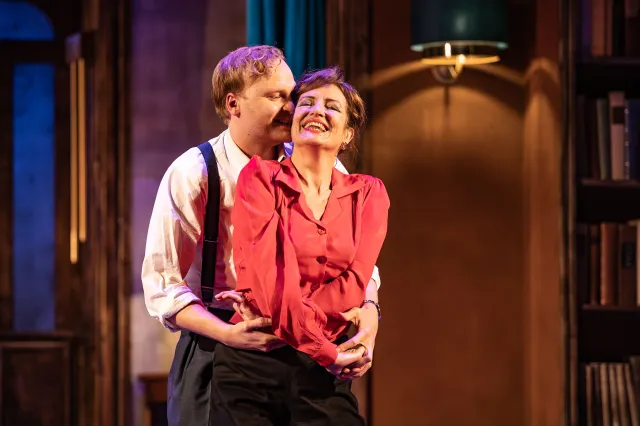
The first piece, Always by Jonathan Myerson, is set in a Kyiv hotel room on 21 February 2014, in which an MP and his wife, who have a son who is part of the pro-European student protests outside, are taken hostage by men in white coats carrying guns. It’s interesting in the way in which it hints at resentments around the idea that people of Kyiv are detached from the rest of Ukraine, but it’s unfortunately ultimately rather hammy.
In David Edgar’s Five Day War, a group of delegates gather in a country B&B to “audition” for roles in the next government. It’s slightly The Traitors-esque and Daniel Betts is a standout as the slippery “Foxtrot”, but it’s overly cryptic and confusing to follow.
Following the interval, Three Mates, a monologue by Ukrainian playwright Natalka Vorozhbit (translated by Sasha Dugdale and directed by Victoria Gartner), is certainly the strongest of the five. Featuring an excellent performance by Ian Bonar as Andriy, a singer who is living a half-life, having avoided conscription. One of his best friends has been fighting since the beginning, while the other paid a considerable sum to flee to Austria and is complaining about being nervous about going skiing for the first time in years. Andriy and his wife made the air raids in the underground car park almost cosy, but she and their child are now in the UK and he is alone.
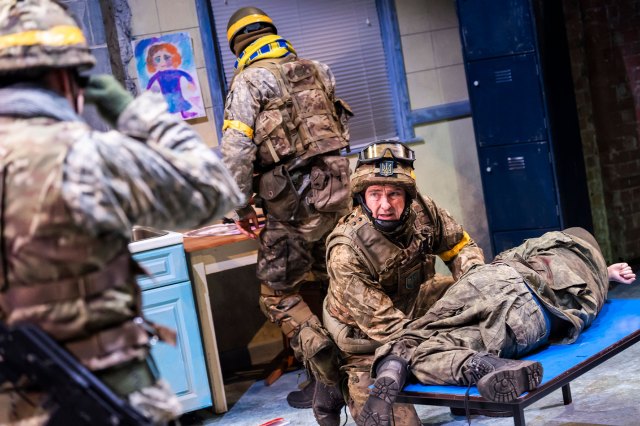
In David Greig’s Wretched Things, three soldiers take refuge in an abandoned primary school (the children are probably dead or in Siberia), where they come across a North Korean soldier fighting for Russia who is barely alive. It’s a philosophical piece that doesn’t quite come to life.
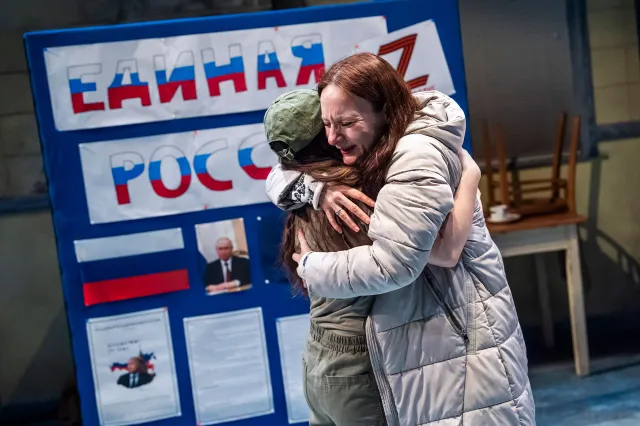
The cycle concludes with Taken by Cat Goscovitch, the most emotive piece, and the second strongest, exploring the 20,000 Ukrainian children stolen by Russia on the pretence of giving them a holiday. It is helmed by a strong performance by Jade Williams as Anna, mother of the abducted 12-year-old Lilya (Clara Read). When she rescues her daughter a year later, she has been brainwashed, and a troubled adolescence awaits.
Ukraine Unbound is a worthy initiative and Petrovska’s musical skills are something to behold. Unfortunately, however, the pieces are too uneven to add up to a satisfying evening of theatre.






Featured In This Story
Related Articles
See all

Latest Reviews
See all


Latest Videos
A Mirrored Monet musical in London – first listen
Dean John-Wilson performs “In The Light” ahead of the London premiere