
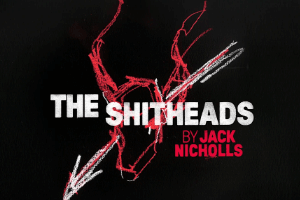
The Sh*theads at the Royal Court – review
Jack Nicholls’ play about prehistoric cannibalism runs in the Jerwood Theatre Upstairs until 14 March
 |
London
|
|
London
|
13 February 2026

When artistic director David Byrne announced this play as the starting point of an ambitious 70th anniversary season upstairs at the Royal Court, he said he had never read anything like it. That’s for sure. The Sh*theads by Jack Nicholls starts weird and gets uncompromisingly weirder.
It’s one of four world premieres scheduled for the small studio theatre, all of them chosen from plays that have been sent in on spec, written by unknown playwrights who are offered a guarantee that their play will be read and a chance for their voice to be heard.
There are echoes of Sarah Kane and Martin McDonagh in The Sh*theads, but Nicholls’ voice and imagination are defiantly his own, setting the action in and around a cave in prehistoric times, when the weather is destroying the land, and an ice age may be on the way.
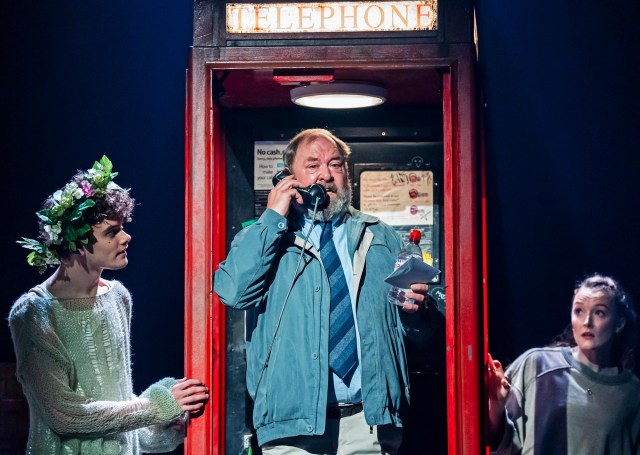
What’s wonderful and energising about the production, directed with flair and commitment by Aneesha Srinivasan and Byrne himself and designed with panache by Anna Reid, is the way that it turns the tiny space into an entirely convincing prehistoric landscape. It opens with a huge elk charging across the stage (sound by Asaf Zohar, marvellous puppetry by Finn Caldwell), pursued by Clare (Jacoba Williams) and Greg (Jonny Khan) who, in the scene that follows, kill the elk and begin to talk about their lives and dreams.

“I want what’s in your head,” says Clare, who means that in ways that are quite literal. The rest of the play is about what happens when she returns to the cave where she lives with her crippled but tyrannical father (played with venomous suggestiveness by Peter Clements, who endows his dialogue with Pinter-like menace) and her innocent sister Lisa (Annabel Smith, all fluttering questions). They are joined by Danielle (Ami Tredrea) and her baby (another convincing puppet, expertly manoeuvred by puppetry captain Scarlet Wilderink).
Clare and her tribe, who form a group that makes them look like a terrifying Renaissance holy family, believe they are magic because they live in a cave that they have inherited down the generations. It’s decorated with a veneer of civilisation – a standard lamp, and a wooden chair – but the chandeliers in the ceiling are made from human skulls and bones. They see themselves as different from “the sh*theads” – represented by Greg and Danielle – whose heads are full of excrement and who cannot speak.
You don’t have to squint very hard to see the analogy with discussions around immigration and the othering of outsiders to turn them into a threat. But Nicolson’s writing is impressively vigorous and constantly twists in ways that are unexpected and – sometimes – disturbing. There’s a lot going on under the surface: a discussion of the stories we tell ourselves, of the genetic imperatives of violence, of the origins of gender difference.
It’s overlong (running without an interval) and not always as shocking as it thinks it is. But it is beautifully staged (Alex Fernandes’s lighting deserves an award in itself), acted with commitment and meaning and has a remarkable ability to undercut expectations and open up thinking. Which is exactly what a play in the Royal Court’s upstairs space should be doing.






Featured In This Story
Related Articles
See all


Latest Reviews
See all




Latest Videos

Watch Emily Lane perform “It Roars” from Mean Girls rehearsals
The new tour opens this month