
Summerfolk at the National Theatre – review
Nina and Moses Raine’s adaptation of Maxim Gorky’s play, directed by Robert Hastie, runs in the Olivier theatre until 29 April
 |
London
|
|
London
|
18 March 2026
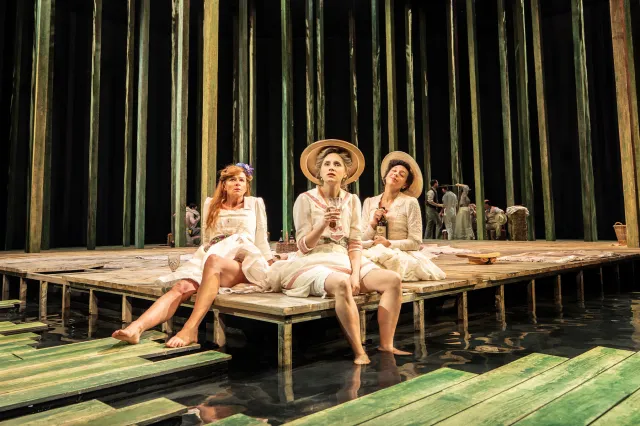
“Did you see Cherry Orchard?” one character asks another. “Went on too long, didn’t like it,” they swiftly reply.
It’s a brilliant moment in Moses and Nina Raine’s pithy adaption of Maxim Gorky’s Summerfolk, a play that literally picks up where Chekhov’s masterpiece left off. This is Russia in the summer of 1905, when the orchards have been chopped down to make way for new-builds – summer dachas where the newly-wealthy middle class can lie around indolently and talk.
And talk. And talk. This version of Summerfolk, directed with verve by Robert Hastie, is 40 minutes shorter than its last incarnation on the National’s stage, when Trevor Nunn directed it some 25 years ago. But it is still staggeringly wordy.
Fortunately, the Raine siblings have provided a contemporary translation full of humour and vigour, bringing some 23 characters to clear life and the production has an excellent cast, including Doon Mackichan as a hapless poet, Justine Mitchell as a crusading doctor and Paul Ready as a high-living lawyer, who are expert in the fine calibration of comedy, landing their words with precise force.
The effect is like Chekhov made explicit. All his references to sex, repression, the changing times, are here emphasised and elaborated as the characters fall in love, get bored, get angry, get drunk. “These summerfolk are all the same,” says a watchman (Richard Trinder), who rather too obviously circles the house. “They pop up and are gone, like scum on a puddle. Or warts.”
Gorky’s point is political. These lawyers, doctors and engineers are the children of the poor. They have clawed their way up to wealth and respectability, yet now they have achieved superiority they pay no heed to those still struggling. The doctor Maria Lvovna (Mitchell), is the sole voice of the liberal conscience, constantly needling the others about doing good. Her friend, Varvara (Sophie Rundle, wonderfully passive yet seething) sees the fatal ennui and waste but finds herself trapped within the misogynistic and limited world represented by her husband Bassov (Ready, charming, alarming and very funny).
Under the “unbearable sunny boredom” of a hot summer, there’s a constant sense of looming doom, of the revolution around the corner which they are all unable to face. The writer Shalimov (Daniel Lapine), supposedly the hope of the intelligentsia, postures and preens, his hollowness revealed by his vanity. A bored bachelor Ryumin (Pip Carter) fancies himself in love with Varvara while pleading “I’m busy looking for the meaning of life as well.”
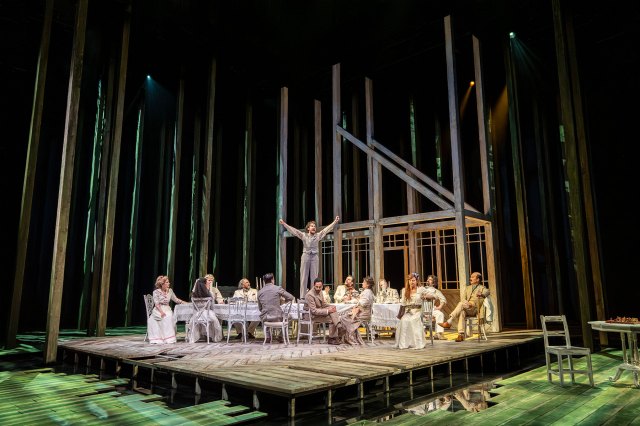
Characters who initially seem harmless reveal themselves to be vicious, like Arthur Hughes, excellent as the builder Suslov, whose anger erupts into bile, or the harassed housewife Oga (Gwyneth Keyworth) her face contorting as she chases the latest gossip. What love there is misplaced as in the tragi-comic affair between Mitchell’s ageing doctor and Alex Lawther’s youthful Vlass, whose entire body seems to crumple as she rejects him on the grounds of their age difference.
Mitchell is simply superb, catching all the woman’s hope before she faces reality. The moment when her daughter Sonya (Tamika Bennett) comforts her introduces a rare moment of understanding and real emotion into the febrile comings and goings.
All these encounters take place on Peter McKintosh’s handsome wooden set, with sturdy wooden pillars reaching skywards, that adapts beautifully to the different settings. The third act, with a stream where the cast can paddle, is particularly fine, and every change is echoed by Paul Pyant’s sensitive lighting that gently creates different times of day and reflects the turns in mood.
“The mess they leave behind,” says the watchman, despairingly, looking at the litter left in the forest. Gorky is painting a picture of a careless society, bound to be destroyed. His play speaks just as loudly to our careless times, even if it does so at considerable, sprawling length.






Featured In This Story

Related Articles
See all


Latest Reviews
See all







Latest Videos
I’m Every Woman – The Chaka Khan Musical releases new trailer
Performances begin at Hackney Empire this week