
Small Island at Leeds Playhouse and on tour – review
Matthew Xia’s revival will also be staged at Birmingham Rep and Nottingham Playhouse
 |
Birmingham | Leeds | Nottingham
|
|
Birmingham | Leeds | Nottingham
|
18 March 2026
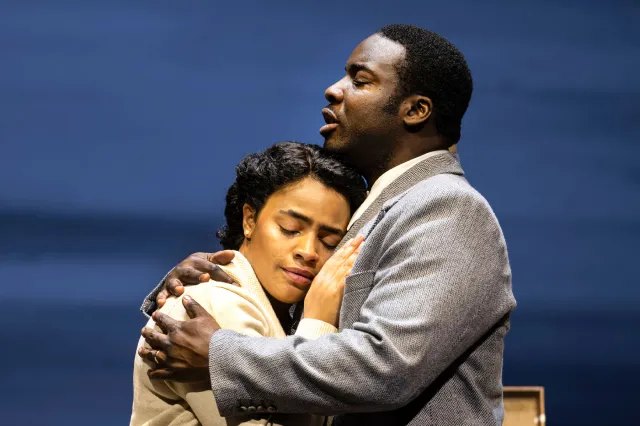
Andrea Levy’s modern-classic novel is a story of epic proportions. It follows the interwoven lives of four characters, covering the Windrush Generation and the realities of post-war Britain in the process. Helen Edmundson’s adaptation – already a critical and commercial hit with two sold-out runs at the National Theatre in 2019 and 2022 – is equally epic, coming in just shy of three and a half hours. Director Matthew Xia must have felt a certain weight of expectation in taking on a new production. Fear not: he rises to the challenge.
We follow Hortense (Anna Crichlow) and Gilbert (Daniel Ward) from Jamaica to London in the 1940s. Gilbert has dreams of becoming a lawyer; Hortense doesn’t want to be the girl who is left behind. It takes Gilbert two attempts to make it to England. He joins the RAF and is stationed in Lincolnshire before returning home when the war ends.
His second attempt sees him board HMT Empire Windrush. His dreams unabated, he makes a deal with Hortense to afford the fare: he will go, and she will follow as his wife. The prejudice and racism they face on their arrival shocks them. In London, Queenie (Bronté Barbé) and Bernard (Mark Arends) find themselves in a similar marriage of convenience as Queenie seeks escape from Lincolnshire.
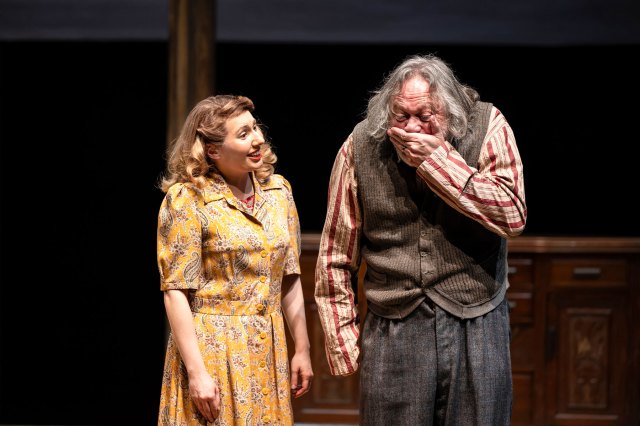
Barbé and Ward are excellent; their characters feel fully formed. Crichlow and Arends have a tougher time. Both Hortense and Bernard are intensely rigid, unwilling to bend to a changing world. Each sees any change to their ideals as lowering their standards, albeit for distinctly different reasons.
For Hortense, she is undermining her upbringing. For the bigoted Bernard, he is undermining his race. Narratively, it makes sense, but it creates a dramatic challenge; there isn’t much room for either actor to grow until the bittersweet end. But there’s incredible sympathy in Xia’s direction. You feel that you completely understand each protagonist, and Xia has you buy into their story. Even in the Leeds Playhouse’s roomy Quarry Theatre, it feels intimate, and Xia keeps you engaged throughout, despite a runtime that could use a close shave.
Simon Kenny’s staging – a square, wood-panelled revolve – expands with Britain’s post-war society to create the rooms Queenie has established as an act of survival against economic challenges. A painter’s wash of a backdrop is lit by Ciarán Cunningham in Caribbean sea blues and evening reds. British Pathé footage gives a sense of place and time in act one, marking every scene change, before disappearing entirely in the second half: the sentimentalism of the archive shots is eschewed to expose the warts-and-all version of life in this period of British history.
In many ways, Small Island is a story of dreams: realised and unrealised, big and small. For some, it’s seeing daffodils or having a doorbell; for others, it’s the chance of a legal career, or – like Gilbert, Hortense and Queenie – the hope of a life better than the one defined for you. It’s monumental theatre on a national scale and, whatever its flaws, it demands your attention.






Related Articles
See all


Latest Reviews
See all





Latest Videos
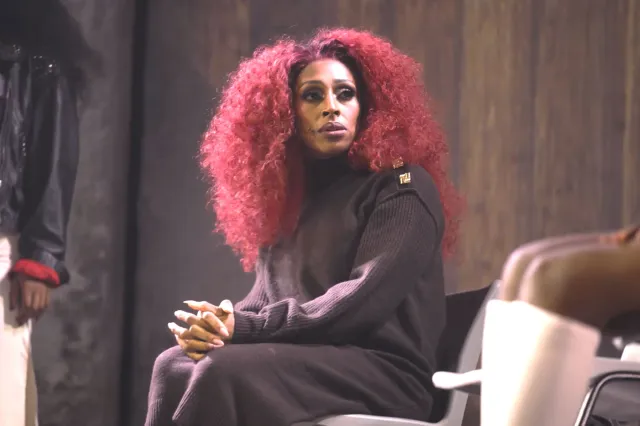
I’m Every Woman – The Chaka Khan Musical releases new trailer
Performances begin at Hackney Empire this week