
Producer Oliver Royds on the vital importance of making theatre for kids
Why is kids’ theatre constantly underestimated in the broader theatre ecosystem?
 |
Nationwide
|
|
Nationwide
|
5 August 2026
Theatre producer Oliver Royds wears a lot of hats. Between running BOS, Nicoll Entertainment, and Troubadour Theatres, he has built a career finding smart, clever ways to make live entertainment work.
The idea for Nicoll Entertainment came from an accidental clash. Royds and his business partner Nick Brooke were working in adjacent offices when they realised they were both secretly bidding for the rights to the exact same show.
“Nick and I were both essentially bidding on the same bit of IP,” Royds recalls. “We were in an office next to each other, and we were, ‘Hang on a minute. You’re bidding on this show and I’m bidding on this show, and there’s literally a wall between us. This is crazy. Let’s club together and do it together.’ That’s really where it naturally progressed.”
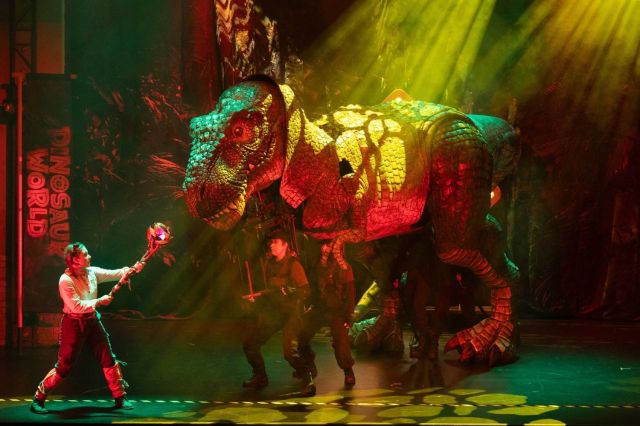
Today, Nicoll Entertainment focuses on two distinct areas: picture book adaptations like The Tiger Who Came to Tea, and large-scale puppet productions like Dinosaur World Live, created in partnership with puppet designer Max Humphries – which has returned for a summer season in Wembley.
Their puppet shows are specially engineered for global appeal. Many productions feature only one speaking actor alongside ensemble puppeteers, making them seamless to tour internationally.
“By having one speaking person, it means that actually, if it needs to be, we can change it out to a different language if we’re going to China or if we’re going to Japan or wherever it might be,” Royds explains. “It makes it very versatile.”
From an operational standpoint, children’s theatre is also a masterclass in venue efficiency. It fills lucrative real estate during the day when traditional West End auditoriums usually sit dark.
“The economics of our business are baffling,” Royds observes. “You’ve got these prime bits of real estate sitting all over the country and in central London that are empty for 90 percent of the day. Putting a kids’ show over the top of a conventional evening play or musical is a great way of getting another audience, making some money for the theatre, and sharing costs.”
For Royds, maintaining high production values for younger audiences isn’t negotiable – especially when for many it will be their very first taste of live performance: “Kids’ theatre, there’s good kids’ theatre and there’s bad kids’ theatre,” he says. “You don’t want to scrimp on it. You want to make sure that the kids are getting an amazing experience, both visually and in terms of storytelling, because there’s nothing worse than seeing bad kids’ theatre.”
That commitment to the experience extends to pricing. With many tickets starting at ten pounds for Dinosaur World Live, Royds is acutely aware of the cost-of-living pressures facing parents.
“Theatre can feel very elitist very easily, so it’s important that we don’t have too many barriers to get people into it,” he says. “People are really feeling the pinch at the moment, so getting the right price bracket is quite important.”
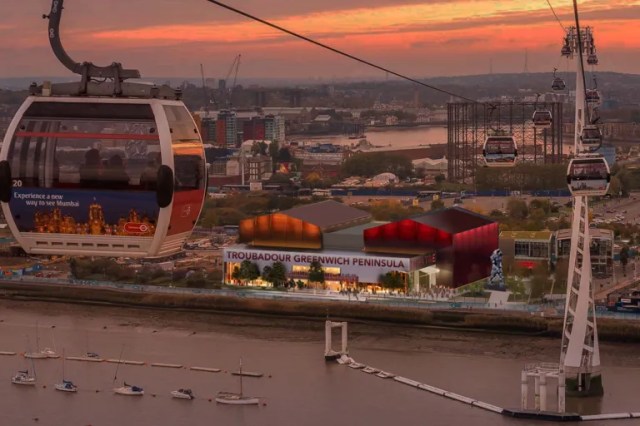
That same practical thinking drove the creation of Troubadour Theatres (one of which is hosting Dinosaur World Live), which builds flexible venue spaces outside the West End grid in places like Wembley Park, Canary Wharf, and North Greenwich.
“We in our industry are so obsessed with the West End,” Royds says. “No one can afford to live in the West End, and trying to get into the West End is sometimes pretty hard, especially on a day with three kids. It’s not fun. Our remit at Troubadour has always been to find spaces and venues that are easy for people to get to.”
Troubadour isn’t stopping there either. The brand’s footprint is scaling up fast, with major expansion plans and fresh site announcements currently in the works. “There’s more to come as well,” Royds hints. “Can’t talk about it quite yet, but hopefully next year there’ll be some more announced. It’s exciting. London is an amazing city in terms of culture, and to be able to have spaces that you can fill with different things – and to have spaces where you can put kids’ shows in – is great.”
At a time when young people are surrounded by screens, Royds sees live performance as more vital than ever. Beyond keeping venues viable, kids’ theatre acts as the essential grassroots engine for the entire industry. For Royds, it is where the future generation of audience members, actors, and backstage creatives are born.
“Children’s theatre is the grassroots of the theatre industry,” Royds points out. “It’s often overlooked, but it’s so important for the development of children’s imaginations, as well as having the ability to inspire the next generation of theatre makers and practitioners.”
The lifespan of a successful children’s show is unique in commercial theatre because the audience automatically refreshes every couple of years. A show like The Tiger Who Came to Tea can enjoy a ten-season West End run because a brand-new generation of toddlers enters the target age bracket each year.
That ongoing engagement creates a long-tail impact that extends far beyond the final curtain call. For a young family, a one-hour stage show often unlocks months of play, storytelling, and imaginative focus at home: “I mean, look, the The Tiger Who Came to Tea: the Tiger’s like Harry Styles for some of these kids! He’s their rockstar.”
“You go to see a show like Tiger, and then it’s not just the show,” Royds says. “The week after, it’s the obsession with the merch, the story, the characters – you’re essentially helping parents sort out hours of playtime and half-term activity with just one single trip to the theatre.”
“I think we’re actually really going to go through a golden era of live entertainment, as a reaction to the fact that everything else is on a screen or on a button,” Royds says. “That experience that we have collectively watching something is ingrained in our DNA since we sat around a campfire thousands of years ago. We need creativity and imagination probably more so than we’ve ever needed.”
A massive part of Nicoll Entertainment’s success comes down to their bespoke puppetry division, run in partnership with designer Humphries in Farnham. Producing massive, full-scale creatures like the ones seen in Dinosaur World Live and Dragons and Mythical Beasts, the workshop operates almost like an internal imaginarium.
Royds describes the scale of the puppetry as “War Horse on steroids,” but the real magic comes from the subtle, human craftsmanship built into each piece.
“The way Max and his team build them, and the way the puppeteers puppeteer them, sometimes you do sit there going, ‘Wow, it’s brilliant,'” Royds says. “The way they blink their eye, they become real characters. You can’t fool any kids.”
To heighten that connection, Nicoll Entertainment incorporates a post-show interactive session into every performance of Dinosaur World Live – affectionately dubbed the “M-E-A-T and greet”. Rather than keeping the audience behind the proscenium arch, kids are invited up onto the stage during the performance, and then given the chance to meet the puppets face-to-face afterwards.
“What we wanted when we created it with Derek Bond and the team was to make a dinosaur show that felt interactive, educational, and fun, but really up close and personal,” Royds says. “One kid came up to one of our baby T-Rex puppets during a meet and greet, looked over his shoulder, leaned in, and whispered, ‘Don’t worry, I won’t tell anyone you’re not real.'”




source on Google
Featured In This Story
Related Articles
See all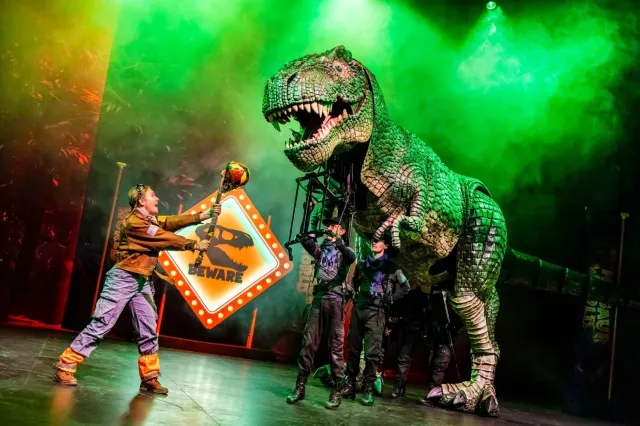
Latest Reviews
See all

Latest Videos
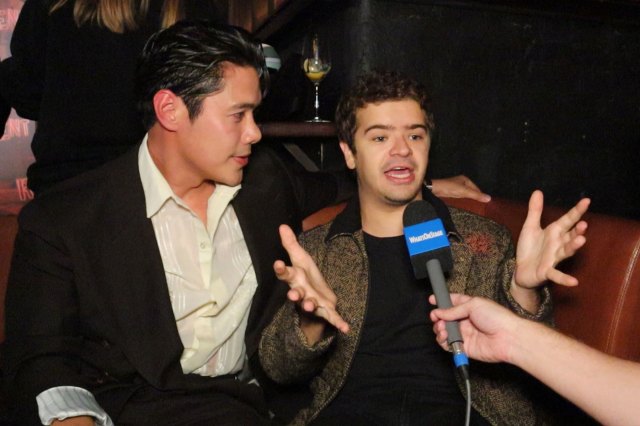
Gaten Matarazzo and the cast of Rent on living “La Vie Bohème” in the musical’s 30th anniversary year
Luke Sheppard’s West End revival is now officially open at the Tom Stoppard Theatre!