
Features
Jon M Chu pulls back the curtain on filming Wicked: For Good – and recalls the first time he heard Ariana Grande and Cynthia Erivo sing together
Chu was speaking today at the BFI in London
 |
Nationwide
|
|
Nationwide
|
10 October 2025
© Universal Studios
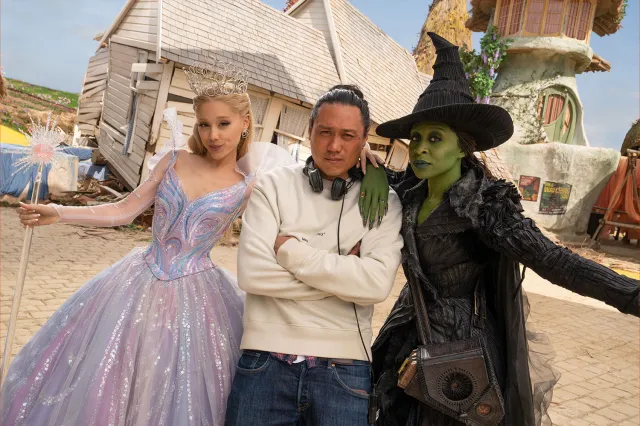
Director Jon M Chu, currently overseeing the gargantuan cinematic adaptation of the musical favourite Wicked and its second part, Wicked: For Good, was in conversation at the BFI London Film Festival this morning, offering remarkable insight into the creative and technical decisions that led to the two-film behemoth.
From redefining iconic musical moments to a meticulous logistical breakdown, Chu made it clear that adapting the Broadway and West End hit was less about translating the show and more about building a new narrative identity.
The most significant early decision was the split into two features, a move Chu described as a necessary “big move.” He revealed that the original single-film script was over 200 pages, feeling like a “mish-mash” and not a true cinematic piece.
“I knew whenever you join a project… you get, like, two or three weeks where you’re like – you can do whatever. You better do big shifts then,” Chu explained, to much laughter. The goal became defining the emotional core of the first movie to end satisfyingly with Elphaba’s flight. Splitting the narrative allowed the production the freedom to add significant backstory, including Elphaba’s childhood, which is largely absent from the stage show. This established her complex relationship with her powers from the beginning, ensuring the climax – the ‘Defying Gravity’ sequence – felt earned. Chu also noted that the film required a re-tooling of the action at Shiz, providing Elphaba with a clear obstacle: she was never meant to attend the university.
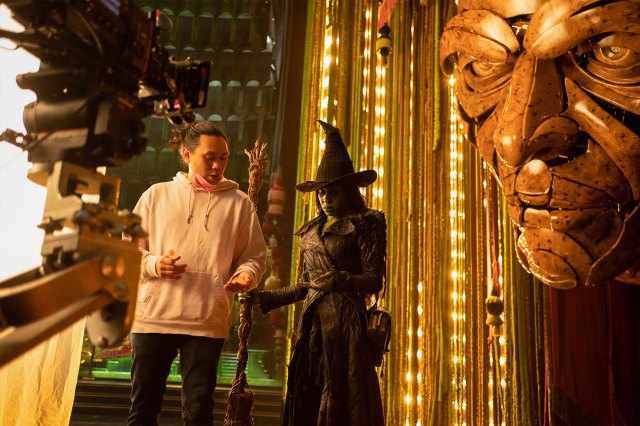
Filming was conducted simultaneously for both parts, presenting a “massive technical challenge.” Chu required 22 musical numbers to be “rehearsed, blocked, looked at, and budgeted by every department” before a single frame of film was shot.
© Universal Studios
To maintain clarity across this huge enterprise, every scene on a “big board” was assigned a single emotional quality, such as “yearning” or “courage.” This provided a blueprint for every department. Chu gave an example: “‘Yearning.’ I need to make the colours… she needs to be a totally different colour than everything else. Let’s make the set so that the set has a lot of negative space.”
Chu revealed a core philosophy for approaching a musical on screen: “I’m not making the movie. I’m getting all the ingredients.” He clarified that the on-set pressure is reduced by viewing the shoot as simply collecting the best options for the editor to “cook” later – a metaphor informed by his own experience growing up in a San Francisco family restaurant.
Chu was clear that the movie needed to find its own truth within the source material: he made the radical choice to make Elphaba fall first during the famous “Defying Gravity” sequence, reasoning: “She has to earn that flight.” As she falls, she sees her younger self, giving the flight a personal motivation, rather than a purely victorious plot point. Chu notes, interestingly, that Elphaba doesn’t vanquish anyone in that moment – it’s all an internal triumph.
For “Dancing Through Life”, Chu and choreographer Chris Scott invented a giant spinning chamber (said to be an insurance nightmare) for the Shiz library sequence. This decision was based on the need to explore the characters’ “relationship to gravity” before the climax. The initially “circular and perfect” sets of Oz represent order, which Elphaba’s journey is designed to “break”, with triangles and cracks.
A few teases for part two: for the song “For Good”, despite the temptation to go big, Chu realised it was the “most intimate” moment of their relationship. He scrapped “big shots” and cranes, realising the filmmakers had to “get out of the way, let them try,” resulting in a quieter, deeply emotional scene. In terms of bringing back old-school effects, Chu also stated that the Tin Man and Scarecrow effects are all practical, rather than digital.
Another tease: audiences were invited to watch a scene from Wicked: For Good, where Elphaba sneaks into Glinda’s apartment the night before her wedding to Fiyero, with the two then sharing a heartfelt selection of emotional beats. It ends with Glinda begging Elphaba to go and see the Wizard again, saying she “knows how to talk to him” – but Elphaba refuses.
Taking it right back to the beginning – Chu recalled the arduous casting process for Glinda and Elphaba. Whilst he initially wanted to “discover people,” the complexity of the vocals and acting required experience. Ariana Grande’s audition was so compelling – she “so funny and so real” but “had to earn it” – that it redefined the film’s identity. Chu stated that, by the end of Grande’s audition process, during which she even began to improvise and crack jokes aplenty, he felt that he was talking to the “real life Glinda” and that “the show was the interpretation of this person” years later. Another key aspect of this was to see whether Grande could access Glinda’s “vulnerability.”
The director admitted that there were no chemistry reads between the two leads after casting. “I knew who the best for Elphaba was, the best for Glinda was, it was undeniable,” he confessed. He and the team agreed: “If they hate each other, the film will pick it up, and that’s great [in numbers like “What Is This Feeling?’, for example]. If they love each other, it’s also gonna be great. Energy is energy.”
Cynthia Erivo, who spoke in her audition of singing Wicked as an escape during her early career, gave such an “expansive” performance of “The Wizard and I” that it showed the filmmakers “what this movie could be.” Chu said that Erivo recollected renting out rooms with friends just to sing Wicked together.
Erivo and Grande’s chemistry was first witnessed after they were cast, during the lockdown period, when they met with Chu and the creative team. Stephen Schwartz was present at Chu’s home. The composer asked if he should play, and the two actresses, completely unprepared, decided to sing “For Good” in the living room. It was the first thing they sang together. Chu, who filmed the moment on his phone with his children present, called the impromptu duet “devastating” and “a spiritual thing,” stating, “We knew what we had at that moment, all of us, and how special it was.”
Ultimately, audiences can’t deny that the energy is one of mutual love and care – epitomised in the lengthy Ozdust Ballroom passage – which Chu explained 14-minute-long takes in order to allow the two leads to build up to the emotional climax – though Chu had to prevent Grande from crying, as happened many times during auditions.
The director confirmed that the production relied heavily on the stars’ live singing on set, aided by a live pianist, which allowed the actors the freedom to deliver the songs with the necessary emotional rawness, regardless of tempo.
Chu’s parting message was that the film’s high-risk endeavour was driven by the desire to put “hard optimism” into the world, with the central theme being that “there is no expiration date for courage.”
The two-part saga will conclude when Wicked: For Good lands in cinemas on 21 November.




Latest Reviews
See all
Latest Videos
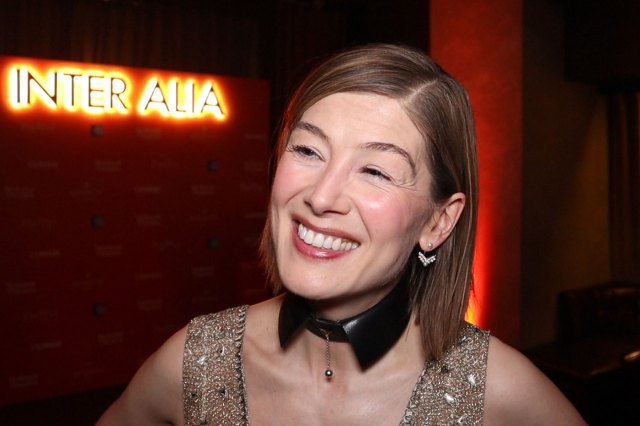
Rosamund Pike in Inter Alia – watch the West End opening night highlights
The National Theatre’s hit production follows in the footsteps of Prima Facie