
Designer Ben Stones on his gigantic, easter egg laden-design for Hamlet at the National Theatre
The show will be broadcast on NT Live in January
 |
London
|
|
London
|
19 November 2025
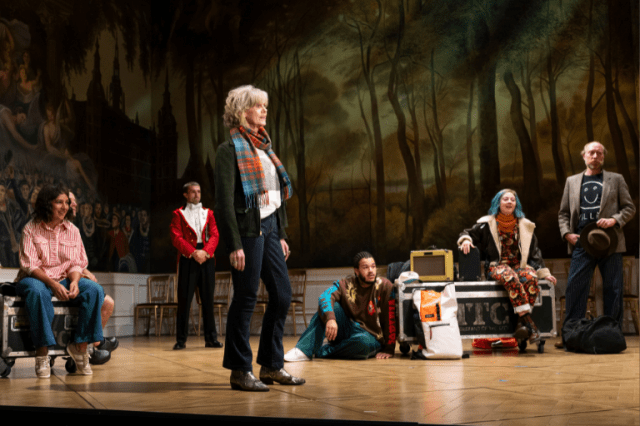
When Robert Hastie’s production of Shakespeare’s Hamlet opened at the National Theatre, critics and audiences alike were immediately struck by the sheer audacity of the set design.
Towering over the action was a colossal, hand-painted mural, a dizzying collage of historic Danish art – with a theatrical twist.
The man behind this all is Ben Stones, a designer known for his abstract, playful aesthetic, but who here embraced a complex hyper-realism. The mural is more than just decoration; it’s a dramatic, metatheatrical statement. It is fused with the recognisable visages of past Hamlets – all watching their successor from the walls of Elsinore. The immense painting, subtly twisted with the faces of former princes, frames the entire production, ensuring that this Hamlet is constantly aware of its theatrical lineage.
“It was Rob’s idea right from the beginning,” Stones explains. “He basically framed this by saying his Hamlet loves theatre, he’s a theatre beast, and he’s also a bit more meta – he knows he’s in a play. That allowed us to have so much more fun with referencing different styles.”
When asked about the challenge of creating such a monumental piece, Stones chuckles, conceding a comparison to a grand master. “The scariest thing was the start of it, seeing the scale of it as a blank canvas.”
He’s not wrong: the final piece is certainly monumental, requiring Herculean effort from the National’s legendary scenic art department. Stones shares the staggering statistics: the mural is 26.4 metres in length, 6.8 metres high (with 5.2 metres of painted area), and took 920 hours to complete.
The process itself was a profound act of artistry, a triumphant return to traditional scenic painting in an age dominated by digital printing. Stones is effusive about the skill of the team, supervised by Lindsay Tufnell, and led in technique by Charles Court.
“Printing has sort of overtaken scenic art in theatre,” Stones notes. “The National has one of the best departments in the country, and getting to use that resource was incredible.” Instead of the traditional grid method, the team used modern projection to scale up the image, saving hundreds of hours of tracing. Charles even “went and studied a lot of these early paintings so that he understood the way that the brushstroke worked with them and the intentions of them.”
The faces woven into the Danish artwork are the ultimate theatrical Easter egg. While Stones keeps the full cast list close to his chest, he confirms that they are all there – a complete history of the role.
“They’re all hidden in there. Everybody who’s been in it… even Tinuke Craig’s schools Hamlets, the three boys who played on that tour. We were very clear that if we include, we are including everyone who’s ever spoken those words in any version of this kind of play.”
The designer views the mural as a loving tribute, not a parody. “It’s a love for all of these people. It’s totally about an adoration for theatre from both myself and Robert. There’s no sort of snarkiness in any of what we’ve done.”
Stones reveals that the iconic mural-covered room was not the first concept. He and Hastie, while designing Hamlet remotely from New York whilst working on Operation Mincemeat on Broadway, initially conceived a world of all red curtains.
“We had this idea of it being all very theatrical, and it was all the red curtains, which happens in the middle of the play now. But that was the world of it.”
It was only upon returning to London that Stones felt the design wasn’t quite working for the show’s star. “It’s not right, it’s not playful. We’ve always wanted Hiran Abeysekara to have a sort of a playground for his ideas and the way he performs.”
The breakthrough came when Hastie referenced murals in traditional estates. Stones immediately found the modern equivalent he was looking for: Emerald Fennell’s Saltburn.
“That was the feeling I wanted from it: here is like a new world bashing up against, clashing with the old,” he explains. The design settled on an aristocratic estate, not necessarily Elsinore, populated by “not particularly nice people rattling around this old mansion.”
This shift to a hyper-realistic, yet decadent, setting felt like a departure for Stones.
“It was a slight departure from my abstraction, but it was in service of trying to be clear,” he says. Stones admits to a long-standing personal struggle with Shakespeare, which informs his design philosophy. “For me, the design is purely about clarity. Just be clear, you’ve got to help people sometimes when it’s their first Shakespeare. I don’t want anybody to sit and watch a Shakespeare I’m touching and be put off it for life.”
The design isn’t just visually stunning; it’s technically groundbreaking. The enormous mural isn’t painted directly onto hard wood but onto a canvas attached to a reusable modular flat edge with bungee ropes.
“It’s actually all on a canvas… so it’s a modular, a new thing for the National Theatre… It just wraps around it like a piece of clothing,” Stones explains. This sustainable method means the entire set can be transported for a potential New York transfer without incurring the environmental cost of building a new wooden set, proving that high design can also be environmentally conscious.
The design’s metatheatricality culminates in the Mousetrap scene, where the vast, muralled room transforms into a raw, contemporary theatre.
“We both wanted it to be the complete opposite to the style framing the show. There’s almost three styles within the show: there’s the room, there’s the curtain of the theatre, which gets a bit more abstract, and then there is the play within the play [during the grave scene], which is an entire form of theatre on its own,” Stones elaborates.
The designer admits that in this section, abstraction creeps back in, but always with purpose. At the end, the set remains slightly broken, reflecting Hamlet’s understanding that his world is an artifice.
“It’s all artifice, really. It’s, we are pretending this is a room, but it’s, Hamlet knows he’s in a play in a way. He can step out of it and we can break it all apart.”
Stones is quick to deflect the praise for Hamlet, reiterating his gratitude for the artisans who brought his vision to life – chiefly Tuffnell, Court, Danielle Barr, Maya Kazmarski and Lauren Jones, alongside apprentice painters Jade Boycott and Lily Cleaver. “It is a huge thank you to those, the scenic artists of the National Theatre, because honestly, you can’t design something like this unless you have those people.”
He hopes the Hamlet design serves as a vivid reminder of the craft. “It’s an art that isn’t in every theatre anymore. It really does change it, ’cause you can’t edit a print in the same way we’ve been editing this mural.”
Hamlet is going to cinemas via NT Live from January (people can find tickets on the NT Live website) and going to BAM in New York in April.












Latest Videos

I’m Every Woman – The Chaka Khan Musical releases new trailer
Performances begin at Hackney Empire this week