Who’s Afraid of Virginia Woolf? at Oxford Playhouse – review
Mike Tweddle’s revival of the Edward Albee classic runs until 7 March
 |
Oxford
|
|
Oxford
|
25 February 2026
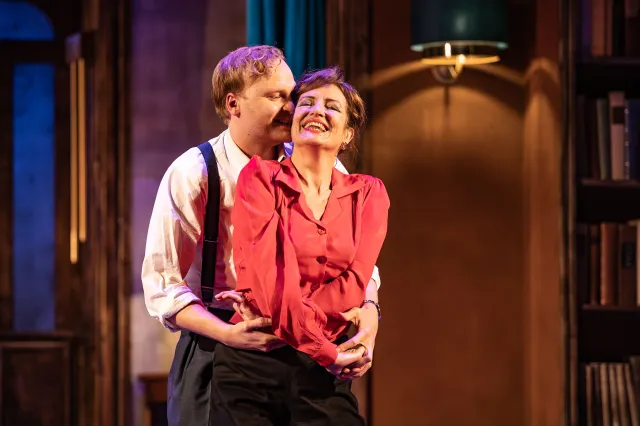
Who’s Afraid of Virginia Woolf? is, famously, a play about a married couple who rip each other to shreds in an escalating display of visceral hatred. But that’s not exactly what is happening in this Oxford Playhouse revival. The cruelty and poison are there, but along with them is a deep and desperate longing, and a couple who need each other; who understand, love and desire each other; who are bound together in grief and regret, and cope with it by playing violent, abusive games. In Mike Tweddle’s visionary production, Edward Albee’s masterpiece ceases to be a car-crash at which the audience rubbernecks in horror, and becomes a tragedy for us all.
Mike Nichols’ blistering film has cast a shadow over this play ever since 1966. Elizabeth Taylor’s and Richard Burton’s tantrums were so personal that the film became almost a prurient peer through the Hollywood keyhole at their own marital crises. They made it about them. This production exorcises those celebrity demons.
And it does it with a cast of astonishing power. Katy Stephens as Martha is sensual, spiteful, cynical, pitiable, loathsome, lustful and tender – occasionally all at the same time. She stalks, high-heeled and hunched, after her prey, like a Gerald Scarfe cartoon from The Wall. And her voice, switching from deep, deliberate drawl to agonised screech at the drop of a whisky glass, is bewitching. Her long-suffering husband George, played by Matthew Pidgeon, is a reservoir of resentment disguised as charm: patient as a crocodile waiting to strike, but no less vulnerable and damaged himself.
Leah Haile (Honey) and Ben Hall (Nick) are like lambs to the slaughter when they enter their new friends’ home for a “friendly drink” at 2am. But even in the supporting roles, both actors shine. Honey’s frailty is no two-dimensional 1960s cardboard cutout, but a veil for deep scars of guilt, and Nick’s apparent nice-guy image slowly strips away to reveal an exploitative, rapacious social climber. No one gets out of this play alive.
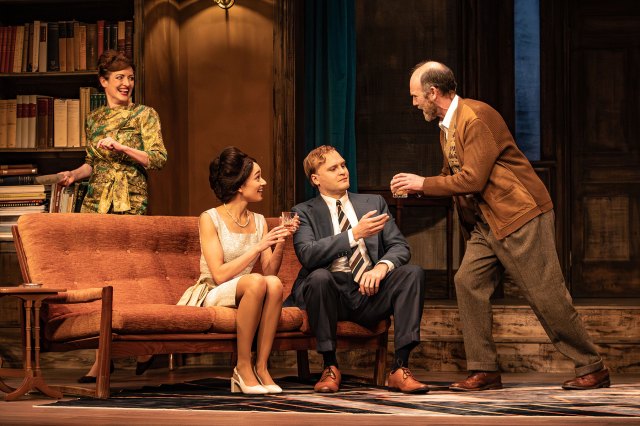
Director Tweddle’s production constantly nibbles at the fourth wall and introduces unrealistic elements that crack open the sealed living room on stage. At the start, there’s the sound of an orchestra tuning up, as if to remind us that what we’re watching is no more than performance. And whenever a character has an extended, lyrical anecdote, they step down onto the forestage, occupying a different mental plane. At one point, Martha fiddles with the stage curtains. It’s such a simple action, but the effect is remarkable: she’s simultaneously adjusting the curtain in her own living room and in our theatre. The barrier between cast and audience finally breaks down entirely at the start of the final act, when Martha appears unexpectedly in the stalls, before the interval has even ended, yelling drunkenly. (The Oxford audience stiffens momentarily in concern: has anyone called security?) It’s a theatrical masterstroke: the monster has got loose from its cage, exiled from the fiction of the play and stranded in the real world, searching for some kind of, any kind of, human connection. It’s The Purple Rose of Cairo come to life. If Albee’s original play was a metaphor for the selfishness and alienation of American life, this production is about a universal need for empathy and understanding at a time when so many are polarised.
Liz Ascroft’s set is a phenomenal realisation of all this production’s ideas. While functioning as a standard living room, it is actually a set of nested proscenium arches, receding away from us like endless reflections in a pair of mirrors. The characters aren’t just moving around their world, but moving through different layers of deception and performance. And (again appropriately for Oxford) they are surrounded on all sides by bookshelves stuffed with academic tomes. The books entrap them, dense, unread, uncompromising, like the prison walls of the university from which they can’t escape.
Who’s Afraid of Virginia Woolf? is the Playhouse’s first home-produced show in 20 years. On this evidence, it certainly won’t be the last.