
The Holy Rosenbergs at Menier Chocolate Factory – review
Lindsay Posner’s revival runs until 2 May
 |
London
|
|
London
|
10 March 2026
Timing is everything. In 2011, Ryan Craig wrote this play about a north London Jewish family being pulled apart by politics against the background of the first Gaza war, the three weeks at the turn of 2009 in which Hamas and the Israel Defence Forces battled in a conflict that left between 1,166 and 1,417 Palestinians and 13 Israelis dead.
Watching Lindsay Posner’s powerful revival at the Menier Chocolate Factory, slightly tightened and focused but still set in 2009, its resonance in the midst of a far more destructive conflict in Gaza – and now a wider war in the Middle East led by Israel and the United States – seems almost deafening.
The principal difference is that Craig’s play focuses on the tensions created when Ruth (Dorothea Myer-Bennett), a Jewish human rights lawyer, agrees to work on a UN report trying to determine whether war crimes have been committed by the IDF (and Hamas) in the course of the fighting. Today, the conflict seems to spiral outside the conventions of those international laws and peace-making bodies.
But the play’s strength is that it grounds its arguments so firmly in a family, bound by tradition and love but separated by politics. David Rosenberg (Nicholas Woodeson) is a catering magnate, mainstay of the Edgware Jewish community where his family has lived for generations, fighting to bring his business back from ruin after a woman dies after one of his kosher feasts.
It’s vital that his status is not threatened. But antagonism to Ruth’s involvement in the fictional Crossley report (based on the real Goldstone Report) means that when she returns for the memorial for her brother, killed fighting for the Israeli Defence Forces, his entire livelihood and his patriarchal position are both at stake. He is also at odds with his other son Jonny (Nitai Levi), struggling to define his role.
The opening act, which draws up the lines of engagement, is utterly compelling. The arguments about whether Ruth’s attendance at the memorial is hypocritical or powered by love, the need for fairness, justice and decency when a nation is engaged in a struggle for its survival, and the rise in antisemitism, ping around alongside family jokes, the pressing of marble cake on a constantly wrong-footed Rabbi (“He’s a rabbi, not a spaniel”) and the setting of the table with the best silver for an all-important dinner.
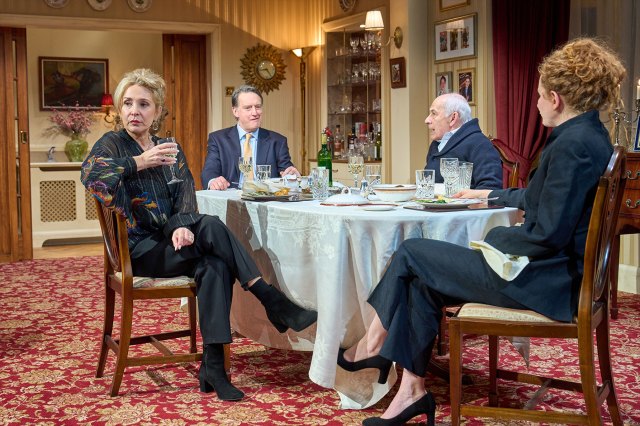
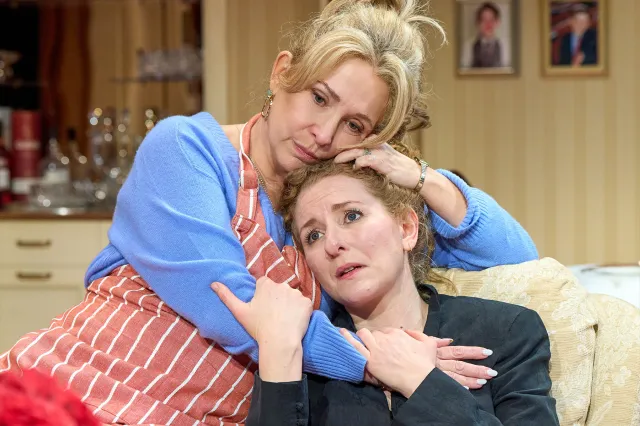
The cast are simply superb, with Woodeson perfectly capturing the mixture of defiance and exhaustion that is powering David’s self-delusions, and Tracy-Ann Oberman as his wife Lesley disguising her fury (at her daughter), grief (at the death of her son) and worry (about her husband) under a constant round of business and fuss. She endows every line with truthful force, while Myer-Bennett brings to Ruth the knowledge of a woman sure of her convictions, while absolutely knowing what she is sacrificing. The scene where the two huddle in a chair, remembering their lost boy, is very touching.
Tim Shortall’s designs ground the truth-telling in a convincing suburban room, its slightly shabby furnishings and fittings having seen better days, the ever-present neighbours’ homes just visible outside the bay window. In the second act, the carefully wrought sense of reality gets stretched by the arrival of Ruth’s boss (played with casual intellectual elegance by Adrian Lukis), who gets engaged in an over-emphatic, though still fascinating, argument with the synagogue chair Saul (Dan Fredenburgh) about the need for Israel’s right to defend itself and the primacy of human rights.
Craig also begins to lean heavily into a discussion of familial guilt that owes too great a debt to Arthur Miller’s All My Sons, and the final confrontation between Ruth and her father doesn’t quite ring true. But Posner and his cast make sure the tension never lessens. The Holy Rosenbergs is an imperfect play, but a brave and intelligent one too.






Featured In This Story

Related Articles
See all




Latest Videos
I’m Every Woman – The Chaka Khan Musical releases new trailer
Performances begin at Hackney Empire this week