
Safe Space at Chichester’s Minerva Theatre – review
The world premiere of Jamie Bogyo’s debut play runs until 8 November
 |
Chichester
|
|
Chichester
|
20 October 2025
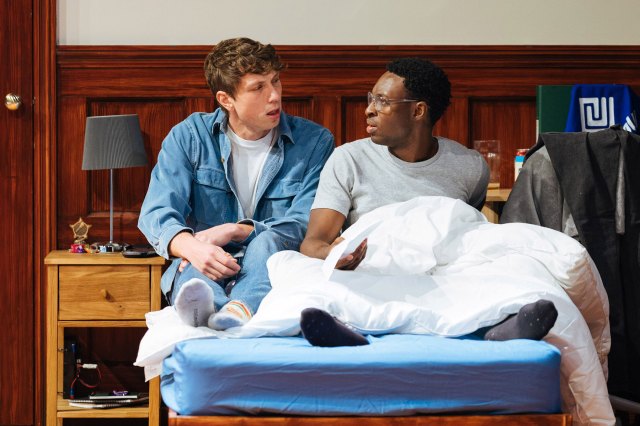
Inspired by real events at Yale University in 2016/17, Safe Space marks the final production in the 2025 Chichester season as well as the debut piece of writing for Jamie Bogyo. We’re at the end of the Obama era and Trump is about to take power for his first term. The Black Lives Matter movement is yet to get the traction that it will later find, but in university campuses around the world discourse and debate is already well underway.
Amongst the well-manicured Ivy League colleges, Calhoun College formed part of Yale University, named after the former Vice President of the USA and great proponent of the slave trade. The student body are campaigning to change the name of the college and to disassociate from Calhoun.
It’s become a familiar argument in organisations, venues and locations all around the world. Is it just cancel culture to remove the players that shaped our history from public conscience, or is it absolutely the right thing to do to remove any kind of honour related to those that were part of such scars on our society? This is the background to which Bogyo writes his quintet of characters, all students at the college.
The potential for heavy debate is giving levity with the introduction of the Glee Club. A cappella singing provides the surprisingly upbeat opening with interspersed moments of musical relief throughout. Bogyo writes with clarity but mostly fails to real get under the skin of the issue. Asking if Calhoun was a “product of his time” and if that should excuse his actions, quickly becomes a side show to the personal lives of the five students. What he does successfully manage though is to expose the hypocrisies and contradictions in the lives of the campaigners from all quarters.
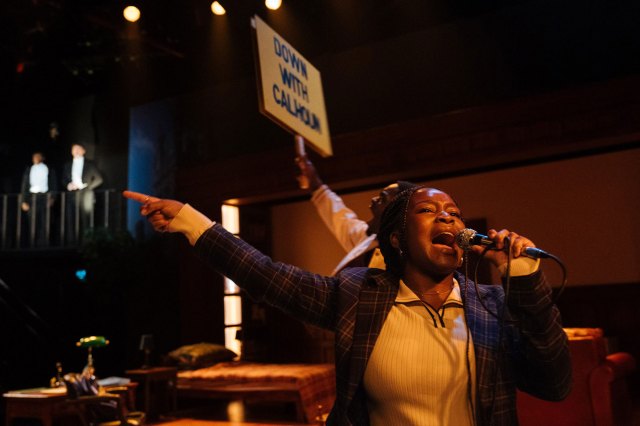
Ernest Kingsley Jr’s Isaiah is a level-headed Black student that is reluctant to enter into the debate and believes that “this is not the battle that Black people should be fighting”. Kingsley Jr is filled with likeable charm and plays Isaiah with a heart that appears heavy, not wanting just to be “how a Black man is expected to be”. There is a beautiful moment when Isaiah sings John Legend’s “Ordinary People” – the weight of the fight lifts from his shoulders as the universal leveller that is music frees him into his own world.
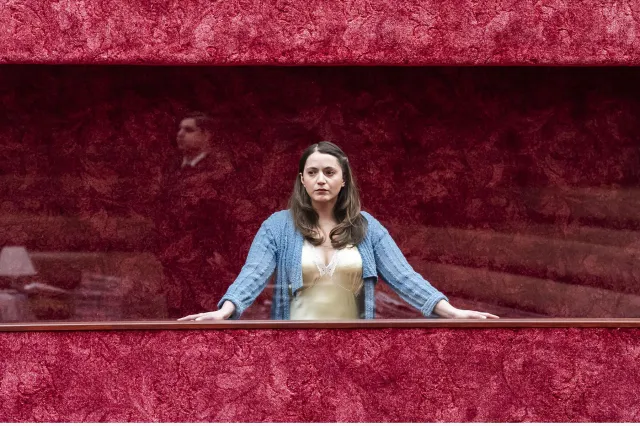
His best friend is a privileged young Republican, played by Bogyo himself. Connor is bullish and keenly fixed on tradition. He’s clearly not racist, he “voted for Obama” but is leading the charge to retain Calhoun’s name above the door. Connor’s girlfriend Annabelle is given feisty energy by Celine Buckens. She is the white virtue signaller, not “just a snowflake but an entire blizzard” according to Connor. She’s up for every fight and is campaigning to become the President of the Women’s Leadership. A blink-and-you-miss-it moment reveals her true self as she suggests that the winner of the contest, fellow Black student Stacy, may just be a diversity hire.
Bola Akeju’s Stacy moves from giggly young freshman to hell-raising activist in ludicrously quick time, whilst Ivan Oyik’s firebrand Omar, the revolutionary leader of the fight to change, makes the opposite rapid move and reveals his own ironic privilege that anti-climatically domesticates his character.
Bogyo paints the narrative in too many broad strokes. The pivotal plot point of Calhoun becomes lost amongst bed-hopping horny teenagers with personal agendas, never settling on what the real argument should be. We touch on class and privilege with quite a bit of women’s rights too. It’s all important stuff, but as a whole becomes an overmixed cacophony of under explored narratives.
Director Roy Alexander Weise attempts to theatricalise the writing, but it remains largely stuck in neutral. Loose ends are all quickly and conveniently tied up and broken relationships are all too easily fixed with a song. These are conversations that should be messy and provocative, but Bogyo keeps everything frustratingly neat and tidy – we all know that’s not how the real world works.






Related Articles
See all


Related City Guide

Latest Reviews
See all






Latest Videos
New musical FlyBy – have a first listen
New musical alert!