
Romeo and Juliet with Sadie Sink and Noah Jupe – review
Robert Icke returns to the Harold Pinter Theatre with another Shakespeare tragedy
 |
London
|
|
London
|
1 April 2026
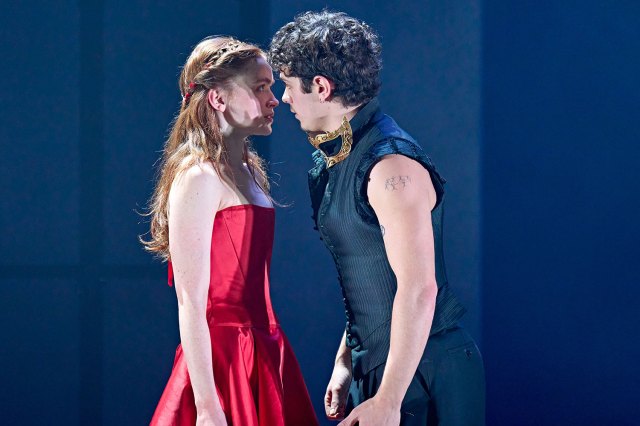
Spoiler alert. The star cross’d lovers still die at the end. But Robert Icke’s production of Shakespeare’s tale of woe, starring Sadie Sink and Noah Jupe, does everything it can to keep the suspense going.
Noticing that the play is built on coincidence and is full of “what if”s that could have turned tragedy into comedy, Icke creates a sequence of sliding door moments, marked by blinding flashes of light, that actually show an alternate version of the play.
They aren’t always the obvious ones, though the messenger who is stopped from reaching the banished Romeo because of the plague, is also shown arriving to deliver his all-important news that Juliet isn’t actually dead.
But Icke asks intriguing additional questions. Supposing the messenger hadn’t got muddled with his party invitations and told Romeo and his fellow Montagues about the party at the house of Lord Capulet, the family’s arch enemy? Or imagine if a waiter hadn’t spilt a tray of down Paris’s front just as he was about to meet Juliet, so that Romeo sees her instead.
That scene is wonderfully handled on Hildegard Bechtler’s elegant set of sliding panels, where Juliet, in angular red dress (the costumes are a mixture of contemporary and slightly Elizabethan) is framed, frozen, against the disco lights in the background, blindsided by love.
When she and Romeo express their love in a balcony scene that puts her on the bed, and Romeo below the stage, both Sink (of Stranger Things fame) and Jupe (making his stage debut after his appearance in Hamnet) perfectly capture their youthful excitement in the glory of the thing, she jumping up and down on the mattress for pure abandoned joy.
Later, as the mood darkens, they are perhaps a little too histrionic, skating on the surface of the words, and losing the clarity that both exhibit in the earlier stages. Sink is at her best when she’s at her stillest and most earnest, gazing into her lover’s eyes with feverish excitement and determination; Jupe has moments when his boyish exuberance is tempered by a growing wonder. But the chemistry between them seems to dissipate as the mood grows darker.
This is partly because the intelligent questions raised by Icke’s approach, slow down the more propulsive elements of Romeo and Juliet’s headlong plunge towards tragedy. The sheer speed of their trajectory is emphasised by a digital clock that appears intermittently to tick down their four days from meeting to death. But their emotional journey feels less freighted.
As if to increase its significance, Icke rifles his director’s toolbox and crosscuts Shakespeare’s scenes so that Juliet’s waiting for her marriage night takes place at the same time as Romeo’s banishment (in bloody T-shirt) for killing Tybalt (a wasted Aruna Jalloh). After Juliet takes the poison, the ensuing wedding preparations become a voiceover in a nightmarish soundscape (by Giles Thomas) while Jon Clark’s exceptional, varied lighting and Ash J Woodward’s videos throw shifting digital numbers of a screen above her head to mark the suspension of time.
It is never less than interesting, but whereas in his productions of Hamlet and Oedipus, Icke’s analytical mind added to the tragedy, here it sometimes pulls against it. Apart from a heart-wrenching moment in the tomb when – in the final sliding door – Juliet sits up, awake, as Romeo enters. Which is what all romantics always wish.
Generally, however, the rigour of his approach pays off best in the surrounding roles. Clare Perkins is magnificent as the Nurse, bustling and full of self-importance, but also of wisdom and warmth. When the mood turns against Romeo, her practical advice is delivered with great tenderness though fiercely rejected by Sink’s febrile Juliet.
As Mercutio, Kasper Hilton-Hille is genuinely dangerous, charismatic and slightly frightening as he lowers his tights at all comers. He turns his death scene into a real joke, until suddenly stripping off his shirt to reveal the blood beneath. Dylan Corbett-Bader and Jamie Ankrah make something out of nothing as Benvolio and the put-upon Capulet servant Peter, while Eden Epstein conjures an entire back story for a terrifyingly neurotic Lady Capulet in a few brief minutes.
It’s a production full of closely observed detail, that refuses to take any element of the heady story for granted. If it isn’t quite up there with Icke’s best, that’s only because he has set the bar so high.
Listen to Sink and Jupe discuss the show in our dedicated podcast here:






Featured In This Story

Related Articles
See all



Latest Reviews
See all




Latest Videos

Sadie Sink and Noah Jupe make their West End debuts in Romeo and Juliet – watch the highlights
Robert Icke’s new production is officially open at the Harold Pinter Theatre!