
Cyrano de Bergerac with Adrian Lester at the RSC’s Swan Theatre – review
Simon Evans and Debris Stevenson’s adaptation of the Edmond Rostand classic runs until 15 November
 |
Stratford-upon-Avon
|
|
Stratford-upon-Avon
|
8 October 2025

Romantic, funny, poignant, philosophical and ultimately profoundly sad, this production of Cyrano de Bergerac has just about everything. It’s utterly exquisite, perfectly judged from the flourish of the adaptation to the size of Adrian Lester’s prosthetic nose.
Under the direction of Simon Evans, who, with the poet Debris Stevenson, provides a subtle, cleverly updated version of Edmond Rostand’s 1897 original, this Cyrano does a very rare thing: it celebrates the pleasure of simply allowing its audience to be absorbed in a terrific narrative, brilliantly told.
It is full of art and artifice, but it is content to be direct and unassuming. And it is powered by a performance of such finesse and feeling from Lester – astonishingly making his RSC debut – that you keenly feel his long absences from the stage.
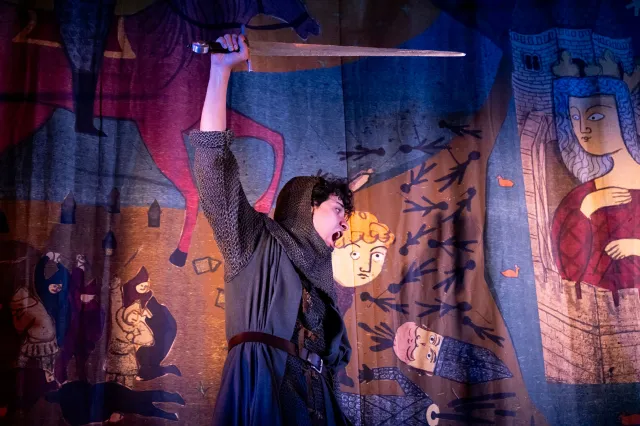
Everything about it leans into a sense of wonder. It opens with a half-mystical scene of the boy Cyrano, already embarrassed by his nose, being addressed by the gentle baker poet Ragueneau (a warm Christian Patterson) before sweeping into the swagger of a red velvet-curtained theatre where Cyrano the adult makes his appearance, swishing his sword, indulging in clever word play to better his enemies.
Lester commands the space. His timing, his pauses, as well as his words, the way his eyes light up when he sees an opportunity, are superb. But so too is the humour. The scene introduces the running joke whereby Cyrano has won a band of musicians in a bet, and they strike up Alex Baranowski’s eloquent music whenever he speaks. Even Joshie Harriette’s rich lighting changes when he hits a flight of poetry.
But what’s wonderful about the production and Lester’s performance is that from the very beginning, it shows Cyrano’s vulnerability beneath the swagger, the way that a man who seems so full of confidence has let himself believe that he is not worthy and does not deserve his own chance of happiness with Susannah Fielding’s spirited Roxanne. His excitement when he believes she loves him is infectious.

Once he starts to woo her on behalf of the handsome but inarticulate Christian (Levi Brown), his fate is sealed, and the play’s complex web about honesty, truth and human fallibility begins to be woven. By the end, Cyrano has no words, only an inarticulate sense of love.
Everything about this unlikely love triangle is beautifully conceived. Brown’s Brummie Christian – whose main skill is knowing collective nouns for every farmyard animal – is terrific, slightly baffled by everything happening around him, dim but not stupid, worthy of affection. And as Roxanne, Fielding catches exactly the qualities Cyrano describes in her – “sharp…laughs with her mouth open” – presenting a woman who is excitedly seizing her chance to live.
The wooing scene where Cyrano adopts the voice of Christian is perfectly controlled, full of feeling and physical comedy as the three of them fall over their own misapprehensions and the musicians, who are still on stage. Lester’s double take as Christian nearly blows the elaborate pretence – “whose sarcophagus am I speaking from?” – is a joy.
In fact, everything in this production is a pleasure, from the colours of Grace Smart’s costumes and set to the way that light seeps from the piece as the mood darkens and the soldiers go to war. Yet the wit and the humanity stay in place, and every member of the ensemble – from Greer Dale-Foulkes’ witty Abigail to Philip Cumbus’s wise Le Bret and Scott Handy’s Le Guiche – all play their part in making this a memorable evening. It’s a triumph.





Related Articles
See all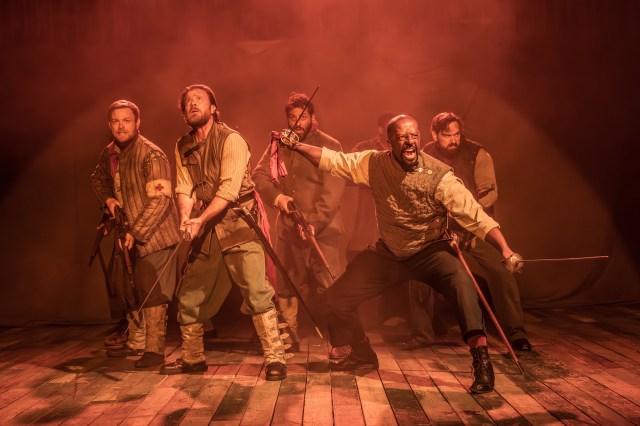




Related City Guide
Latest Reviews
See all






Latest Videos

Miss Saigon releases new trailer as West End run goes on sale
The heat is on… with a West End run next year!