
The Ladies Football Club at Sheffield Crucible Theatre – review
The world premiere production, written by Stefano Massini and adapted by Tim Firth, runs until 28 March
 |
Sheffield
|
|
Sheffield
|
6 March 2026
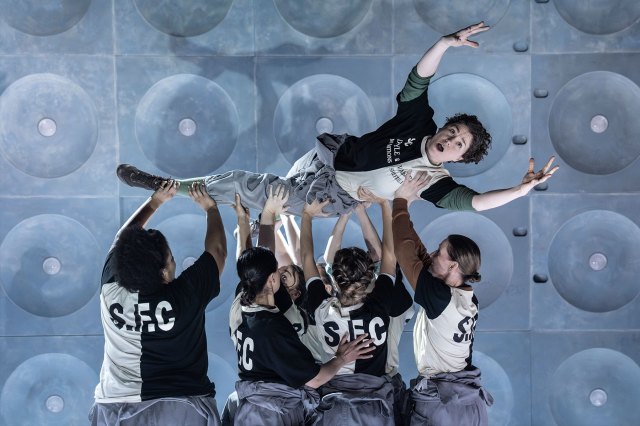
It’s difficult to say why a production that ended in a wildly enthusiastic standing ovation left me comparatively underwhelmed. Perhaps it’s that the events surrounding the beginnings of women’s football during the First World War, which are fictionalised here by Stefano Massini and adapted by Tim Firth, are now far better known than the programme and the play suggest.
Clearly, the inspiration is Dick, Kerr Ladies of Preston. Complete with their distinctive bobble hats, they formed a team for a charity match on Christmas Day 1917 and went on in the next few years to dominate the ladies’ game, playing in France and America and attracting enormous crowds. The team withstood considerable setbacks: in 1921, giving a demonstrably false medical reason for what was naked self-interest, the Football Association banned women’s matches from grounds under its jurisdiction (the ban lasted until 1970), and then the firm which had originated the whole thing, Dick, Kerr & Co., withdrew their support for the team. Changing the name to Preston Ladies, the team survived until 1965, playing on smaller grounds outside the FA’s influence and raising huge sums for charity.
Massini chooses, however, not to shine a full spotlight on such determination against the odds in The Ladies Football Club. They work for a fictional armaments manufacturer in Sheffield and, having played a handful of games, are invited to Stamford Bridge to compete against an all-star team of professionals. Then, as World War I ends, most of them are laid off as the men return, and the FA ban comes into force. So the story ends, except for a strangely moving coda about their future lives and the next but two generation, represented by Violet’s great-granddaughter Maia.
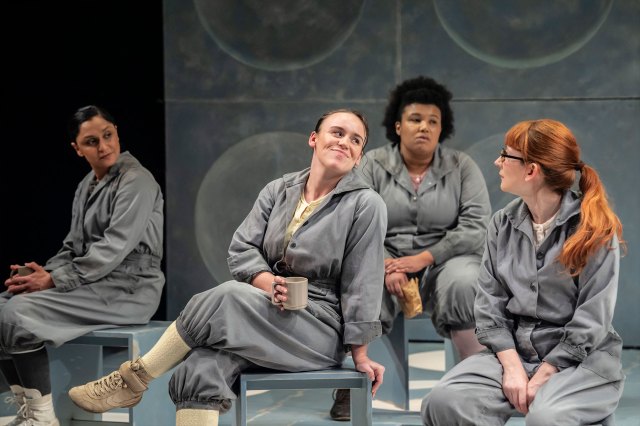
The events of World War I are an ever-present background, but the football matches are staged in a distinctly cartoonish way, from the women playing with a bomb-within-a-football to Olivia dancing through the defence to score… an own goal! Director Elizabeth Newman and movement director Scott Graham fill the stage with precisely animated, physically demanding, often witty activity in the football scenes and three composers (Ella Wahlstrom, Steve Parry and Firth himself) ratchet up the drama.
Newman cleverly gives us two 45-minute halves (though with a bit of injury time) and 11 named characters, all of whom present their problems and idiosyncrasies in some of the quieter moments – it is a very noisy production!
The cast perform nobly, not only in the action scenes, but in projecting themselves as individuals: the Marxist, the one with her private world, the fierce Scot, the omniscient reader of magazines, and so on. Stories emerge from the surrounding teamwork. Standouts include the little and large duo of Olivia (Bettrys Jones) and Justine (Anne Odeke) and the double act of Violet (Cara Theobold) and Rosalyn (Jessica Baglow), which sets the tone for the whole piece with their narrative exchanges.
It’s certainly “an event where movement, music, sound, light, design and words come together”, as the programme puts it, with Grace Smart’s designs opening up the space in front of a screen with mobile projections of everything from the score to images of the factory layout, but I would only question what we learn from it.






Related Articles
See all


Latest Reviews
See all



Latest Videos
Rosamund Pike in Inter Alia – watch the West End opening night highlights
The National Theatre’s hit production follows in the footsteps of Prima Facie