
Les Liaisons Dangereuses with Aidan Turner, Lesley Manville and Monica Barbaro at the National Theatre – review
Marianne Elliott’s revival runs in the Lyttelton Theatre until 6 June
 |
London
|
|
London
|
2 April 2026
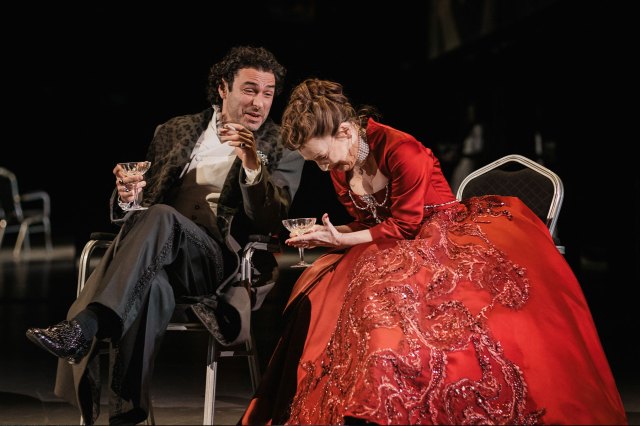
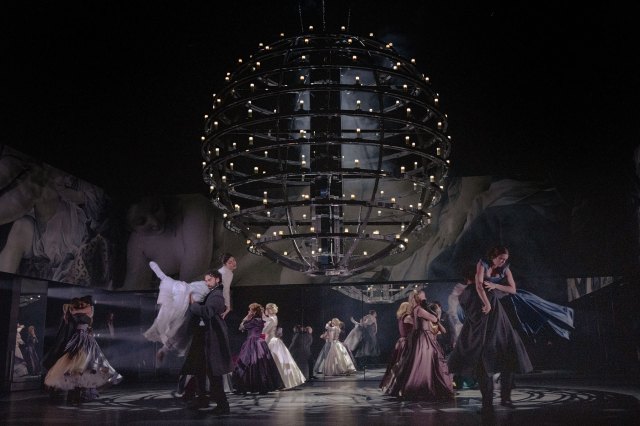
In a mirrored dance studio, overhung by an erotic frieze, evening-suited men lounge louchely, smoking cigarettes. Then the central doors swing open and a glittering, elegant figure in a red ballgown is revealed: Lesley Manville’s Marquise de Merteuil has arrived. It is her party, but it is the men who begin the dance, sweeping the women in peacock satins around the floor.
From its opening moments, Marianne Elliott’s production subtly reconfigures Christopher Hampton’s Les Liaisons Dangereuses for the MeToo generation. In a world where love is a battle of single combat, a hand-to-hand struggle for survival, women are constantly melding themselves to the shapes and behaviour demanded by the men, who still hold all the cards.
When Hampton first adapted the play from the epistolary novel of Choderlos de Laclos in 1985, Alan Rickman memorably played the rakish Valmont, Merteuil’s co-conspirator and former lover, as a lizard-eyed seducer, cold-hearted until his world is utterly upturned by falling in love with one of his prey.
Aidan Turner endows him with the conspicuous charm that Merteuil ascribes to him, making him puppyish and almost clownish until he reveals the pure power and malice beneath. He is sexy, but the sex almost doesn’t matter. It’s the pursuit that counts.
The conniving couple are bored, rich and morally hollow. Yet the key scene between them is the one where Merteuil reveals how she has gained dominance in this brittle world as he watches, concentrated like a cat. “Win or die,” she concludes, and Manville, who is terrifyingly magnificent, gives the words frightening, icy force.
Later, she stands in front of one of the mirrors that are constantly moving around Rosanna Vize’s fluid set, where servants wheel beds and walls into place, and examines her body critically. Alongside her stands Hannah van der Westhuysen’s Cecile, the convent girl ruined by Valmont as part of a bet. As the younger woman takes off her clothes, happily, revelling in her sexual power, Manville’s Marquise covers herself up. She might let her hair down to pretend she is still young, but age is catching up with her; her influence is waning.
This awareness adds a tragic dimension to her fall, and it’s emphasised by the fact that Hampton has slightly rewritten the play to give Cecile more power. Valmont may have raped her, but she has learnt to fight back. She has become Merteuil. The fact that Manville played Cecile in the first production of the play gives their final confrontation extra resonance.
Elliott – returning to the National as a director after more than a decade – has created a sumptuous, expansive picture of a decaying society, rotten at its core. Natalie Roar’s costumes, mixing 18th-century shapes with more modern detail and sparkle, fill the stage with colour and passion which contrasts with the monochrome creams of the servants, and the plain pastels worn by Madame Tourvel, the woman who loves both God and her husband and whom Valmont, with almost boy like determination, is determined to seduce for the sheer challenge of it.
Monica Barbaro (so good as Joan Baez in A Complete Unknown, and making her stage debut) plays her with tremulous directness, a woman genuinely surprised by the strength of her feelings, and desperate to escape them. In a marvellous scene that closes act one, Tom Jackson Greave’s choreography, which sculpts the entire production, sets her racing in a circle around the stage, frantically running away from the world.
That moment is characteristic of the intelligence of the whole evening. It takes a play that has become a classic – inspiring films and TV series – and asks new questions of it. There’s no doubt that its themes have become more troubling as time has gone on. But Manville and Turner are simply superb, their performances deep and thoughtful. They make the characters fallibly human, and Elliott makes the evening sing.






Featured In This Story

Related Articles
See all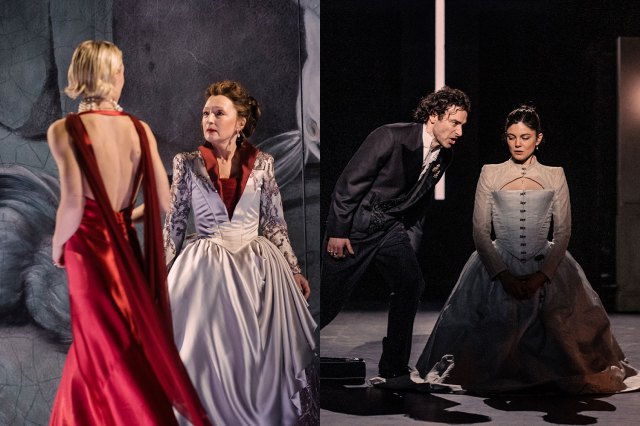

Latest Reviews
See all




Latest Videos

Rosamund Pike in Inter Alia – watch the West End opening night highlights
The National Theatre’s hit production follows in the footsteps of Prima Facie