John Proctor is the Villain review – The Crucible on trial at the Royal Court
The UK premiere of the hit Broadway play runs until 25 April
 |
London
|
|
London
|
27 March 2026

The setting is a school classroom in a one-stop town in Georgia, USA, a place so small that to travel ten miles makes you an outsider. But the themes of Kimberly Belflower’s dazzling play are universal.
She takes a group of what in the UK would be six formers studying Arthur Miller’s classic play The Crucible, where their popular English teacher Carter Smith (Dónal Finn) is excited to tell them that John Proctor is the hero, a man of integrity and honour. He writes hero on the board in capital letters, as he tells them, “That’s what art is for – to make sense of moments in time like this one.”
Because this is 2018, the moment when the MeToo movement is taking off, and the idea of justice looms large. This group of bright young women has already fought the School authorities to set up a feminist society – “to spread awareness, foster dialogue, and ignite change,” as studious over-achiever Beth (Holly Howden-Gilchrist) explains. And when they start to dig deep into The Crucible they begin to reach the conclusion expressed in the play’s title.
Belflower’s skill in writing this exuberant, perceptive and absolutely essential play is that she has a lot of cakes and eats them. This is at one level, a high-school comedy, with all the characters fulfilling stock roles. Apart from Beth, there’s opinionated Nell (lively Lauryn Ajufo), a newcomer from Atlanta, rich-girl Ivy (Clare Hughes), and serious Raelynn (Miya James), who has taken a chastity pledge because her father is the minister at the Church most of the town attends.
Then there is an inept but surprising school counsellor (Molly McFadden) and two boys, dim but willing Mason (Reece Braddock) who takes his role as an honorary feminist seriously, though quite often gets it entirely wrong – and the threatening Lee (Charlie Borg) once boyfriend of Raelynn, who left her to sleep with her best friend Shelby (Sadie Soverall).

It is Shelby’s return to school, after a mysterious three-month absence, that acts as an incendiary device, blowing up all the women’s certainties and forcing them to reassess what they know, who they can trust. As in The Crucible, it becomes a question of who is to be listened to, who has the right to have their word believed.
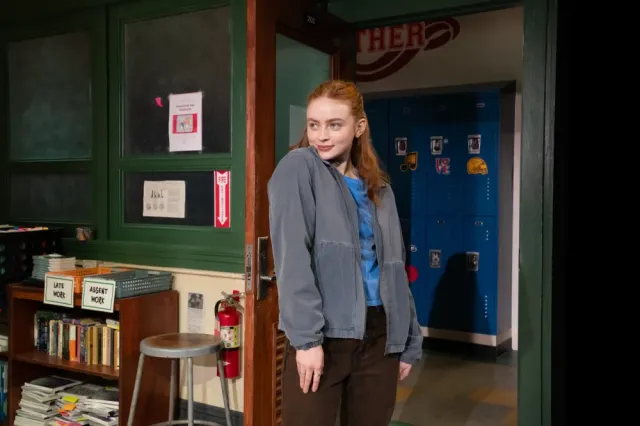
All of this is contained on a set that is designed by AMP, featuring Teresa Wiliams, to resemble the most real of schoolrooms with slogans such as “Lightbulb moments” and “mindset matters” on its walls, and half tennis balls on the desks and chairs to stop them scraping. The lighting by Natasha Katz makes the changing times of day stream through large windows down one side but also fulfils a more metaphorical purpose by highlighting the women at moments of revelation or doubt.
Beautifully acted and directed with deep care by director Danya Taymore, it’s a witty and convincing picture of teenage girlhood, its brightness, hopes and fears. They are all a little in love with Smith – “he’s like the teacher in an inspirational movie” – and Finn turns him into a character who basks in that adoration, but whose persona hardens as the play progresses.
They all too know more about sex than the basic lessons they are being fed, expressing their feelings and their moods through the music they listen to – Beyoncé, Billy Eilish, Lorde. As the narrative twists and turns, the story of The Crucible also becomes a prism through which they see their lives as women and the confusing and damaging events that surround them. The most damaged is Shelby and Soverall, red hair flying, tears of both sadness and laughter streaming down her face, makes her magnificent in her refusal to submit.
John Proctor is the Villain won seven Tony nominations when it was seen on Broadway, and it’s easy to see why. It is a play full of vitality, but also of vital questions. As it reaches its final cathartic scene, when Soverall and Raelynn perform an act of interpretative dance as part of their end of term examination, it fulfils its own premise. This is art that helps us to understand life, a tribute to literature as a map for comprehension, and to dance for expressing all the things that words cannot.