
Henry V with Alfred Enoch at the RSC’s Royal Shakespeare Theatre – review
Tamara Harvey’s production runs until 25 April
 |
Stratford-upon-Avon
|
|
Stratford-upon-Avon
|
25 March 2026
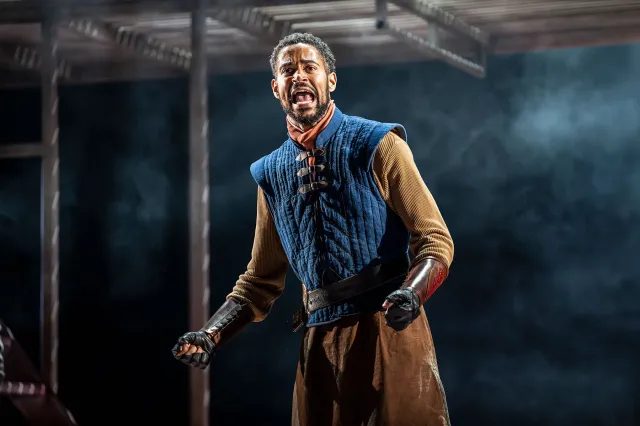
It’s 2026, and a war is being fought by men who define power by superiority in battle. It’s no wonder that Shakespeare’s Henry V goes on being relevant to contemporary times: the impulses that drive men to fight echo down the centuries.
Tamara Harvey’s new production for the Royal Shakespeare Company is both insightful and full of integrity. It isn’t political as such; it doesn’t attempt to update the action but leaves it firmly in the 15th century. Yet it offers constant reminders that the victims of war are always the people who fight them, who have no vested interest in the outcome, yet fall and die repeatedly in service of other men’s dreams of power.
She makes some radical choices in pursuit of this vision. There is no Chorus setting the scene; instead, Alfred Enoch’s Hal absorbs most of the speeches, turning them almost into soliloquies that let the audience into his creation of the story.
In the final scene, it is Natalie Kimmerling’s unusually subtle French princess who foretells the time to come, when Henry’s apparent victories against her country have crumbled to nothing. This is part and parcel of an unusually feminised production, that places women on the battlefield alongside men and gender swaps many roles: the traitor Scroop, for example, becomes Henry’s lover which may shock purists but makes her betrayal and subsequent hanging all the more telling.
Other choices are more traditional. Lucy Osborne’s delicate design makes scenes look like the borders of an illuminated manuscript, or a child’s book of medieval times, with rich reds and blues showing strong against a background of draped cloths that are lit in pastel colours by Ryan Day’s extraordinary lighting. As the action moves to France, the scaffold – literally – at the back of the set moves too, turning and transforming itself into battlements and ramparts. The picture book disappears, the light darkens and grows more stark.
The movement, by Annie-Lunnette Deakin-Foster and fight direction by Kate Waters, is unusually integrated and strongly stylised. The cast fall in slow-motion over and over again as they are slain. This causes some confusion about who is on which side but forcefully makes the point that sides are irrelevant; it is suffering that is universal in war.
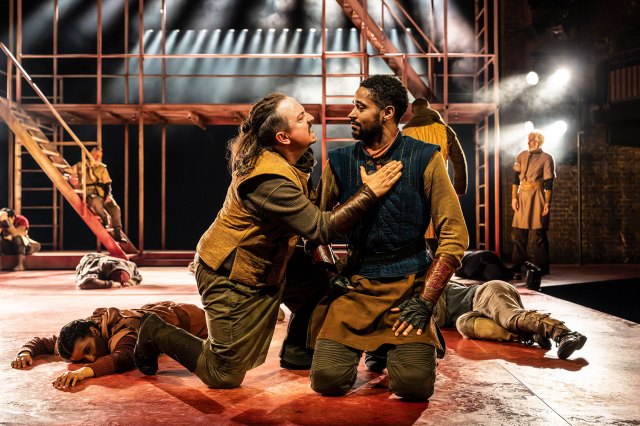
Harvey, who is co-artistic director of the RSC, also brings individual scenes to extraordinarily vivid life. The despicable Pistol (Paul Hunter) is imagined like a tightrope walker, in tights and jerkin, fastidiously picking his way around the stage, trying every trick in the book with refined villainy. In the famous scene where Katherine tries to learn French, Kimmerling is tending to the wounded. The effect is both funny and shocking.
The French King (Jamie Ballard) is so weak that you understand the Dauphin’s bullying. When his son is killed he is felled by grief, pouring himself over the body as the peace negotiations take place around him.
At the heart of everything stands Enoch’s Henry V, softly-spoken and considerate, but from the very beginning a man who knows his mind and who hardens as the play progresses. There’s hesitation and watchfulness there and he takes the great speeches both rhythmically and conversationally, inviting the audience – on one or two occasions drawing them in – to imagine being one of the happy few or to take his side in wooing his bride.
It’s a quietly charismatic performance in a production that is low on triumphalism and spectacle. Both the bombastic Fluellen (Sion Pritchard) and the soldier Williams (Ballard again), have much of the comic business surrounding them pared back, so that what they say about war rings out loud and clear. “I am afeard there are few die well that die in a battle,” Williams famously says when he encounters a disguised King on the eve of Agincourt.
The line is allowed to rise and shimmer in the air, making the point of this thoughtful production.






Related Articles
See all


Related City Guide
Latest Reviews
See all


Latest Videos
First listen: Lifeline musical has its London premiere
The show opens later this week