
Deaf Republic at the Royal Court – review
Dead Centre and sign language poet Zoë McWhinney’s world premiere production runs 13 September
 |
London
|
|
London
|
5 September 2025

This haunting new piece from Irish company Dead Centre, making their Royal Court debut, tells the tale of a town that goes deaf in protest at the murder of a child. The reason he was murdered, at the hands of an invading soldier, is because he couldn’t hear the instruction to move. And it’s this gulf between the spoken word and actual communication that becomes a central theme, along with the grinding brutality of war.
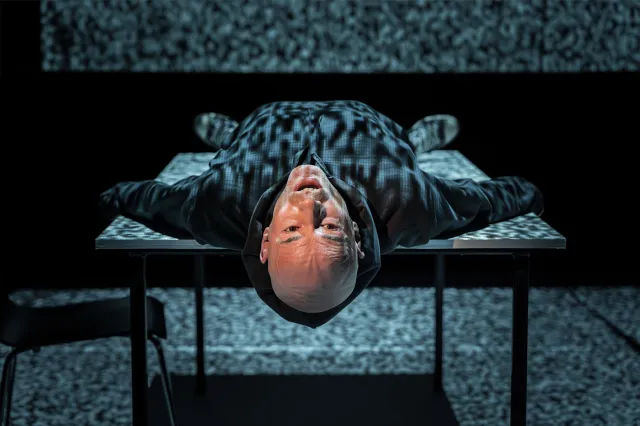
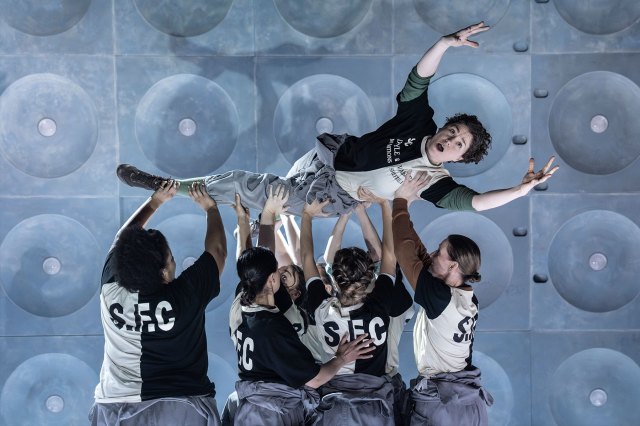
Adapted by the company and Zoë McWhinney from Ukrainian-American poet Ilya Kaminsky’s 2019 book of the same name, Bush Moukarzel and Ben Kidd’s production is highly technically adept. It fuses puppetry, projection and impressive aerials with an ethereal soundscape by Kevin Gleeson, to create a multimedia experience that befits the richness of the source material.
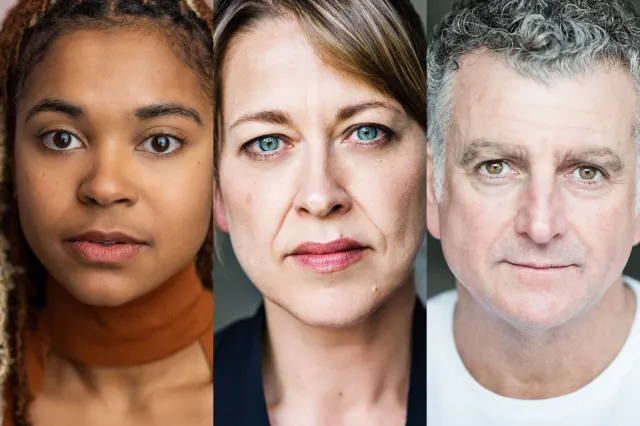
It’s a difficult watch, as characters are brutalised and their bodies winched skywards as they’re killed. But it starts off lightly enough, with a prologue consisting largely of joshing between Deaf actor Romel Belcher, who signs, and his interpreter, or ‘worder’, Caoimhe Coburn Gray. He explains the show is “accessible” (a word that recurs several times) in that it’s being part-spoken for those who can hear.
Belcher and Gray (both excellent) soon morph into young sweethearts Alfonso and Sonya, who witness the aforementioned atrocity while performing a puppet show for an illicitly gathered crowd in the fictional town of Vasenka. This scene is stunningly choreographed in silence, as the gathered townspeople express their horror at what has taken place as they’re one by one driven from the square, leaving just Sonya cradling the dead child (in puppet form). From this moment on they all communicate with Dylan Tonge Jones’s increasingly frustrated soldier only through sign language, as a stand-off ensues. Is their “infection” of deafness real? And does it matter if it isn’t?
The focus later shifts from Alfonso, Sonya and their baby daughter Anushka to a sort-of bordello overseen by the sardonic Galya (Derble Crotty) that becomes a vengeful slaughterhouse for the soldiers who come to call (chillingly, all played by Jones). It transforms into a highly stylised meditation on the unending nature of modern conflict, but in doing so slightly loses impact as the violence becomes filmic, almost cartoonish, and the effects begin to feel gimmicky – notably a video drone that briefly flies across the audience. It suffers somewhat from over-ambition, as it struggles to tie its disparate ideas together.
But the impact is undeniable and the strangeness of it all a reflection of the notion highlighted by Belcher at the beginning, that there is an expressiveness to sign language that remains unknowable in spoken English. You could perhaps view it as a hymn to the power of story, theatre and make believe to overcome real-world horror. However, there’s a dystopian darkness underscoring it that leaves a lasting impression, and the fact it ends with a joke, told by the soldier, is as bleak a coda as one could imagine.






Featured In This Story

Related Articles
See all
Latest Reviews
See all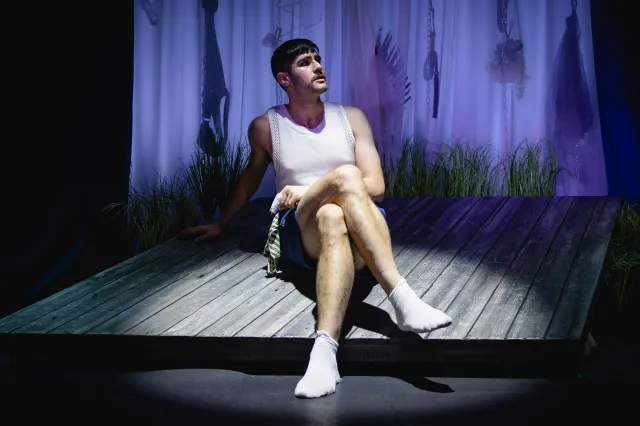

Latest Videos
26th Annual WhatsOnStage Awards – watch the full highlights
Oh, what a night at The London Palladium!