
Copenhagen at Hampstead Theatre – review
Michael Longhurst’s production marks the first London revival of the Michael Frayn play since its premiere in 1998
 |
London
|
|
London
|
8 April 2026
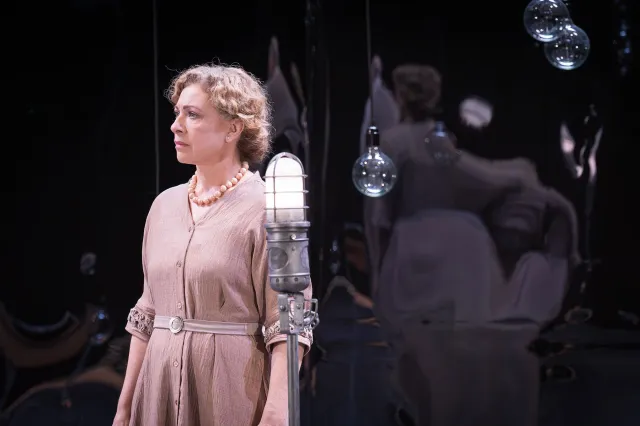
Playwright Michael Frayn has written one of the funniest plays in the English language – the imperishable farce Noises Off! Copenhagen, on the other hand, is one of the densest and most serious. It requires concentration and a willingness to delve deeply into the worlds of physics, history and human psychology.
Yet in its own way, it is just as rewarding. Watching Michael Longhurst’s skilful production at Hampstead Theatre, its lessons ring loudly down the years. Some lines about the responsibility of scientists could have been written yesterday, and as its arguments twist backwards and forwards, the humane quality of its concerns grips and engrosses.
Frayn’s play circles around a mysterious meeting between two Nobel Prize-winning physicists in 1941, when Werner Heisenberg left Germany to visit Nazi-occupied Copenhagen to see his friend and mentor Niels Bohr. No one knows quite what Heisenberg’s motivation for the meeting was: did he come to suggest to Bohr that the physicists on either side of the Second World War would not use the theoretical physics they had developed together in the 1920s to make an atomic bomb? Or did he hope to discover, as a leading scientist under Hitler, just how far the Allies had got with their own work?
In a fascinating programme essay – a postscript to the published edition of the play – Frayn, now 92, explains that subsequent discoveries of unseen letters suggest that the truth about the meeting, which left Bohr furious and severed a 20-year friendship, is even more complicated and ultimately unknowable than it was when he wrote the play back in 1998.
But in some senses, that does not matter. This is essentially a memory play; its structure is to suggest various drafts of history, as working together in a ghostly space, long after their death, the two men and Bohr’s wife Margrethe endlessly replay the events and scientific breakthroughs of their lives together, trying to make sense both of the universe and of their actions.
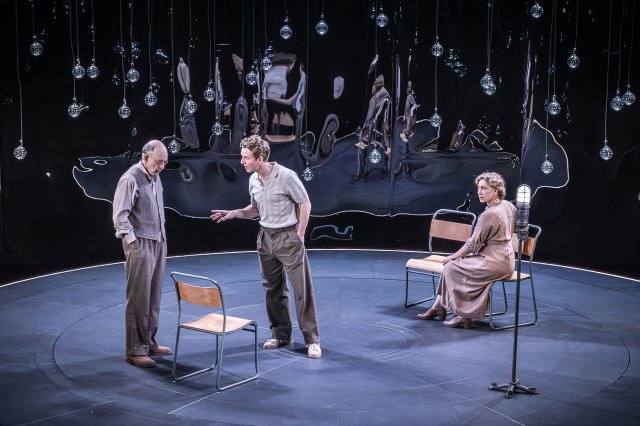
Longhurst’s achievement is to embody the way that theoretical physics guides their discourse within a setting, designed by Joanna Scotcher, that enables them to interact like the nucleus, atoms, particles and photons they are constantly studying and seeking to understand. Surrounded by a pool of water, and constantly changing bulbs of light (marvellous lighting by Neil Austin), part of the stage itself rotates, as the men walk back and forth on a travellator, moving at different speeds as they replay the events of the fateful night, or flit like the particles in Heisenberg’s uncertainty principle, their trajectory altered as soon as they encounter one another.
In the end, the physics – fascinating in itself – matters less than the moral dilemmas. Should scientists ever have developed a weapon of mass destruction, knowing it could end up in the hands of mad men? Who is more culpable – Bohr, who eventually helped Oppenheimer, or Heisenberg, who failed to make a significant calculation that could have gifted the Nazis the bomb? What is the role of man in the universe he seeks to explore?
All these questions are as pertinent and pressing in a world of Donald Trump and astronauts travelling to the far side of the moon as they were when the play was written, and they are beautifully asked here. Alex Kingston is simply superb as Margrethe, bringing a sardonic tone of reality to the men’s endless debate, often sitting at the centre of the circle, while Damien Molony is engagingly restless and questing as Heisenberg, a man who thinks as fast and dangerously as he skis.
He perhaps looks a little too young as the 40-year-old Heisenberg, while Richard Schiff, at 70, is a little too old for Bohr. But the age gap emphasises the pseudo father and son relationship between them, and Schiff’s occasional hesitations are combined with a graceful sense of doubt which suits the character of a man who constantly strove to be fair.






Featured In This Story

Related Articles
See all


Latest Reviews
See all



Latest Videos
Rosamund Pike in Inter Alia – watch the West End opening night highlights
The National Theatre’s hit production follows in the footsteps of Prima Facie