

Reviews
Broken Glass at the Young Vic – review
Jordan Fein’s revival of the Arthur Miller classic runs until 18 April
 |
London
|
|
London
|
4 March 2026
Broken Glass was written in 1994, when its author, Arthur Miller, was 79. His great playwriting days between 1947 and 1955, when he produced All My Sons, Death of a Salesman, The Crucible and A View from the Bridge in quick succession, were long behind him.
Broken Glass feels like his last assertion of his role as a moral playwright, one of the giant truth-tellers and idea-grapplers of American theatre, a warning against isolationism and lack of courage. Yet it’s also a work wracked with personal guilt, an almost feverish final-stand examination of his own Jewish identity, and his attitudes to women.
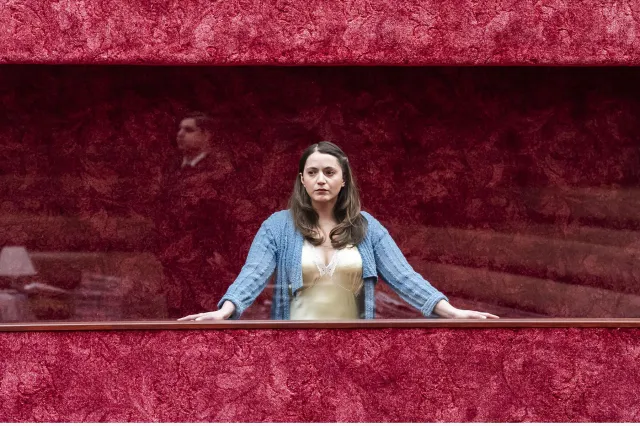
It has so many ideas flowing through it, it doesn’t always cohere, but Jordan Fein’s bold, non-naturalistic production (his first of a straight play after Fiddler on the Roof and Into the Woods) concentrates it into an intense study of the dangers of ignoring the world around you – and what you see in the mirror.
The glass of the title has many meanings, but it is most specifically the broken glass of Kristallnacht, the moment in 1938 that the insurgent Nazi party in Germany smashed down Jewish stores and buildings, leaving the streets covered in shards and issuing the strongest warning to the world about Hitler’s murderous intent.
Reading reports of the atrocity in papers in her comfortable home in Brooklyn, a Jewish American woman named Sylvia Gellberg (Pearl Chanda) becomes literally paralysed with fear, unable to move her legs. The play revolves around the attempts of the unconventional socialist doctor Hyman (Alex Waldmann) to cure her and to unpick her relationship with her husband Phillip (Eli Gelb), who is in constant denial of his Jewishness as he attempts to curry favour with his Wasp boss (Nigel Whitney).
Fein, and his designer Rosanna Vize, set the piece in the equivalent of a doctor’s waiting room where the cast sit on the same battered fawn-cushioned benches as the audience. A line of clocks showing the time in London, Berlin, Beijing and Tokyo are pinned to an ugly puce plush wall, over an oblong window, where the characters sometimes stand, gazing at the action. A goldfish swims around in its bowl, its size changing as it moves.
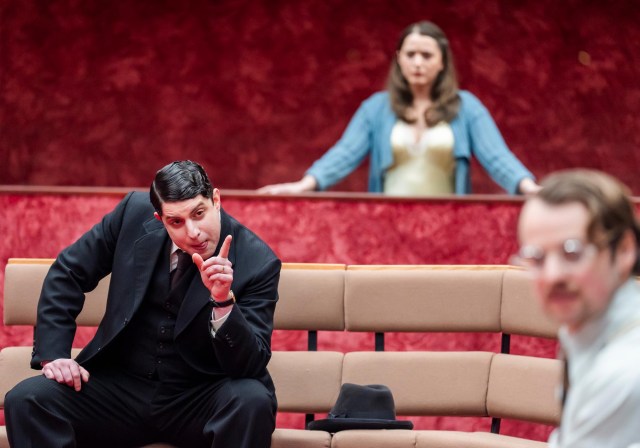
Adam Silverman’s flat, white lighting puts both audience and protagonists in the same space, until it darkens into melancholy pools of low light as Sylvia slowly explains her feelings. Chanda, convincingly motionless, weaves an almost hypnotic spell as the tangled web of emotion is slowly untied.
Great piles of newspapers – both contemporary and historic – line the seats, making the point that although the play is set in the past, it was written against the background of the Bosnian war, and still speaks today. No one can understand why Sylvia is so upset. “It’s across the ocean, isn’t it?” says her supportive but uncomprehending sister Harriet (a wonderfully busy performance by Juliet Cowan). Miller’s point is that perhaps we all ought to be.
The problem is he throws in so many other points en route, not least Dr Harry’s unethical treatment methods (“Imagine we have made love”) and his own complicated relationship with his wife Margaret (Nancy Carroll, cutting and terrific), who fulfils the role of being the one character who sees everything with clarity. “You’re like a pane of glass, Harry,” she tells her husband.
At the centre of everything is the self-loathing Phillip, whose concept of what it means to be a Jewish man in an antisemitic society has led him to throw away his entire life. Gelb, so good as a laid-back sound engineer in Stereophonic, is equally extraordinary here, lending Phillip a buttoned-up physicality that finds release in twitching shoulders and nervous little hand gestures, and chin tucks. He begins as a great lumbering bully – both buying Sylvia pickles as a clumsy gesture of love, then slamming them down fiercely as a story of past violence unfolds – and ends as a frightened child.
The phantasmagorical moment when the production slips terrifyingly into another dimension, and he suddenly identifies with the suffering of the Jewish Germans, is genuinely shocking.
Fein’s thoughtful direction holds and tightens the corkscrewing emotions and thoughts of the play in a production that is always gripping and often devastating. It’s a messy play, but an important one, compelling in the richness of its concerns.






Featured In This Story
Related Articles
See all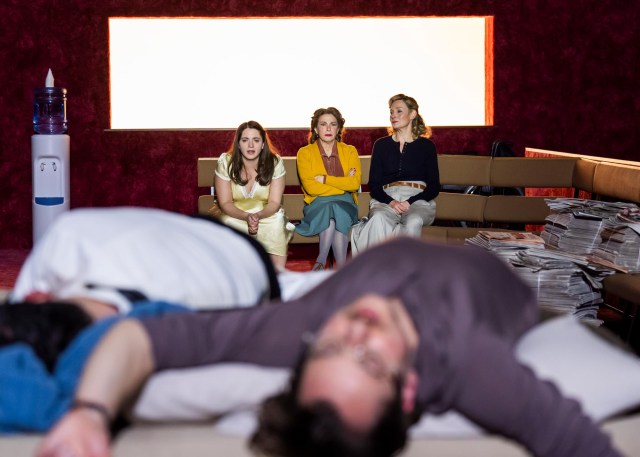

Latest Reviews
See all





Latest Videos
New musical FlyBy – have a first listen
New musical alert!