
Fringe Powerhouses Take on West End
 |
London's West End
|
|
London's West End
|
23 November 2000
Like New York s Broadway, the West End is usually regarded as the torch-carrier for the best of British theatre. But should it be, what with fringe powerhouses the like of the Almeida achieving so much outside of its postcodes? WOS correspondent Mark Shenton considers the bearings of geography and commercialism in London s theatreland.
The West End – that cluster of old-fashioned, often musty, theatre buildings that geographically inhabit an area that is roughly bounded by Shaftesbury Avenue to the North, the Embankment to the South, Kingsway to the East and Regent’s Street to the West – is of course a term synonymous, too, with the commercial theatre.
The long-established subsidised theatres outside of this area – the RSC at the Barbican, the National Theatre on the South Bank, and the Royal Court at Sloane Square – are also notionally regarded as West End houses. However, in outlook and output they sometimes seem as if they inhabit a parallel universe, except of course when the National is staging things like Singin’ in the Rain and Noises Off, when it seems virtually indistinguishable from its commercial rivals across the river.
But it s the comparatively newer kids on the block that are increasingly blurring the differences and distinctions between the commercial theatre and other kinds of theatre-making. Whereas West End venues are basically rooms available for hire by anyone with the money (and often, it seems, the lack of sense to do so), these new kind of theatre makers are producers in their own right for the shows that go on in their venues, which in turn become defined by the work done there in active pursuit of an artistic policy. And increasingly, many of them are looking away from the confines of their own, usually small, home theatres, to produce on a wider canvas.
So, for example, the Almeida now regularly produces away from its home base in Islington – at one point this summer, it was possible to see Richard Eyre‘s production of Sartre’s The Novice at the Almeida, an electrifying pairing of Richard II and Coriolanus, starring Ralph Fiennes in the title roles at a superb ‘found’ space, the Gainsborough Studios in Shoreditch, that was epic in itself, while in the West End its production of Nicholas Wright‘s Cressida was at the Albery starring Michael Gambon. The Donmar Warehouse has also established a separate producing arm, not only to facilitate transfers from its Covent Garden base but also to produce directly into larger West End houses, such as the Old Vic (where it presented Antigone or the Comedy (The Real Inspector Hound/Black Comedy double bill).
Meanwhile, the West End landscape is changing in other subtle ways, too. The Society of London Theatres – the professional organisation which regulates and promotes commercial theatre interests and administers the annual Laurence Olivier Awards – has lately expanded to include amongst its members such theatres as the Lyric Hammersmith, Hampstead and Almeida, as well as the Donmar which by a historical and geographical accident has long been a member (and therefore eligible to have its productions considered for Olivier Awards). Though Hammersmith, Swiss Cottage and Islington are strictly outside of the geographical reach of the West End, neither is the RSC’s Barbican base or the National’s South Bank location in the West End, either, and their membership has never been questioned. So it s great that the contribution to London theatre of an even wider embrace of venues is being acknowledged at last, and it s not just a question of location but also of artistic policy.
In the West End itself, two important new venues have sprung up. The Soho Theatre, for the last decade or so a peripatetic fringe company since losing the lease on its basement space near Oxford Circus, has established a permanent home in a stunning new building in Dean Street in the heart of Soho; while the Arts Theatre, an intimate two-level house off Leicester Square, has returned to full-time professional adult use after the departure of the Unicorn children’s theatre which had long been based there. These two theatres alone are set to galvanise the way theatre is done in London, by putting new writing back into the centre of the capital and the heart of its theatrical life.
As we move further into the new century, definitions of theatre are changing anyway. It s no longer an event defined by taking place in a room that has four walls divided by a proscenium arch, but is something that happens anywhere, anytime, wherever people gather to tell stories or share a communal experience. That may be in a discotheque – as witness the recent showing here of the New York hit The Donkey Show, which played at the Hanover Grand nightclub – or a disused former film studio like the Gainsborough. The Hanover Grand actually is located within the West End, the Gainsborough certainly not. But both were definitely commercial venues for the duration of the run of these shows.
All of which underlines the fact that the practice of classifying theatres according to geography rather than use is surely redundant. I d say it s time to re-examine these definitions again.




Latest Reviews
See all



Latest Videos
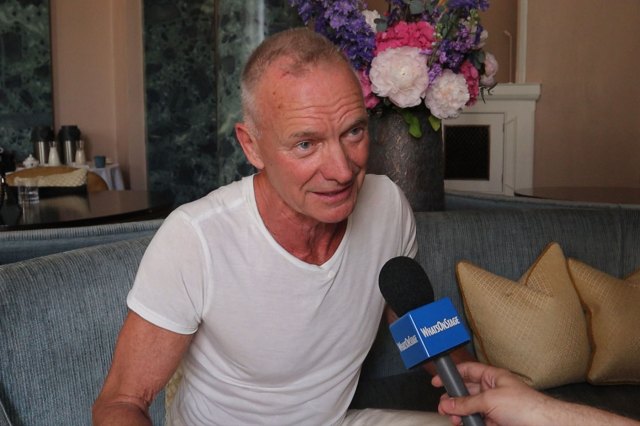
Sting discusses his upcoming West End debut and The Last Ship musical’s voyage to London
The 17-time Grammy Award winner is set to anchor down at Theatre Royal Drury Lane!