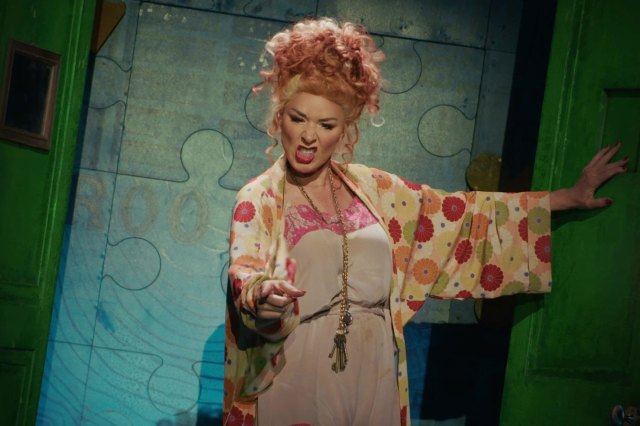
West Revives Romans in His First Sheffield SeasonDate: 23 June 2005Actor-turned-artistic director Samuel West (pictured) has today announced plans for his inaugural season at Sheffield Theatres, which he took over from Michael Grandage at the start of this month (See News, 22 Oct 2004). West’s programme will comprise eight new productions - running from 21 September 2005 to 17 June 2006 across the Crucible, Studio and Lyceum theatres - including world premieres by Mark Ravenhill and Tanika Gupta and a revival of Howard Brenton’s controversial The Romans in Britain. West will direct two of the season’s productions and appear in one. In the Crucible West has chosen to play Benedick in Much Ado About Nothing, directed by Josie Rourke, who he’s newly appointed as his associate director. The production launches West’s first season, opening on 28 September 2005 (previews from 21 September) and continuing until 5 November. Speaking to Whatsonstage.com today, West explained his acting involvement in the Shakespeare comedy: “I wanted to meet the city from the stage initially, to be seen and to see, to learn the stage from the point of view of an actor before I started directing on it.” He also admitted that the part of Benedick is “a lot funnier than most people I get offered”. No further casting has yet been announced for this or the season’s other productions. Much Ado About Nothing will be followed, from 7 December 2005 to 21 January 2006 (previews from 1 December), by one of the first major UK revivals of 1968 Broadway musical Promises, Promises. Based on Billy Wilder and Neil Simon’s Oscar-winning 1960 film The Apartment, in which a man tries to climb the corporate ladder by letting bosses use his apartment for their romantic trysts, Promises, Promises is the only musical ever written by Burt Bacharach, the ultimate songwriter of 1960s and 70s cool. Bacharach and his long-time lyricist Hal David churned out popular hits such as “Magic Moments”, “The Story of My Life” and “Raindrops Keep Falling on My Head”. Their score for Promises, Promises includes “I’ll Never Fall in Love Again”. The Crucible revival is directed by Angus Jackson. In the New Year, West will make his directing debut as artistic director (under Grandage’s helm, he revived Terry Johnson’s Insignificance in March of this year) with the first major revival of The Romans in Britain. Howard Brenton’s play, premiered at the National in 1980, drew parallels between the modern presence of British troops in Northern Ireland and Julius Caesar’s ancient conquest of this island. However, it became most famous for its graphic scene of male-on-male rape, which inspired campaigner Mary Whitehouse to instigate a private prosecution (later dropped) under the Sexual Offences Act of 1956. The play’s infamy is “absolutely not why we’re doing it,” said West. “In fact, it’s kind of the opposite. We felt very strongly that the controversy surrounding that particular scene somehow obscured the fact that Howard had written a sweeping, epic drama of our times.” At Sheffield, The Romans in Britain will run from 8 to 25 February 2006 (previews from 2 February). The Crucible programme will conclude with Stephen Sondheim’s Assassins. The 1991 musical, which has a book by John Weidman, brings together everyone, from John Wilkes Booth to Lee Harvey Oswald, who has tried to kill the US president. Nikolai Foster’s revival runs from 14 March to 1 April 2006 (previews from 9 March).
In the Studio The Studio’s in-house schedule opens, from 3 to 12 November 2005 (previews from 31 October) with the world premiere of Gladiator Games, the latest from British playwright Tanika Gupta (Hobson’s Choice, Sanctuary, Inside Out). Based on public inquiry accounts into the fatal assault on Zahid Mubarek, the new play follows a family seeking the truth behind the death of a young British Asian in Feltham Young Offenders Institute. Charlie Westenra directs. Gladiator Games is followed by West’s second directorial undertaking, the European premiere of Sarah Ruhl’s The Clean House, about Brazilian Matilde whose mother dies laughing at a joke her father made up for their wedding anniversary. Its limited season is from 21 March to 8 April 2005 (previews from 16 March). The final in-house production in the studio is the world premiere of Mark Ravenhill’s Meat Piece, directed by Dominic Leclerc and running from 7 to 17 June 2006 (previews from 1 June). Best known as the author of Shopping and F***ing, Ravenhill’s other plays include Mother Clap’s Molly House, Some Indecent Polaroids and, premiering at the Donmar Warehouse next February in a production directed by Michael Grandage and starring Ian McKellen (See News, 31 May 2005), The Cut. Meat Piece is a piece of dance theatre about modern food production and consumption. In the Lyceum Meanwhile, in the adjacent Lyceum Theatre, which normally receives visiting productions, Josie Rourke will revive The Long the Short the Tall, the 1958 wartime thriller written by Willis Hall, the British dramatist who died earlier this year and who was best known for his collaborations with Keith Waterhouse. Following its Lyceum run, from 1 to 11 March 2006 (previews from 23 February), The Long the Short the Tall will embark on a regional tour.
Heterogeneous programming Commenting on his programming choices for his first season, West told Whatsonstage.com: “I think it was just a question of finding things we thought needed to be said. There’s nothing in the season that doesn’t have some form of imperative, whether it’s the need to laugh or re-examine or think more carefully. I’m very intrigued by issues of difference, multi-culturalism, the nature of invasion - both invader and invaded - and how we behave under extreme circumstances such as war, occupation and incarceration. We live in confusing times. If we go to the theatre in an attempt not only to have a laugh and a good night out but also to learn about ourselves, I think we’ve done our job.” West added that he liked the challenge of rediscovering rarely performed plays rather than presenting more traditional, populist fare – the latter being a strategy, he said, that ran the risk of encouraging a “homogenised high street” kind of regional theatre. “The one thing the people of Sheffield won’t forgive us for is simply putting on what we think they want to see rather than putting on what we think needs to be seen.” - by Terri Paddock Related Content |
Buy Tickets
Free Newsletter
Featured Video Featured Editor's Picks
| ||||||||||||||||||||||||||||||||||||||||||||||||||||||||